

Third-Party Tested Kratom: What to Check Before You Buy
What if a kratom lab report looks impressive but doesn’t match the product or batch you’re considering? A “third party tested kratom” claim can sound reassuring, yet its value depends on what was tested, when the testing took place, and whether the report matches the item in your cart.
It makes sense to look for independent testing. A report can provide useful evidence about the sample analyzed, such as alkaloid levels or certain contaminants. It can’t prove that every unit is identical, guarantee safety, or establish product quality in every respect.
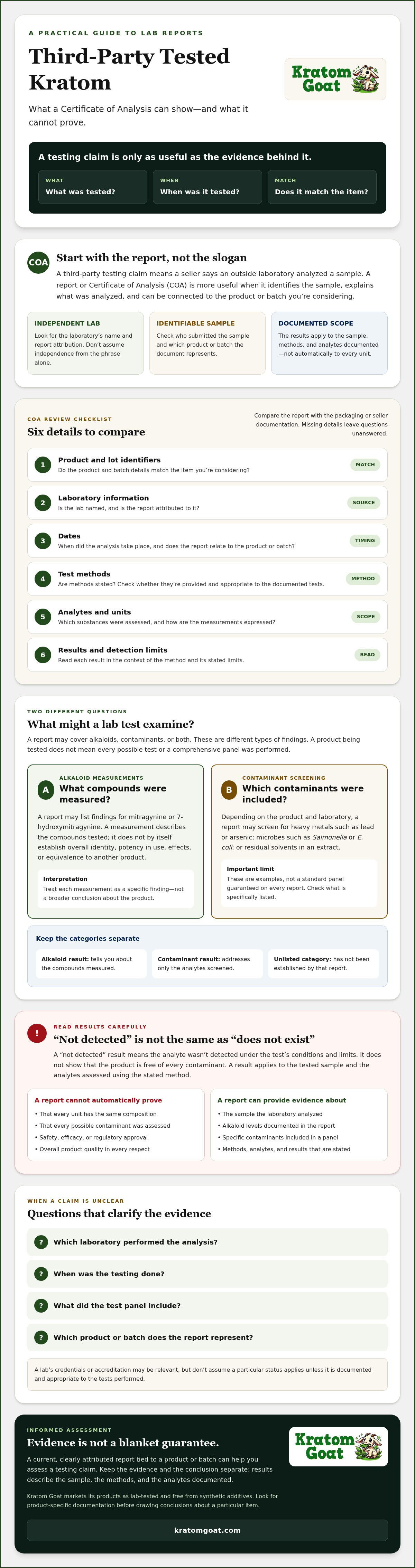
This guide explains what testing can and cannot show, then walks through the details to check in a Certificate of Analysis (COA): product and lot identifiers, laboratory information, dates, test methods where provided, analytes, units, and results. You’ll also learn how to spot gaps and assess whether a seller explains its evidence clearly, without treating a lab report as a blanket guarantee.
Key Takeaways
- A third-party testing claim is more useful when independent lab evidence is available and tied to the product you’re considering.
- Check whether a report measures alkaloid content, screens for contaminants, or covers both. These results answer different questions.
- For third party tested kratom, compare the product and batch identifiers on the report with the packaging or seller documentation.
- If a testing claim is unclear, ask which lab performed the analysis, when it was done, and what the test panel included.
- Kratom Goat markets its products as lab-tested and free from synthetic additives. Look for product-specific documentation before drawing conclusions about a particular item.
What “third-party tested kratom” means, and what the claim does not mean
Third-party tested kratom is kratom for which a seller says an outside laboratory analyzed a sample. The claim is meaningful only when the lab’s independence and the report’s connection to the product can be checked. A testing statement on a product page is not the same as accessible, product-specific evidence. A report or Certificate of Analysis (COA) should identify the sample and explain what the lab analyzed, rather than offer only a general assurance about a seller’s products.
That distinction matters because kratom (Mitragyna speciosa) contains multiple alkaloids, and a report can cover some measurements without addressing every quality question. Test results describe the sample, methods, and analytes documented in the report. They don’t establish that every package has the same composition or that every possible contaminant was assessed.
How independent laboratory testing differs from in-house checks
In-house checks are performed by the seller or its own operation. Third-party testing refers to analysis by an outside laboratory, but don’t assume independence from the phrase alone. Look for the laboratory’s name and report attribution, then check whether the document identifies who submitted the sample and which product or batch it represents. A lab’s credentials or accreditation may be relevant, but don’t assume a particular status applies unless it’s documented and appropriate to the tests performed.
What a test result cannot establish on its own
A reported result answers a narrow question: what did the lab measure in this sample using the stated method? An alkaloid measurement describes the compounds tested, while a contaminant screen addresses only the contaminants included in its panel. Neither automatically proves safety, efficacy, or regulatory approval. Even a result reported as “not detected” means the analyte wasn’t detected under the test’s conditions and limits, not that the product is free of every contaminant.
Keep the evidence and the conclusion separate. A current, clearly attributed report tied to a product or batch can help you assess a testing claim, but it isn’t a universal guarantee. If a seller says its kratom is lab-tested, look for the supporting documentation and check what the report actually covers.
What kratom laboratory tests may examine
A lab report is useful only in the context of what it measures. Some analyses focus on alkaloids; others screen for contaminants. A report may cover one category or several, so don’t assume a product has undergone a comprehensive panel simply because it was tested. Check the listed analytes, methods, units, and detection limits before interpreting the results.
Product identity and alkaloid measurements
An identity test or alkaloid analysis reports findings for the substances the lab examined. A result for mitragynine or 7-hydroxymitragynine, for example, doesn’t by itself establish overall product identity, potency in use, effects, or equivalence to another product. For background on one commonly discussed alkaloid, see this guide to 7-hydroxymitragynine science and standards. Treat each measurement as a specific finding, not a broader conclusion about the product.
Contaminant panels and their limits
Depending on the product and laboratory, a report may include screens for heavy metals such as lead or arsenic, microbes such as Salmonella or E. coli, or residual solvents in an extract. These are examples, not a standard panel guaranteed on every report. The National Institute on Drug Abuse has warned about harmful contaminants, including heavy metals. Check whether a report specifically lists the screening relevant to your question.
Read the scope closely. A result applies to the tested sample and the analytes assessed using the stated method. “Not detected” is meaningful only in relation to that method’s detection limit; it doesn’t mean every possible contaminant was ruled out. Likewise, a report that lists alkaloids but no microbial screening doesn’t establish microbial results.
- Look for: named analytes, test methods, units, and detection limits.
- Compare like with like: distinguish alkaloid measurements from contaminant screening.
- Note what’s absent: an unlisted category hasn’t been established by that report.
These details make a third party tested kratom claim easier to assess without overstating what a lab can prove. To compare product details, review Kratom Goat product information and look for documentation that supports the specific claims being made.
How to evaluate a third-party kratom test report
Use the report as a document to verify, not a badge to accept at face value. For a third party tested kratom claim, check that the evidence connects to the product you’re considering and that the results are clear enough to interpret. A batch-specific report documents a particular sample; a general testing claim doesn’t establish results for every product or batch.
Match the report to the product and batch
Start with the product name and form, then look for a batch or lot identifier. Compare those details with the package or seller documentation when available. Check the sample collection date and report date to understand how the document relates to that batch. A report for one item, formulation, or lot doesn’t validate a different product or a later batch. If a detail is missing, ask for clarification rather than assuming wrongdoing.
Read the laboratory details and reported results
Identify the laboratory and confirm that the report is attributed to it. Then review the methods, analytes, units, and any stated detection limits. These details show what was measured and how to read the results. A “pass” label needs context, so check the criteria behind it and which results it covers. The kratom Certificate of Analysis guide offers more detail on interpreting COAs.
- 1. Product match: Does the report identify the product and form you’re considering?
- 2. Batch identifier: Does its lot or batch number match the packaging or seller documentation?
- 3. Laboratory identity: Is the testing lab named and the report clearly attributed to it?
- 4. Dates: Are collection and report dates provided and relevant to the identified batch?
- 5. Methods and analytes: Does the document state how and what the lab tested?
- 6. Results: Are units, detection limits, and any pass criteria clear?
Missing information is a reason to ask focused questions, not proof that a seller or product has violated a rule. Ask whether the report matches the current batch, which laboratory performed the work, and which tests the panel includes. The AKA GMP Standards Program provides context on a voluntary industry program, but participation or an audit claim doesn’t replace checking the product-specific report.
For comparison, review the available Kratom Goat product information and look for documentation that supports any testing statement.
Questions to ask when a kratom testing claim is unclear
A clear testing claim should be specific enough to check. If a product page says “lab-tested” but doesn’t show a report, that’s a reason to ask for details, not proof of a violation. A direct, neutral question can help you understand what evidence exists and whether it applies to the product and batch you’re considering.
A practical checklist for contacting a seller
Keep your questions focused on documentation and scope. For example, ask:
- Is a laboratory report or Certificate of Analysis available for this specific product and batch?
- What batch or lot identifier should I compare with the product packaging?
- Which laboratory conducted the testing, and is its identity shown on the report?
- Which analytes and test categories does the report cover?
- How are reports updated when a new batch becomes available or testing documentation changes?
These questions help distinguish a general quality statement from evidence linked to a particular sample. If a report isn’t available, ask what the seller means by its testing claim and whether other product-specific documentation can be reviewed.
Red flags to interpret carefully
Broad language such as “tested for purity” is incomplete unless the seller explains what was tested and provides supporting details. Be especially cautious of absolute promises that a product is entirely safe or free from every contaminant. A test report speaks only to its documented sample, methods, and analytes. Claims that go beyond that evidence deserve clarification.
Context matters. A missing batch number, unclear lab attribution, or older report may make it difficult to confirm relevance, but none alone proves misconduct. Ask whether the identifier is listed elsewhere, whether the report corresponds to the current batch, or whether the seller can explain the date. The response can help you judge how transparently the testing claim is communicated.
Testing documentation can make comparison more informed, but it can’t resolve every uncertainty about a product. For third party tested kratom, consider the report’s scope and product match alongside the seller’s willingness to explain what the evidence does and doesn’t show. Avoid drawing legal conclusions from a single document; applicable requirements can vary and should be checked using current authoritative information.
To compare product details, review Kratom Goat’s product information and look for documentation relevant to the item you’re considering.
How Kratom Goat’s testing claims fit into an informed buying decision
Kratom Goat markets its products as lab-tested and free from synthetic additives. These are company claims, not a substitute for reviewing evidence about a specific item. A product-level conclusion requires documentation that identifies what was tested and connects the results to that product. Don’t assume a general statement or a report for one offering applies to another.
Use the same careful approach to assess any third party tested kratom claim: look for documentation, check what it covers, and keep conclusions within the evidence. If a report isn’t visible on a product page, that alone doesn’t establish why it’s missing or what testing may have occurred. Ask whether documentation is available for the product and batch you’re considering.
What to verify on a product page
Check whether the page links to or describes a lab report for that exact product. If documentation is available, confirm that it names the laboratory, provides a batch or lot identifier and dates, and states the analytes and methods covered. Compare its identifiers with the packaging or seller documentation when available. A report that lacks these details may still prompt useful questions, but it’s harder to connect confidently to the item in front of you.
Kratom Goat’s selection includes various specialized botanical formulations and traditional offerings. Naming these offerings doesn’t establish specific test results for them. Verify any report individually, rather than treating testing information for one product as proof about the rest.
Choose transparency without confusing it with a guarantee
Batch matching and readable documentation make it easier to assess what a test says. They support a more informed comparison between sellers and products, but they don’t establish universal safety or efficacy. No report should be read as a guarantee that every possible concern has been addressed. The useful standard is straightforward: clear claims, identifiable documentation, and results interpreted within their stated scope.
Explore Kratom Goat’s confirmed product selection and review the available details for the specific item you’re considering.
Make your next comparison evidence-led
A “third party tested kratom” claim is most useful when you can connect a report to the exact product and batch you’re considering. Check the laboratory identity, dates, methods, analytes, and results, then keep your conclusions within the report’s scope. Testing can offer meaningful information, but it doesn’t guarantee safety, efficacy, or the absence of every concern.
Kratom Goat markets its products as lab-tested. Treat that as a company claim, and look for product-specific documentation before drawing conclusions about any named offering. The company also reports more than 2,000 customer reviews. Check the current count and rating when considering customer feedback.
Careful questions and clear documentation make it easier to compare sellers. Review Kratom Goat’s product information and assess the available details for the item you’re considering.
Frequently Asked Questions
Is third-party tested kratom safer?
Not necessarily. Independent testing can provide information about the sample and analytes a laboratory examined, but it doesn’t guarantee safety. A report may not cover every batch or every possible contaminant, and it can’t establish whether a product is appropriate for a particular person. Review the report’s scope, methods, and limitations. Testing claims are not medical advice, so don’t treat a lab result as a personal health recommendation.
How can I tell if kratom is genuinely third-party tested?
Look for a report that names an independent laboratory and identifies the product, batch or lot, report date, test methods, and analytes. Compare its product and batch details with the packaging or seller documentation. If you see only a broad “lab-tested” statement, ask whether batch-specific documentation is available. Don’t assume a report for one product or batch applies to different products or later batches.
What should a kratom Certificate of Analysis include?
A useful Certificate of Analysis (COA) should identify the laboratory and sample, provide relevant product and batch information, and show the report date, methods, analytes, units, and results. Detection limits or criteria used to interpret results may also help explain what the findings mean. COA formats and test panels vary. Check the document’s scope rather than assuming it’s comprehensive, and read any pass/fail label alongside the criteria behind it.
Does third-party testing prove kratom is free from contaminants?
No. A test report applies to the sample tested and the analytes included, using the stated methods and limits. For example, a report that lists a heavy-metal screen doesn’t automatically establish that microbes or residual solvents were tested. Review the panel to see which categories are covered, and note any stated limitations. Broad words such as “clean” or “pure” aren’t a substitute for examining the documentation.
How often should kratom products be tested?
There isn’t one testing schedule you can assume applies to every seller or product. Check whether the report matches the batch currently being considered, and review its dates and identifiers. You can ask how the seller updates documentation when a new batch becomes available or testing information changes. If the report’s connection to the current batch is unclear, request clarification before relying on its results.
Can a kratom lab report confirm a product is legal?
No. A laboratory report presents findings from testing; it doesn’t determine whether a product may legally be sold or possessed. Requirements can differ by jurisdiction and change over time, so test results shouldn’t be treated as proof of legal status. Verify current claims with reliable, up-to-date sources relevant to the location in question. General product-testing information is not legal advice.
What does “independent laboratory” mean for kratom testing?
It generally means a laboratory separate from the seller or producer conducted the analysis, but verify the relationship instead of relying on the label alone. Check that the report identifies the lab and attributes the results to it. Don’t assume the lab is accredited or follows a particular standard unless the documentation supports that claim. Independence offers useful context, but it doesn’t mean the test covers every analyte or concern.