

Taking Kratom on an Empty Stomach: What to Know Before You Decide
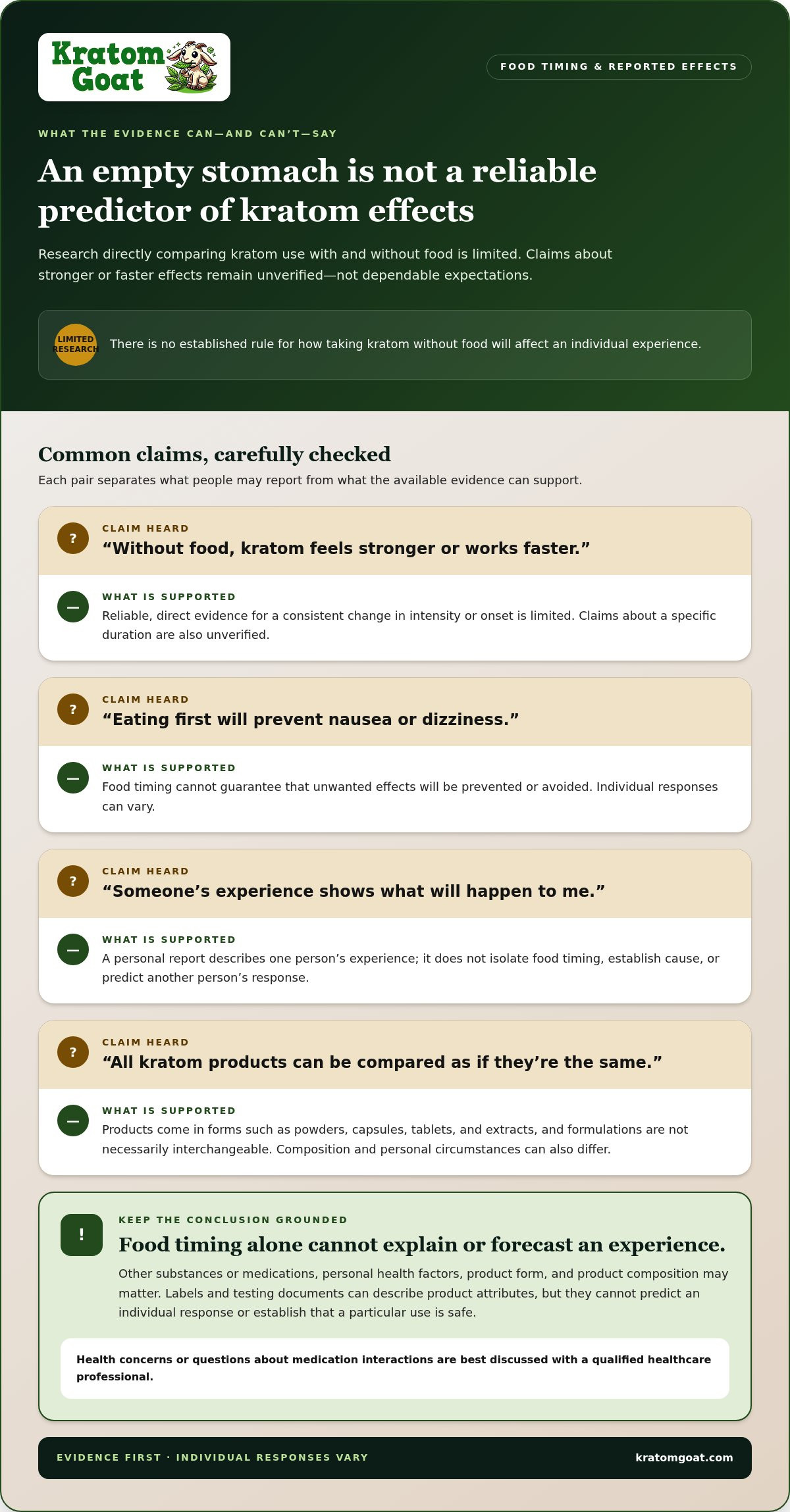
Could taking kratom on an empty stomach make its effects stronger, or increase the chance of feeling unwell? Online accounts often say food changes how quickly or intensely kratom is felt, but personal reports aren’t the same as scientific evidence. Research directly comparing kratom use with and without food is limited, so there’s no reliable rule for predicting how a meal will affect an individual experience.
If you’re unsure whether to eat first, that uncertainty is understandable. Nausea and dizziness are among the unwanted effects people may be concerned about, but food timing can’t guarantee that these effects will be prevented or avoided. Responses may also vary with the product’s form and composition, other substances or medications, and personal health factors.
This article separates what’s known from what remains anecdotal, explains why experiences can differ, and offers a safety-first framework for considering personal risks. It also covers when self-experimentation isn’t appropriate and why a qualified healthcare professional is the right person to consult about health concerns or medication interactions.
Key Takeaways
- There’s no established rule for how taking kratom on an empty stomach will affect you. Personal reports don’t prove a universal effect.
- Product composition and individual circumstances can make comparisons difficult, so food timing alone may not explain a different experience.
- Claims of stronger effects, faster onset, or less discomfort are unverified, not reliable expectations.
- A safety-first checklist can help you identify personal health factors and decide when to discuss concerns with a qualified clinician.
- Labels and testing documents can describe product attributes, but they can’t predict your response or establish that a particular use is safe.
Taking Kratom on an Empty Stomach: What Can You Actually Expect?
There’s no reliable evidence establishing a predictable empty-stomach effect for everyone. Available evidence doesn’t support a dependable rule that taking kratom without food will make it feel stronger, work faster, or last for a specific length of time. Research directly examining food timing and kratom is limited, so a confident answer for all users would go beyond what’s known.
Online accounts can sound certain: one person may describe a noticeable difference before eating, while another reports no change or an unpleasant experience. These accounts can explain why the question comes up, but they can’t isolate food timing or predict what will happen for someone else. Personal reports describe individual experiences; they don’t establish that an empty stomach reliably changes kratom’s effects. A narrative inquiry available through PubMed Central discusses varied reported experiences, not proof of a predictable food-timing effect.
Does an empty stomach make kratom feel stronger or faster?
Reliable, direct evidence for a consistent change in intensity or onset is limited. Claims that kratom acts faster, feels stronger, or lasts for a particular length of time without food should be treated as unverified, not as practical guarantees. One person’s report isn’t a controlled comparison: other factors may have differed, and the experience can’t establish a dependable rule.
Why do people report different experiences?
People and products differ. Kratom products come in forms such as powders, capsules, tablets, and extracts, and formulations aren’t necessarily interchangeable. Personal circumstances and the context of use can also affect how someone describes an experience. These differences make it difficult to attribute a reported change to an empty stomach alone. One person’s account can’t establish another person’s likely response.
Consider two people who say they took kratom without eating. They may have used different products or forms, or had different personal circumstances. If one reports a faster onset and the other no noticeable change, that contrast doesn’t show that food caused either outcome. Anecdotes can be genuine without answering the cause-and-effect question.
Food timing is one factor people discuss, not a reliable shortcut to a stronger or more predictable experience. It also can’t be treated as a way to prevent unwanted effects. Without direct evidence, claims about eating or fasting should remain qualified, rather than becoming instructions to try a particular approach. Don’t use another person’s experience as a forecast for your own.
When assessing a claim, ask what it demonstrates. Does it describe one person’s experience, or compare food timing under controlled conditions? Does it account for the product and other differences? Direct evidence on this specific question is limited. Keeping that distinction clear helps separate an interesting report from a conclusion you can rely on.
What Could Affect Kratom Experiences Beyond Food Timing?
Food timing is only one part of a much larger picture. Product composition, personal circumstances, and the setting in which someone uses a product can complicate comparisons. If two people report different experiences, or one person describes different experiences on separate occasions, that alone doesn’t show that eating or fasting caused the difference.
Reported effects can vary, and food timing alone cannot predict an individual response. This matters when people compare products by form or refer broadly to “kratom” as if every product were identical. The plant’s alkaloids are part of the product-specific context. Research on 7-hydroxymitragynine offers context on one alkaloid, but it doesn’t establish how food timing affects an individual response. Available scientific literature should be interpreted according to what studies actually examine, not treated as proof about fasting.
Why product form and composition matter
Tablets, capsules, and liquid extracts are formats, not dependable categories for predicting how quickly or differently a product will feel. Products can also differ in composition and other product-specific details. Without relevant evidence for a particular product and question, it isn’t sound to assume that format determines an effect or to apply a claim about one product to all kratom products.
Labels and other product information can help distinguish what a specific product is and how it is presented. They can’t show what a person will experience or establish that a certain food timing is appropriate. When comparing products, keep the comparison specific: details about one formulation aren’t evidence about another.
Why individual experiences are not reliable predictions
Self-reports may differ in product details, expectations, and circumstances. Those factors can be hard to separate after the fact, especially when someone is recalling an experience rather than making a controlled comparison. Anecdotes may show that people report varied experiences, but repetition doesn’t establish the cause or make a reported pattern a reliable prediction.
For example, someone may notice a difference between two occasions and attribute it to having eaten. If the product, personal context, or other circumstances also differed, the observation can’t isolate food timing as the explanation. That doesn’t mean the person’s report is false. It means the report describes what they perceived, not what caused it or what someone else should expect.
Keep product details distinct from evidence about effects. Kratom Goat’s kratom product information can help you understand what’s described for a specific offering, but it can’t predict your response or serve as medical guidance. Distinguishing product descriptions from evidence is more useful than assuming that one format, ingredient detail, or anecdote settles the food-timing question.
Empty-Stomach Kratom Claims: How to Separate Evidence from Anecdote
Claims about taking kratom on an empty stomach often sound definitive: stronger effects, faster onset, or less discomfort. To assess them, ask what kind of evidence supports the claim. A testimonial can report an experience, but it can’t establish that fasting caused it or predict how another person will respond.
| Common claim | What the evidence supports | What remains unknown |
|---|---|---|
| “It feels stronger without food.” | This is an individual report, not an established outcome for everyone. | Whether food timing causes a consistent change in intensity. |
| “It works faster on an empty stomach.” | Online accounts may describe perceived timing, but they don’t establish a reliable onset rule. | Whether fasting predictably changes onset across products and individuals. |
| “Food prevents discomfort.” | A person may report feeling better after eating, but that doesn’t prove food was the reason. | Whether eating prevents or reduces unwanted effects for a particular person. |
What a research paper can and cannot tell you
A 2023 narrative inquiry, available through this research reference, describes reported kratom experiences. It is not a controlled trial of food timing. Describing what participants said can document their perspectives, but it can’t demonstrate on its own that eating or fasting caused a specific effect.
That distinction matters. A paper about general experiences may provide useful context, but it doesn’t answer a separate question unless its methods examine that question directly. Check what researchers studied before applying a finding to empty-stomach use, and avoid extending conclusions beyond the study’s stated scope.
How to assess product and online claims
Look for evidence that addresses the exact claim, not just a confident headline or customer testimonial. Ask whether a source explains how its information was gathered and whether it concerns the product and outcome being discussed. If those details are missing, treat the statement as a claim, not a demonstrated effect.
Laboratory information serves a different purpose. A kratom certificate of analysis guide can help readers understand tested product attributes shown in a COA. A COA doesn’t predict personal effects or establish that using a product without food is safe. Likewise, words such as “natural” or “lab-tested” aren’t guarantees of safety.
Keep the conclusion measured: anecdotes may raise a question, and product documents may describe tested attributes, but neither settles how food timing will affect an individual. For product-specific descriptions, review Kratom Goat’s kratom product information without treating it as medical evidence or a prediction of personal response.
A Safety-First Checklist Before Making a Decision
There’s no evidence-based food-timing rule that can guarantee a predictable or risk-free experience. Before deciding whether to use kratom, consider your health circumstances, any medications or other substances, and whether a qualified healthcare professional should address your questions. Uncertainty about food timing is not evidence that a practice is safe.
This is a decision framework, not a recommendation to try kratom without food. It doesn’t set a dose or schedule, and eating shouldn’t be treated as a way to remove potential risks. If you can’t confidently assess a health concern, don’t rely on an online anecdote to settle it.
Questions to consider before using kratom
Use these questions to identify when professional guidance matters:
- Could a health condition affect the decision? If you have a medical concern, ask a qualified healthcare professional whether kratom use raises specific risks for you.
- Do you take medication or use other substances? Discuss possible interactions with a clinician or pharmacist who can review your circumstances. Don’t assume that changing meal timing addresses an interaction.
- Are you pregnant or breastfeeding? Seek qualified medical guidance before considering kratom. These circumstances call for individualized advice, not conclusions drawn from general online reports.
- Are you relying on someone else’s experience? A testimonial can’t account for your health, product, or other circumstances, and it isn’t individualized medical advice.
If any answer leaves you uncertain, pause rather than experimenting with food timing or making changes to manage a concern. A clinician can consider details that a general article cannot assess.
When to stop and seek professional guidance
If you’re already using kratom and develop severe, alarming, or rapidly worsening symptoms, seek urgent medical help. Don’t wait for an online discussion to determine whether the symptoms are related or whether meal timing would change them.
For non-urgent questions, speak with a qualified healthcare professional instead of adjusting how or when you use kratom based on a perceived effect. Share the product information and relevant details about medications or other substances so the professional can assess your situation. This is particularly important if you’re pregnant, breastfeeding, or managing a health condition.
Product information can describe a particular offering, but it can’t evaluate your health circumstances or establish that using it with or without food is safe. Keep that distinction clear: product details aren’t medical guidance, and a label can’t replace a conversation with a qualified clinician when personal risks are involved. If you’re reviewing a product, read the available kratom product information for its stated attributes, without treating those details as a recommendation for empty-stomach use.
How to Use Product Information Without Treating It as Medical Advice
Product information can help you understand what a particular kratom offering says about its format and other stated attributes. It can’t tell you how you personally will respond, whether taking kratom on an empty stomach is appropriate for you, or whether using a product is medically safe. Keep those questions separate: product documents describe the product, while a qualified healthcare professional can address personal health concerns.
This distinction matters because a label or test result can appear more conclusive than it is. Even detailed product information isn’t a clinical assessment, and it shouldn’t be read as a promise about effects, side effects, or food timing. No Kratom Goat product or product format should be treated as a solution to a health concern or as specifically suitable for use without food.
What testing documentation can help clarify
A certificate of analysis (COA) records specified attributes tested for a product or sample. It isn’t a clinical safety assessment and can’t predict an individual response. To understand what a document covers, look at the product it identifies, the tests reported, and, where applicable, whether the batch information matches the product in question. Don’t assume one document applies to every product or batch.
The guide to reading a kratom COA can help explain how to interpret testing documentation. Its value is in clarifying what a document provides, not determining whether a product is safe for you or how it may feel with or without food. Don’t extend a test result beyond the attributes it reports.
A clear next step for readers
If you have a health condition, take medication, use other substances, or are pregnant or breastfeeding, seek guidance from a qualified healthcare professional before making a decision. A retailer can provide product information, but isn’t a substitute for individualized medical advice. Don’t use labels, reviews, or testimonials to resolve a personal health question.
If you’ve independently decided to explore kratom products, review the available details for the specific offering you’re considering. Treat that information as a description, not a recommendation for empty-stomach use, a prediction of effects, or a safety guarantee. If you’re uncertain about personal risks, pause and consult a qualified clinician rather than relying on product claims.
Review Kratom Goat product information to examine product details. Reviewing those details is separate from deciding whether kratom use is appropriate for your circumstances.
Make Your Next Step an Informed One
Deciding about taking kratom on an empty stomach shouldn’t depend on pressure to chase a particular effect or copy someone else’s routine. Give yourself room to pause. If personal health questions remain, include a qualified healthcare professional in your decision instead of using product descriptions or online stories as a substitute for medical guidance.
If you’ve independently decided to explore kratom products, use product information for what it can tell you: details about a specific offering and any applicable documentation. Product testing and customer feedback may offer context, but neither predicts your response or guarantees safety. Keep that distinction in mind as you consider what to do next.
Review Kratom Goat product information at your own pace. An informed choice starts with clear questions, careful attention to your circumstances, and no assumptions about what food timing will do. Take the time you need to decide what feels appropriate for your situation.
Frequently Asked Questions
Does kratom hit faster on an empty stomach?
There’s no reliable evidence that kratom consistently takes effect faster without food. One person may notice a difference, but that observation doesn’t establish a dependable timing rule. Product form, composition, and personal circumstances can make experiences difficult to compare. Don’t use a claimed faster onset to decide when to take more or to plan around a specific effect. If timing matters because of a health concern, seek qualified medical guidance.
Is taking kratom on an empty stomach safe?
Current evidence can’t establish that taking kratom on an empty stomach is safe for everyone. Food timing doesn’t determine whether kratom use is appropriate for your health circumstances, and eating shouldn’t be treated as a way to remove potential risks. If you have a medical condition, take medication, use other substances, or are pregnant or breastfeeding, consult a qualified healthcare professional before making a decision.
Can taking kratom without food cause nausea or dizziness?
Nausea or dizziness may be concerns for someone using kratom, but available evidence doesn’t establish that an empty stomach reliably causes or prevents either symptom. If you feel unwell, don’t assume eating will resolve the issue or that food timing is the only possible explanation. Consider the full situation, including the product and any other substances or medications, and seek professional advice if symptoms persist or concern you.
Does eating food change how kratom feels?
Some people may report a difference, but there isn’t enough direct evidence to say that food predictably changes kratom’s effects. Reports vary, and a perceived difference between two occasions doesn’t show what caused it. The product or circumstances, for example, may not have been the same. Treat food-related claims as personal accounts, not instructions or a reliable way to control intensity, onset, or duration.
What happens if I feel unwell after taking kratom on an empty stomach?
If symptoms are severe, alarming, or rapidly worsening, seek urgent medical help. For symptoms that aren’t urgent but continue or concern you, contact a qualified healthcare professional rather than relying on online suggestions or changing your use to test a theory. Be ready to share what product you took, when you took it, and any medications or other substances involved, if you know those details.
Should I take kratom with food if I am concerned about side effects?
Food isn’t a proven safeguard against kratom-related side effects, so this article can’t recommend taking it with food as a protective measure. If you’re worried about a possible reaction or have personal health concerns, pause and speak with a qualified healthcare professional before deciding what to do. Don’t use someone else’s routine as personalized guidance, and don’t change medication or other treatment based on food-timing claims.
Can I rely on a kratom certificate of analysis to determine how I will feel?
No. A certificate of analysis (COA) can document specific tested attributes for a product or sample, but it can’t predict your individual response or determine whether taking kratom with or without food is appropriate for you. Check that the document identifies the product and, where applicable, its batch. Treat it as product information, not medical advice, a clinical assessment, or a guarantee of safety.