

Reading Kratom Lab Reports: Purity and Potency Guide
A Certificate of Analysis is not a marketing flyer; it's a technical audit that determines whether your extract is a premium botanical or a chemical liability. If you've ever felt overwhelmed by rows of data points like PPM or CFU/g, you aren't alone. Most consumers want the benefits of 7-hydroxymitragynine without the fear of heavy metal contamination or synthetic fillers. Learning how to read a kratom lab report is the only way to move past the marketing noise and verify exactly what's inside the bottle.
We believe that safety is the ultimate luxury. You deserve to know that your 7-OH tablets meet the rigorous 2026 microbiological standards, including the total absence of Salmonella in a 25g sample. This guide promises to transform you into a meticulous auditor of your own supplements. We'll show you how to authenticate a COA via QR codes in seconds, explain the 2% alkaloid caps required by the Kratom Consumer Protection Act, and provide the technical framework you need to identify the industry's most reliable, high-standard providers.
Key Takeaways
- Verify the integrity of every batch by understanding the non-negotiable role of third-party, ISO-accredited laboratories in providing unbiased quality audits.
- Master how to read a kratom lab report to confidently interpret technical safety data, including microbial limits and heavy metal thresholds measured in PPM.
- Evaluate the potency of premium products like 7OHMZ and Press'd by analyzing the exact concentration of Mitragynine and 7-Hydroxymitragynine.
- Protect your health by identifying common red flags, such as incomplete panels or missing laboratory credentials, using instant digital verification tools.
The Certificate of Analysis (COA) as a Quality Benchmark
The Certificate of Analysis (COA) acts as the essential passport for every batch of Mitragyna speciosa extract. It is the only objective evidence that a product is both pure and potent. Without this document, a brand is simply asking for blind trust. Premium providers don't operate on trust; they operate on verified data. A genuine COA originates from a third-party laboratory. This independence ensures that the results are unbiased and free from the influence of the manufacturer. When you learn how to read a kratom lab report, you realize that the most critical detail is the batch ID. Generic "product-level" testing is insufficient. A report from six months ago tells you nothing about the tablets in your hand today. Batch-level testing ensures that every single production run meets the same uncompromising standards for safety and alkaloid concentration.
Anatomy of a Professional Lab Report
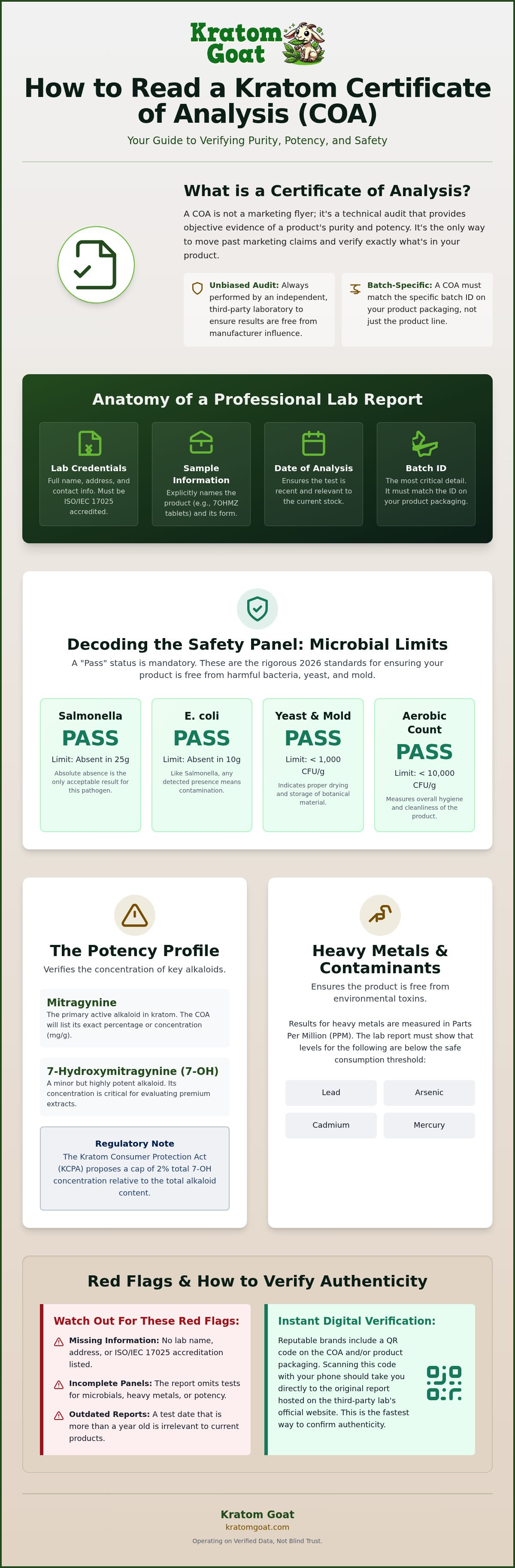
A professional report begins with a clear header. This section must list the lab's name, physical address, and contact information. If this information is missing or obscured, the report is invalid. The sample description should explicitly name the product, such as 7OHMZ tablets or Hydroxie liquid, and specify the form. You must also check the Date of Analysis. Kratom is a botanical product, and its freshness matters. A report dated over a year ago suggests a lack of inventory turnover or a failure to test current stock. Precise documentation links product integrity directly to your experience. Matching the batch ID on your packaging to the ID on the report is the first step in verifying that the product is what it claims to be.
ISO/IEC 17025: The Gold Standard for Labs
Accreditation is the dividing line between a legitimate lab and a "basement" operation. The ISO/IEC 17025 designation means the facility has undergone rigorous external audits to prove its technical competence. It ensures that the equipment used to measure 7-hydroxymitragynine is calibrated correctly and that the testing methods are scientifically sound. Kratom Goat only curates brands that utilize these accredited facilities. You can verify a lab's credentials by searching their accreditation body’s website. This level of scrutiny is the only way to ensure the purity of extracts like Press'd or OPMS. It's a non-negotiable barrier to entry in a market where quality varies wildly. Mastering how to read a kratom lab report starts with verifying the lab itself. If the lab isn't accredited, the numbers they provide carry no weight in a professional safety framework.
Decoding the Safety Panel: Microbial and Pathogen Testing
Safety isn't a suggestion; it's a binary state. When you examine a safety panel, you're looking for a "Pass" status across every microbiological category. Learning how to read a kratom lab report means looking past the summary and into the specific thresholds that define a safe product. Pathogens like Salmonella, E. coli, and Listeria represent the most significant risks in botanical products. In 2026, the standard for these bacteria is absolute. Salmonella must be "Absent in 25g" and E. coli must be "Absent in 10g." There is no sliding scale for these pathogens. If a report shows any numerical value for their presence, the batch is contaminated and fundamentally unsafe for consumption.
Interpreting Pathogen Results
Beyond the binary presence of pathogens, you must evaluate the total microbial load to understand the product's overall hygiene. CFU/g is the standard measure of viable bacterial cells per gram of sample. For a product to be considered safe by modern industry standards, it must meet the following criteria:
- Salmonella: Absent in 25g
- E. coli: Absent in 10g
- Total Aerobic Microbial Count (TAMC): Less than 10,000 CFU/g
- Yeast and Mold: Less than 1,000 CFU/g
High yeast or mold counts often indicate that the plant material wasn't dried properly or was exposed to moisture during transit. While the DEA Kratom Fact Sheet focuses on the plant's chemical properties, the industry's focus on safety panels is what actually protects you from acute illness. If these numbers exceed the 2026 thresholds, the product fails the safety audit, regardless of its potency.
The Consequences of Poor Microbial Control
Contamination isn't accidental; it's a failure of the supply chain. Improper drying and unhygienic storage are the primary culprits for high microbial counts. This is why meticulous brands prioritize clean-room processing and advanced sterilization techniques. For example, OPMS gold capsules are manufactured in facilities that adhere to strict Good Manufacturing Practices (GMP) to eliminate environmental contaminants. You'll often find that high-quality extracts have significantly lower microbial counts than raw leaf powder. The extraction process itself often acts as a purification step, stripping away the plant matter where bacteria thrive. When you master how to read a kratom lab report, you can verify this purity for yourself. You shouldn't settle for anything less than a pristine safety profile. You can browse our curated selection to see how these rigorous safety standards are applied across our entire inventory.
Analyzing Heavy Metals and Residual Contaminants
Kratom is a bioaccumulator. The plant naturally draws minerals and elements from the soil, which can include the "Big Four" heavy metals: Lead, Arsenic, Cadmium, and Mercury. Understanding how to read a kratom lab report requires a focus on these specific contaminants because they pose long-term health risks that aren't immediately visible. An FDA laboratory analysis previously identified significant levels of heavy metals in various market samples, highlighting the necessity of batch-specific screening. On a Certificate of Analysis, these metals are typically measured in Parts Per Million (PPM) or Parts Per Billion (PPB). These units represent the concentration of the metal relative to the total mass of the sample. For context, 1 PPM is equivalent to one milligram of metal per kilogram of kratom. While these numbers seem small, their impact on human biology is substantial.
The presence of heavy metals is often a reflection of the geography where the Mitragyna speciosa was harvested. Volcanic soils or areas with industrial runoff can elevate these levels. This is why we treat the COA as a non-negotiable barrier to entry. A report that lacks a heavy metal panel is incomplete and should be discarded. High-integrity brands use Inductively Coupled Plasma Mass Spectrometry (ICP-MS) to detect these elements at incredibly low concentrations, ensuring that the purity of the final product is backed by the most precise technology available today.
Thresholds for Heavy Metal Safety
Safety standards for botanicals are established by the United States Pharmacopeia (USP). For lead, anything exceeding 1.0 ppm is a definitive red flag. While a single serving might contain a minute amount, heavy metals are not easily processed by the body; they accumulate over time. This cumulative effect is why premium brands utilize advanced filtration during the extraction process to strip away heavy metals that might be present in the raw leaf. When you analyze a COA, look for a "Pass" result that adheres to these USP-aligned thresholds. If a report only lists "Detected" without a numerical value or a clear pass/fail status, the transparency is insufficient. You need concrete data to verify that your daily regimen isn't introducing unwanted toxins into your system.
Residual Solvents in Extracts
Extracts introduce an additional layer of technical scrutiny: residual solvents. While raw powder is simply ground leaf, products like Hydroxie liquid extract use specific agents to isolate alkaloids. A professional COA must include a solvent screening panel to ensure that extraction agents like ethanol or CO2 have been purged to safe levels. "Clean" extraction methods leave no detectable toxic residue. If you are learning how to read a kratom lab report for extracts, verify that the solvent panel is complete and lists "ND" (None Detected) for harmful chemicals. Meticulous sourcing means ensuring that the potency of a liquid shot isn't compromised by leftover industrial chemicals. We demand zero-tolerance for residual toxins, ensuring that the physical outcome of the product remains pure, natural, and reliable.
The Potency Profile: Mitragynine and 7-Hydroxymitragynine
Potency is a metric of precision. While the safety panels discussed earlier ensure the absence of toxins, the potency profile confirms the efficacy of the botanical experience. Mitragynine (MIT) is the primary alkaloid in natural leaf, typically found at concentrations between 1% and 2% by dry weight. However, for users seeking specialized outcomes, 7-hydroxymitragynine (7-OH) is the focus. Understanding how to read a kratom lab report means identifying these values expressed as a weight by weight percentage (w/w%). This technical measurement tells you the exact mass of the alkaloid relative to the total mass of the product. Precision is critical for products like 7OHMZ tablets, where even a minor variance in concentration can significantly alter the physical outcome.
We approach potency with the mindset of a meticulous expert. A report that merely lists "kratom extract" without a specific alkaloid breakdown is insufficient. You need to see the quantified results for both primary and secondary alkaloids to understand the product's profile. High-standard brands provide this data for every batch, ensuring that the product you receive matches the laboratory's findings. This transparency is the only way to verify that your extract is potent, pure, and professionally manufactured.
Understanding Alkaloid Ratios
In genuine, unprocessed kratom leaf, 7-OH levels are remarkably low, often staying well below 0.05%. As of August 2026, the regulatory landscape has placed a heavy emphasis on these ratios. The DEA targets products with a 7-OH concentration of 0.05% or more by dry weight for botanical kratom, or more than 1.00 mg per serving for extracts. Additionally, many states under the Kratom Consumer Protection Act (KCPA) cap 7-hydroxymitragynine at 2% of the total alkaloid content. If a lab report shows a 7-OH concentration that looks "too good to be true" without a corresponding extraction process, it may indicate a synthetic spike. We act as a high-integrity partner, ensuring that every brand we curate achieves its potency through natural concentration rather than artificial additives.
Extract Specific Potency
Extracts require a different level of technical scrutiny than raw powder. You must distinguish between the concentration (mg/g) and the total milligrams per serving. A professional kratom certificate of analysis will clearly state the active milligrams per tablet or liquid shot. This data is essential for precision dosing and consistent results. Mastering how to read a kratom lab report allows you to verify that a brand maintains batch-to-batch consistency. If the alkaloid levels fluctuate wildly between reports, the manufacturing process lacks the necessary controls. High-standard providers like Hydroxie and Press'd maintain tight tolerances to ensure you receive a reliable experience every time. Shop our collection of precision-dosed 7-OH extracts to experience the difference that rigorous testing makes.
Identifying Red Flags and Verifying Lab Authenticity
Technical knowledge is only valuable if the data you are analyzing is genuine. In an industry where quality varies, the ability to distinguish a legitimate audit from a doctored document is your final layer of protection. Red flags are often subtle, but they are definitive. Blurry text, inconsistent fonts, or missing laboratory contact information are immediate indicators of a compromised report. A professional Certificate of Analysis should be crisp, clear, and fully transparent. If a vendor provides a report with obscured batch numbers or "hidden" lab names, they are deliberately withholding the truth about their product's safety. Learning how to read a kratom lab report effectively requires you to look beyond the numbers and scrutinize the integrity of the document itself.
The QR code revolution has fundamentally changed the verification process in 2026. Legitimate brands now include scannable codes on their packaging that link directly to a third-party laboratory's secure portal. This is a critical distinction. The link should never lead to the vendor’s own website; it must lead to the independent lab that performed the analysis. This digital-first approach prevents the fraudulent reuse of old reports for new, untested batches. If a QR code is missing or leads to a dead link, the product fails the authenticity test. You should never accept a manual "copy" of a report when instant digital verification is the industry standard.
Spotting a Doctored Report
Fraudulent reports often leave a trail of digital breadcrumbs. Look closely at the batch numbers and dates. If the font for the batch ID looks different from the rest of the text, it has likely been photoshopped. You must also verify that the laboratory actually offers the specific tests listed on the COA. Some vendors claim "In-House" testing, but this lacks the necessary third-party oversight to be considered reliable. Without a neutral, ISO-accredited facility conducting the audit, the results are essentially a marketing claim rather than a scientific fact. When you master how to read a kratom lab report, you realize that calling the lab directly to confirm a batch ID is the ultimate way to ensure you are receiving a pure botanical.
The Kratom Goat Vetting Process
We operate as a high-integrity partner by assuming the burden of verification for you. Our curation process involves a zero-tolerance policy for any batch that shows even trace amounts of pathogens or heavy metals above USP limits. We prioritize brands that provide absolute transparency across all delivery methods. Whether you are comparing kratom tablets vs capsules, the standard for safety remains identical. Every batch of 7OHMZ, Hydroxie, or Press'd on our site has undergone a rigorous vetting process where we verify the COA directly with the testing facility. This meticulous curation ensures that every product in our inventory is potent, pure, and backed by a legitimate, third-party audit. We refuse to compromise on quality, providing you with the confidence that your supplements are exactly what they claim to be.
Secure Your Experience with Verified Purity
Mastering how to read a kratom lab report empowers you to bypass marketing fluff and focus on the technical reality of your supplements. You now understand that a "Pass" for heavy metals and the total absence of pathogens like Salmonella are the only acceptable standards for premium botanicals. Precision is not optional. By verifying batch IDs and utilizing QR code technology, you ensure that every tablet or liquid shot meets the rigorous safety and potency levels required in 2026. True empowerment comes from knowing exactly what you are putting into your body; you no longer have to guess about purity or potency.
At Kratom Goat, we act as your meticulous curator. We maintain a zero-tolerance policy for synthetic additives and contaminants. Our curated selection only features industry-leading brands like 7OHMZ and Hydroxie. Every batch is third-party tested to guarantee that the precision dosing you expect is exactly what you receive. Shop Lab-Tested Premium Kratom at Kratom Goat and take control of your wellness journey with the confidence that only verified data can provide. Your commitment to safety is our highest priority.
Frequently Asked Questions
What is the most important part of a kratom lab report?
The batch ID and the safety status of pathogens are the most critical elements of any report. A Certificate of Analysis is useless if the batch ID does not match the code printed on your product packaging. You must verify that Salmonella and E. coli are listed as "Absent" before you even consider the potency levels. This verification is the foundation of how to read a kratom lab report effectively and safely.
Can a kratom lab report be faked?
Yes, reports can be doctored through image editing or by presenting outdated data as current. You should always verify authenticity by scanning the provided QR code or contacting the third-party lab directly. Legitimate providers in 2026 use secure portals to host their data, which prevents the unauthorized reuse of old reports. If a report looks blurry or inconsistent, it is a definitive red flag.
What does "ND" mean on a kratom COA?
"ND" stands for "None Detected," which indicates that the concentration of a specific substance is below the laboratory's limit of detection. This is the ideal result for heavy metals, residual solvents, and pathogens. It confirms that the product is free from these contaminants within the highest precision of modern testing equipment. Seeing "ND" provides the ultimate assurance of a clean botanical extract.
How often should a kratom vendor update their lab results?
Vendors must update their results for every single production batch without exception. Professional brands never rely on generic annual testing or outdated reports from previous years. Because kratom is a natural botanical, alkaloid levels and microbial profiles can fluctuate between every harvest. Batch-specific testing is the only way to guarantee that the safety and potency of your specific product are verified.
What are the safe limits for lead in kratom?
The safe limit for lead in botanical products is generally considered to be below 1.0 ppm according to USP standards. Any value exceeding this threshold represents a significant risk for long-term health. We maintain a zero-tolerance policy for any batch that fails to meet these rigorous heavy metal safety requirements. You should never settle for a product that does not clearly list its lead concentration in PPM.
Why do some labs use different units like ppm and mg/kg?
These units are mathematically identical; 1 ppm (part per million) is equivalent to 1 mg/kg (milligram per kilogram). Labs choose different nomenclature based on their internal reporting standards or specific equipment settings. Regardless of the label used, the numerical value represents the same concentration of the substance within the total mass of the sample. Understanding this equivalence helps you maintain a technical perspective on safety data.
Do I need a lab report for every single batch of kratom I buy?
You absolutely need a batch-specific report for every purchase to ensure consistent safety. Natural variations in the environment and processing mean that one safe batch does not guarantee the safety of the next one. Learning how to read a kratom lab report for every unique batch ID is the only way to ensure you are consuming a pure, high-standard product. Consistency is the mark of a professional brand.