

Lab Tested Kratom: The Definitive Guide to Purity, Potency, and Safety Standards (2026)
A printed label claiming "pure botanical" means nothing without independent chemical proof to back it up. You shouldn't have to second-guess whether a product contains toxic heavy metals like lead or dangerous biological pathogens like Salmonella. When your peace of mind is on the line, demanding authentic lab tested kratom isn't just an extra precaution; it is an absolute standard.
You already know how frustrating it is to confront aggressive marketing claims that vanish the moment you ask for verifiable documentation. That skepticism protects you. This guide equips you to master the exact laboratory testing standards required to verify clean, contaminant-free botanicals and evaluate complex Certificates of Analysis (COAs) with total confidence. Ahead, we break down the non-negotiable chemical and microbial screening panels, spotlight the subtle warning signs of doctored lab reports, and show you exactly how to identify verified brands with pristine alkaloid profiles.
Key Takeaways
- Understand why genuine lab tested kratom requires multi-panel analytical screening rather than basic visual inspections or unverified supplier claims.
- Discover how High-Performance Liquid Chromatography (HPLC) precisely quantifies mitragynine content while identifying hazardous biological and chemical adulterants.
- Learn a simple, two-step method to audit Certificates of Analysis by verifying ISO/IEC 17025 accreditation and matching batch numbers directly to product packaging.
- Identify the critical secondary testing protocols required for advanced extracts and 7-OH formulations, including gas chromatography screening for residual processing solvents.
- Find out how reputable botanical curators evaluate third-party laboratory data to guarantee consistent potency, pure alkaloid profiles, and synthetic-free formulations.
What Is Lab Tested Kratom and Why Does Independent Verification Matter?
Authentic lab tested kratom refers strictly to raw botanical material or concentrated extracts subjected to rigorous chemical and biological screening by an independent, accredited facility. In an evolving industry, marketing assertions often replace verified data. Genuine laboratory analysis cuts through subjective claims. It delivers objective proof of alkaloid concentration, purity, and the total absence of toxic contaminants.
Because federal agencies do not regulate botanicals under strict pre-market approval pipelines, the responsibility for quality control falls heavily on vendors. Independent verification isn't a vanity metric; it represents the definitive boundary between unadulterated plant material and compromised product.
The Inherent Vulnerabilities of Agricultural Botanicals
As a natural agricultural crop derived from Mitragyna speciosa, kratom trees absorb whatever compounds exist in their surrounding soil and groundwater. Cultivation in humid, tropical environments introduces constant biological risks that require scientific mitigation.
- Soil Uptake: Roots readily pull heavy metals such as lead, arsenic, cadmium, and nickel from volcanic soils directly into the leaf tissue.
- Open-Air Curing: Traditional drying methods on outdoor tarps expose damp leaves to bird droppings, insects, airborne molds, and airborne dust.
- Milling Contamination: Grinding dried foliage with uncalibrated agricultural machinery can introduce metal shavings and microscopic biological pathogens.
A vibrant green powder might look entirely fresh to the naked eye. Yet visual inspection cannot identify microscopic Salmonella colonies, hidden mold spores, or unsafe heavy metal concentrations.
In-House Testing vs. Independent Third-Party Analysis
Relying exclusively on a manufacturer's internal quality checks presents a clear conflict of interest. Internal personnel operate under commercial pressure to clear harvest inventory quickly, creating an environment ripe for confirmation bias or skipped testing parameters.
Objective third-party contract laboratories operate without a financial stake in whether an individual production lot passes or fails. These specialized facilities enforce strict chain-of-custody protocols from sample intake through analytical completion. By auditing samples against validated scientific methods, third-party facilities ensure that your batch-specific lab tested kratom reflects pristine alkaloid profiles and uncompromising safety.
The Comprehensive Laboratory Testing Panels Required for Botanical Safety
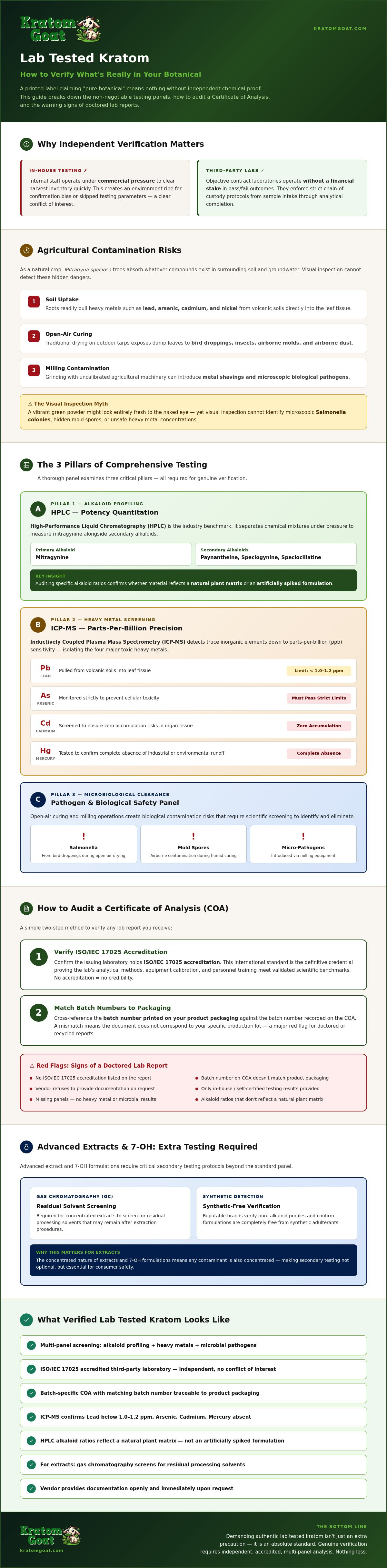
Evaluating botanical integrity requires advanced analytical instrumentation rather than guesswork. A thorough panel for lab tested kratom examines three critical pillars: active alkaloid concentration, toxic elemental screening, and microbiological pathogen clearance. Reputable facilities utilize validated scientific methodology to verify that finished products match their specifications while remaining free from harmful adulterants. In addition to full laboratory panels, operations looking to implement on-site adulterant screening can explore Sale of rapid detection kits and white label chemical solutions to verify sample authenticity and safety rapidly.
Alkaloid Profiling and Potency Quantitation
High-Performance Liquid Chromatography (HPLC) serves as the industry benchmark for alkaloid quantitation. This technique separates chemical mixtures under pressure to measure mitragynine alongside secondary alkaloids like paynantheine, speciogynine, and speciociliatine. By auditing these specific ratios, technicians confirm whether the material reflects a natural plant matrix or an artificially spiked formulation. Precise alkaloid quantification also establishes exact potency metrics, allowing consumers to establish consistent, reliable serving routines without unexpected spikes in potency.
Heavy Metal Screening via ICP-MS Instrumentation
Inductively Coupled Plasma Mass Spectrometry (ICP-MS) detects trace inorganic elements down to parts-per-billion (ppb) sensitivity. This high-precision scan isolates the four major toxic heavy metals commonly pulled from regional soil:
- Lead (Pb): Must remain well below standard botanical limits, typically under 1.0 to 1.2 parts per million (ppm).
- Arsenic (As): Monitored strictly to prevent cellular toxicity.
- Cadmium (Cd): Screened to ensure zero accumulation risks in organ tissue.
- Mercury (Hg): Tested to confirm the complete absence of industrial or environmental runoff.
Because heavy metals accumulate gradually in the human body, continuous batch-specific validation protects against long-term toxic buildup.
Microbiological Pathogen and Contaminant Detection
Microbial analysis identifies invisible biological hazards before packaging occurs. Technicians culture samples to evaluate total aerobic plate counts, yeasts, and molds. Virulent biological pathogens, specifically Salmonella species and Escherichia coli, have an uncompromising zero-tolerance threshold; they must test completely absent in every single batch. Modern commercial cleanrooms use validated dry heat or gamma sterilization methods, neutralizing live bacteria while preserving delicate plant alkaloids.
Federal resources like the DEA Drug Fact Sheet highlight ongoing safety and adulteration concerns across unregulated channels. You can eliminate that risk entirely by securing thoroughly lab-verified botanical products backed by transparent chemical certificates.
How to Read and Audit a Kratom Certificate of Analysis
A Certificate of Analysis (COA) is the definitive proof of botanical safety. Marketing teams can craft convincing packaging, but a laboratory report reveals the unvarnished reality of the product. Learning to systematically review a kratom certificate of analysis gives you the leverage to separate responsible suppliers from negligent operations.
Auditing a document involves four sequential steps:
- Confirm ISO/IEC 17025 Accreditation: Ensure the facility testing the sample is an accredited third party.
- Match Identification Identifiers: Cross-reference the batch, lot, or tracking code on your pouch directly with the lab header.
- Check Sample and Report Dates: Verify testing took place within an active, recent production window rather than years ago.
- Review Quantitative Thresholds: Confirm every safety panel reads "Pass" or falls safely below biological and elemental action levels.
Verifying Laboratory Credentials and ISO/IEC 17025 Status
Never rely on a document generated by an unaccredited facility. Legitimate commercial laboratories hold formal ISO/IEC 17025 accreditation, an international benchmark verifying technical competence, standard operating procedures, and precisely calibrated instrumentation. Quality-driven suppliers align with programs like the AKA GMP Standards Program, ensuring their contract analytical labs provide transparent contact details, physical facility addresses, and signed approvals from the lead analytical chemist.
Matching Physical Packaging to Laboratory Documentation
A COA is meaningless if it does not connect directly to the bottle or package in your hands. Disreputable vendors often commission a single pristine test for one harvest, then reuse that identical document across months of unrelated shipments. Every separate milling lot or extraction cycle requires unique laboratory evaluation. Similar to how regulated plant-derived industries rely on enterprise platforms like PROTEUS420 to maintain end-to-end traceability from cultivation through distribution, authentic lab tested kratom always features printed batch numbers matching the specific analytical run on the certificate.
Spotting Common Red Flags on Falsified COAs
Falsified reports remain an ongoing issue in the botanical market. Digital manipulation is often obvious once you inspect the document closely:
- Mismatched Typography: Different font sizes, inconsistent alignments, or faint digital compression around dates and percentages indicate photo editing.
- Biologically Impossible Yields: Raw, unextracted leaf powder displaying mitragynine levels above 2.0% to 2.2% signals either artificial spiking or manipulated reporting.
- Absent Contact Channels: Legitimate testing facilities encourage verification. If a lab sheet omits a traceable phone number or report reference code, treat that product as untested.
When in doubt, email or call the testing laboratory directly with the sample ID. Reputable facilities confirm authentic records within minutes.
Safety and Purity Standards for Advanced Extracts and 7-OH Formulations
Refining raw botanical material into concentrated extracts introduces chemical variables that raw leaf testing panels do not measure. Standard ground powder requires biological and elemental screening; however, concentrated formulations demand dedicated secondary analytical verification. When you purchase high-potency products, demanding thorough documentation for advanced lab tested kratom is necessary to confirm that chemical purifications left behind zero hazardous processing residues.
Residual Solvent Analysis via Gas Chromatography
Concentrating alkaloids involves food-grade or pharmaceutical-grade extraction agents like ethanol, heptane, or ethyl acetate. Gas Chromatography-Mass Spectrometry (GC-MS) volatilizes the extract sample to separate and measure trace chemicals remaining from the crystallization phase. Under United States Pharmacopeia standards, Class 1 solvents like benzene are entirely unacceptable, while Class 2 and Class 3 processing compounds must remain well below strict residual parts-per-million limits. A pristine extract certificate displays "Non-Detect" (ND) results across all residual solvent indicators.
Testing for Pure 7-OH vs. Synthetic Adulterants
As interest expands around isolated alkaloids, distinguishing natural botanical derivatives from cheap synthetic chemical adulterants becomes paramount. Testing protocols for 7-hydroxymitragynine must verify an authentic alkaloid fingerprint rather than artificial additives masquerading as plant extracts. Advanced liquid chromatography confirms that the target compound matches natural leaf markers, ensuring tablets and liquid shots deliver clean, predictable potency without dangerous unlisted chemical compounds.
The Educated Buyer Checklist for Advanced Formulations
Vetting modern formulations requires examining both the analytical paperwork and the finished physical presentation. Before selecting an advanced extract, confirm the following standards:
- Quantified Active Potency: Look for distinct milligram declarations per tablet or milliliter on the packaging that mirror the certificate's quantified results.
- Protective Packaging: Verify products use blister sealing, child-resistant caps, and opaque barriers protecting sensitive alkaloids from ambient light and air breakdown.
- Traceable Batch Printing: Avoid unsealed blister packs or unlabeled bulk tinctures that fail to link directly to verifiable online analytical data.
Refuse to compromise on chemical clarity. You can browse pristine, fully audited extracts by choosing to explore verified third-party tested tablets and liquids through our curated inventory.
The Kratom Goat Commitment: Premium Curated Brands Backed by Science
Sourcing exceptional botanicals should never require blind faith. Kratom Goat functions as a premier national distributor dedicated to scientific transparency, curating exclusively from industry manufacturers who hold their products to uncompromising laboratory standards. Instead of selling unverified bulk powders or untested private labels, our catalog showcases established pioneers whose production lots undergo exhaustive multi-panel analysis. Every single batch delivers unadulterated botanical power.
Our commitment ensures that every order of lab tested kratom arriving at your doorstep represents pure alkaloid content free from synthetic adulterants, heavy metals, and biological pathogens. Over 2,000 verified customer reviews substantiate this standard, reflecting an unwavering track record of batch-tracked consistency and absolute product integrity.
A Curated Portfolio of Industry Standard-Bearers
True safety begins with strict selectivity. Rather than listing hundreds of unvetted options, we audit manufacturing protocols before admitting any brand into our collection. Our platform partners exclusively with respected industry innovators, including Press'd, OPMS, and Krave.
- Targeted Tablet Formulations: We carry advanced options like Press'd 7-Hydroxymitragynine Tablets, each batch-tested to confirm exact active milligram potency.
- Refined Liquid Extracts: Premium concentrated formulations provide rapidly absorbed alkaloid delivery backed by full residual solvent clearance.
- Standardized Leaf Capsules: Trusted options like OPMS Gold Capsules and Krave Kratom Capsules maintain dependable full-spectrum profiles without artificial additives.
This curation model completely eliminates guesswork. You receive certified botanicals meeting the highest thresholds of purity and safety.
Effortless National Access to Verified Botanicals
Accountability extends from initial synthesis to final packaging. Every item featured across our inventory features distinct batch tracking, preserving a transparent chain of custody from the certified production line directly to your hands. We believe verified testing data should be instantly accessible rather than hidden behind generic customer service email threads.
Enjoy dependable nationwide fulfillment across our comprehensive lineup of premium tablets, botanical capsules, and concentrated liquids. By maintaining uncompromising acceptance criteria, Kratom Goat gives you direct access to the finest lab tested kratom available anywhere, backed by science and verified by independent data.
Demand Verified Transparency for Your Botanical Routine
Uncompromising safety starts with objective chemical data. You now hold the precise framework required to audit ISO/IEC 17025 accredited certificates, catch microbial hazards, and confirm non-detectable solvent levels on advanced extracts. Never settle for superficial marketing assertions when independent laboratory instrumentation can validate every single milligram.
Choosing genuine lab tested kratom protects your wellness and ensures consistent, dependable potency across every serving. Kratom Goat eliminates uncertainty through the strict curation of third-party tested industry brands, guaranteeing every tablet, capsule, and liquid extract is completely free from synthetic adulterants and fillers. Backed by over 2,000 customer reviews validating exceptional product quality, we make certified botanical purity effortless to access nationwide. Step forward with total confidence in your daily regimen and Explore Lab-Verified Botanicals at Kratom Goat today.
Frequently Asked Questions
What does it mean when kratom is labeled as lab tested?
When a product is labeled as lab tested, it means a representative sample from that specific production lot underwent scientific evaluation at an accredited analytical facility. Genuine lab tested kratom is screened to quantify key alkaloid levels and verify the absence of hazardous contaminants like Salmonella, E. coli, and heavy metals. This process confirms that the botanical powder, tablet, or extract matches its product claims and meets established consumer safety benchmarks.
Which specific contaminants are screened for during third-party testing?
Comprehensive third-party screening evaluates both biological pathogens and elemental toxins. Testing panels actively isolate toxic heavy metals, specifically lead, arsenic, cadmium, and mercury, which plants absorb from regional cultivation soil. Simultaneously, biological assays detect common food-borne threats, including Salmonella species, Escherichia coli, aerobic bacteria, yeasts, and molds. A batch passes only when microbiological counts remain within safe botanical thresholds and virulent pathogens test completely negative.
How can I verify if a kratom Certificate of Analysis is authentic?
You can verify a Certificate of Analysis by cross-referencing the printed batch or lot number on your packaging directly with the document header. Look for an active ISO/IEC 17025 accreditation credential, complete laboratory contact details, and a senior chemist's signature. If the typography looks altered or the dates precede recent harvesting cycles, contact the independent testing facility directly with the sample identification number to confirm genuine laboratory records.
Are heavy metals naturally found in kratom plants?
Yes, kratom trees naturally absorb trace minerals and heavy metals directly from soil and groundwater as they mature. Volcanic soils across Southeast Asian cultivation zones often contain naturally occurring lead, nickel, and arsenic. While trace exposure is common in many agricultural crops, independent laboratory quantification ensures that cumulative heavy metal concentrations remain far below international safety limits, preventing elemental toxicity from daily botanical use.
What is the difference between raw kratom testing and extract testing?
Raw leaf testing focuses on basic alkaloid potency, microbial loads, and elemental heavy metals pulled during outdoor cultivation. Concentrated botanical extracts and purified 7-hydroxymitragynine formulations demand additional analytical steps. Technicians use gas chromatography to verify that chemical agents used during concentration are fully eliminated. This secondary screening confirms that advanced lab tested kratom extracts exhibit non-detectable residual solvent levels and pristine, unadulterated alkaloid profiles.
Why is ISO/IEC 17025 laboratory accreditation so important for testing?
ISO/IEC 17025 accreditation is the international benchmark for analytical laboratory competence and data integrity. Unlike standard commercial facilities, accredited laboratories adhere to strict quality management protocols, use validated testing methodologies, and maintain meticulously calibrated instruments. When a facility holds this credential, it guarantees that analytical results for alkaloid potency and contaminant limits are scientifically defensible, repeatable, and completely free from manufacturer bias.
Can kratom contain synthetic additives if it is not lab tested?
Yes, unverified or black-market botanical products can contain hidden synthetic additives, artificial alkaloid spikes, or unlisted compounds designed to mimic natural potency. Without independent High-Performance Liquid Chromatography testing, consumers cannot verify whether a formulation relies purely on natural leaf chemistry. Authentic brands avoid this risk by publishing multi-panel third-party analyses that confirm natural alkaloid ratios and the complete absence of synthetic fillers.