

Kratom Strain Rotation Schedule: A Cautious, Evidence-Aware Planning Guide
What if switching between red, green, and white labels doesn’t reliably change the effects or tolerance you’re trying to manage? If familiar effects seem different over time, it’s understandable to look for a clear plan. A kratom strain rotation schedule may sound practical, but there’s no scientific evidence that rotating strain labels prevents tolerance. Research also hasn’t found consistent differences in the alkaloid profiles of products sold under different strain names.
Your observations still matter. The key is to treat a schedule as a way to track patterns, not as proven protection from harm. This guide explains what rotation can and can’t tell you, and offers a non-prescriptive way to record observations without presenting a routine as medically established. It also covers why a label change may not mean a meaningful product change, what concerns deserve attention, and when pausing use and seeking qualified medical advice is the safer next step.
Key Takeaways
- A kratom strain rotation schedule can help you record patterns, but it isn’t a proven way to prevent tolerance or harm.
- Strain labels don’t guarantee consistent differences in a product’s chemistry or effects, so switching labels may not mean a meaningful change.
- Changing batches or product forms also doesn’t establish that active constituents or risks have changed.
- Use a reflection log to note dates, product labels, reasons for use, unexpected effects, and other relevant factors without assuming what caused them.
- If you use kratom regularly, take medicines, or have concerns, discuss them with a qualified clinician before deciding on next steps.
What Does a Kratom Strain Rotation Schedule Actually Mean?
A kratom strain rotation schedule usually means alternating products or strain labels over time. People may do this in the hope of preserving familiar effects or reducing tolerance. But no universally established schedule has been shown to be safe or to prevent tolerance. Rotation is a consumer practice, not a validated treatment plan, and a calendar alone can’t establish that use is safer.
Kratom comes from Mitragyna speciosa, a plant with multiple alkaloids, including mitragynine. Commercial labels such as red, green, and white may suggest distinct categories, but they don’t guarantee standardized or reliably different chemical profiles. A label change is not proof that a product’s active constituents, effects, or risks have changed.
What People Usually Mean by Strain Rotation
People may switch among labeled strains, move between batches carrying the same label, or change product forms. These are different kinds of changes. A different batch or format does not automatically mean a different alkaloid profile, and switching labels does not necessarily represent a meaningful change in the product itself.
Some users report noticing different effects after a switch. Those experiences can be real to the person, but they don’t establish why the effects changed or show that rotation prevents tolerance. Product composition, individual response, and other circumstances may vary. This information is educational, not individualized medical advice.
Why a Schedule Is Not a Safety Guarantee
Rotation is a tracking approach, not proven protection. There’s no evidence-based cycle or frequency that can be presented as a reliable way to prevent tolerance or other harms. A fixed routine may create a sense of control without confirming that exposure or risk has changed.
A perceived change in effects is not the same as established evidence about tolerance. If someone feels less effect or notices an unexpected response, switching to another label can’t explain the cause or guarantee a safer outcome. Don’t treat a rotation calendar as a dosing recommendation. Use records to describe what happened, not to justify continued use.
A cautious approach starts with clear distinctions: a strain name is a label, a batch is a particular product lot, and a format describes how a product is presented. None of these changes, on its own, proves a change in risk. If regular use, medicines, or concerning effects raise questions, discuss them with a qualified clinician who can consider individual circumstances.
What Evidence Says About Kratom Strain Rotation and Tolerance
Consumer reports and clinical evidence answer different questions. Someone may notice a change after switching labels, but that experience alone can’t show that the label caused it or that rotating prevents tolerance. Available evidence does not establish a kratom strain rotation schedule as an effective way to prevent tolerance or other harm.
What the evidence can support: strain labels are not reliable proof of distinct chemical profiles, and rotation has not been shown to prevent tolerance. What it cannot establish: that a particular rotation pattern will protect an individual. This limitation matters because products can vary and individual responses can differ.
Do Different Kratom Strains Have Reliably Different Effects?
Red, green, and white labels are commercial categories, not standardized guarantees of botanical origin, processing, alkaloid content, or effect. Sourcing and processing can vary, and the same label shouldn’t be treated as a precise measure of a product’s chemistry. Research has not established consistent, meaningful alkaloid-profile differences across products marketed under different strain names. Color labels also can’t reliably predict how any one person will respond.
Kratom comes from Mitragyna speciosa and contains alkaloids such as mitragynine. That general chemistry doesn’t mean products with different labels are predictably chemically distinct. Consumer observations may be worth recording, but they don’t replace controlled evidence.
Can Rotation Prevent Tolerance or Dependence?
No. Rotation has not been established as a method to prevent tolerance or dependence, and changing a label cannot guarantee protection from withdrawal, interactions, or other adverse effects. Mayo Clinic discusses reported safety concerns, including addiction and liver problems. That general information does not determine an individual’s risk or explain a particular reaction.
Tolerance and dependence are health concerns that deserve qualified medical guidance, especially if use is regular, effects change, or stopping feels difficult. A rotation pattern can’t diagnose what’s happening or establish that it’s safe to continue. For chemistry context, see this 7-hydroxymitragynine science guide. Concentrated 7-hydroxymitragynine products are distinct from traditional kratom leaf, so information about one should not be used to assume the same composition or risk profile for the other.
If you’re comparing products, review the available product information, but don’t treat labeling or testing information as proof that rotation prevents harm. A clinician can help assess personal health concerns and possible interactions. This educational overview isn’t individualized medical advice.
Kratom Strain Rotation Compared With Changing Product Forms
Changing a label, batch, or format describes a different kind of switch. None, by itself, confirms a change in composition, strength, or risk. A kratom strain rotation schedule should not turn these categories into a safer-use sequence or imply that alternating them prevents harm.
Strain Names, Batches, and Formats Are Not Interchangeable
A strain name is a commercial label, a batch is a particular product lot, and a format is how a product is presented, such as a tablet or capsule. These terms describe different things. Labels alone can’t establish a product’s alkaloid profile or strength. A new batch may vary, while a different format may contain similar material. Check product-specific information where available, but don’t interpret a label or format change as proof of a predictable effect.
For a general explanation of format differences, see this comparison of kratom tablets versus capsules. Understanding how formats differ does not establish that one is safer or that switching formats changes the underlying risk.
| What changes | What it means | What it cannot establish |
|---|---|---|
| Strain label | A name or category used to describe a product | A distinct, standardized alkaloid profile or predictable personal response |
| Batch | A particular lot of a product | Consistent composition between lots, unless supported by appropriate product-specific information |
| Product form | The format in which a product is presented | That active constituents, strength, or risk have changed |
Why Concentrated 7-Hydroxymitragynine Needs Separate Consideration
Traditional kratom leaf products and concentrated 7-hydroxymitragynine products are not interchangeable categories. A concentrated product should not be treated as simply another strain or format of leaf, or added to a rotation template as though the same assumptions apply. Don’t infer composition from a broad product label. Consult current product documentation and qualified health sources for relevant information.
This comparison is for understanding terminology, not for choosing a product, combining products, or planning a sequence. A switch in label, batch, or form does not establish reduced risk, and no rotation pattern should be presented as a proven safety measure.
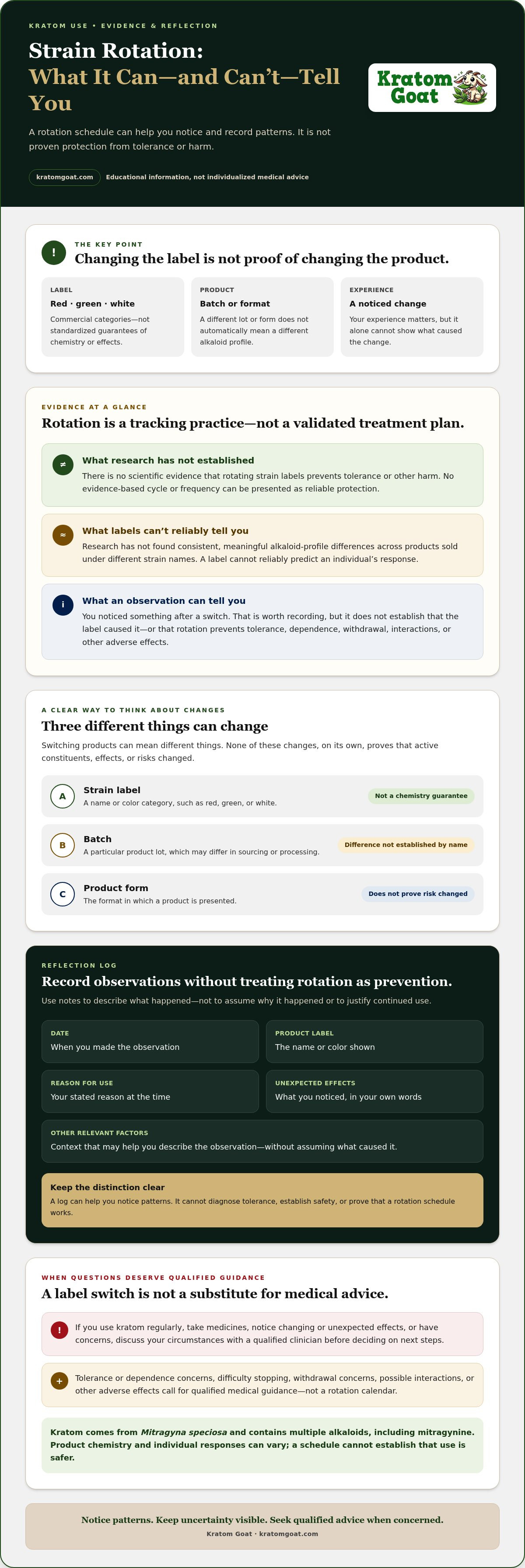
How to Track Kratom Use Without Treating Rotation as Prevention
A record can help you describe what you’ve noticed, but it can’t turn switching products into a safety plan. Think of it as a reflection log, not a dosing calendar. The goal is to keep useful details for your own review or a conversation with a qualified healthcare professional, not to set a cycle or decide when to restart.
A Non-Prescriptive Tracking Template
For each entry, note the date and the information shown on the product label. If available, record the product form and batch details. You can also briefly note your reason for use, any unexpected effects, and relevant context, such as other medicines or supplements. Keep observations factual: “felt different than expected” is more useful than assuming what caused the change.
- Date: When the use occurred.
- Product details: Label, form, and batch information if provided.
- Context: Reason for use, unexpected effects, and medicines or supplements to discuss with a clinician.
Don’t use the log to set a dose, frequency, cycling length, or restart schedule. It can’t establish that a product is safe, identify the cause of a symptom, or determine a medically appropriate schedule. Even a detailed record has limits.
When Self-Management Is Not the Right Approach
If you’re concerned about dependence, withdrawal, possible interactions, or worsening symptoms, pause and speak with a qualified healthcare professional. Share the record, including relevant medicines and supplements. A clinician can assess your individual situation; an online guide or rotation plan can’t replace that advice.
Seek urgent help for severe or rapidly worsening symptoms rather than relying on a log or waiting for a planned check-in. In an emergency, contact local emergency services.
The key distinction is simple: tracking may help organize information, but it does not prevent harm. If you’re reviewing a product’s stated details for record-keeping, review available product information. Product information cannot establish that rotation is safe or suitable for you.
Choosing a Responsible Next Step About Kratom Use
The practical conclusion is clear: a kratom strain rotation schedule cannot be presented as proven harm prevention. If you use kratom regularly, take medicines or supplements, or have questions about changing or stopping use, discuss your situation with a qualified healthcare professional. A retailer can provide product information, but can’t assess your health or replace clinical advice.
Questions to Ask a Healthcare Professional
Prepare a clear picture of your circumstances. Share what products you use, how often, and any changes or unexpected effects you’ve noticed. Bring a list of medicines and supplements, and ask:
- Could my health conditions or medicines affect the risks of kratom use?
- What should I know about possible interactions or symptoms I’ve noticed?
- If I’m concerned about withdrawal or changing my use, what should I do next?
Be direct about concerns, including difficulty stopping or symptoms that are getting worse. Don’t rely on a rotation plan to decide how to change use; ask a clinician for guidance specific to you.
How to Assess Product Information Transparently
For questions about composition, look for current documentation that identifies the specific product and, where stated, its batch. Check what the document says was tested and what the results cover. A certificate of analysis (COA) may offer information about tested attributes, but it is not proof of overall safety, a guarantee of effects, or evidence that rotation prevents harm. If a document doesn’t clearly match the product you’re reviewing, don’t assume it applies.
The kratom certificate of analysis guide can help you understand what to look for in this kind of documentation. Availability and scope can differ, so check current product-specific information rather than relying on general claims about testing.
Keep the roles distinct: clinical questions belong with a qualified healthcare professional; product-composition questions call for relevant documentation. For a product-information check, review available product and testing information. Neither documentation nor a schedule can establish that a product or pattern of use is safe for you.
Make Your Next Step Evidence-Aware
A kratom strain rotation schedule may help you organize observations, but it isn’t a proven way to prevent tolerance or other harm. Switching strain labels, batches, or formats doesn’t establish that a product’s composition or risk has changed. A simple reflection log can help you describe what you’ve noticed, but it can’t determine a safe schedule or diagnose the reason for an effect.
If you use kratom regularly, take medicines or supplements, or have concerns about withdrawal or unexpected effects, discuss them with a qualified healthcare professional. For product-composition questions, look for current documentation that identifies the specific product and, where available, its batch. A certificate of analysis can offer testing details, but it isn’t proof of overall safety.
Kratom Goat states that its products are lab-tested; check what product-specific documentation is available rather than assuming every product has the same records. To review available product and testing information, visit Kratom Goat’s online store. Take a measured, informed approach, and seek qualified advice when personal health questions arise.
Frequently Asked Questions
Is there a proven kratom strain rotation schedule?
No. A kratom strain rotation schedule has not been established as a safe or effective way to prevent tolerance or other harm. There is no evidence-based cycle or frequency to recommend. Some people alternate products or labels based on personal experience, but those reports don’t demonstrate that the practice works. If you’re reviewing your use, a factual log may help organize observations, but it can’t identify a medically appropriate schedule.
Can rotating kratom strains prevent tolerance?
There’s no scientific evidence that switching between commercial strain labels prevents or reduces tolerance. Labels such as red, green, and white aren’t standardized measures of alkaloid content, so changing labels may not mean exposure has meaningfully changed. Tolerance and dependence are health concerns that a rotation plan can’t rule out or diagnose. If you’re noticing reduced effects or feel concerned about your use, discuss it with a qualified healthcare professional.
How often should you rotate kratom strains?
No evidence-based rotation frequency has been established, so there isn’t a daily, weekly, or other cycle that can be recommended as safe or effective. Avoid treating an online calendar as medical guidance or as a way to prevent tolerance. If you’re tracking your use, record dates and product details without setting a dose, frequency, or restart plan. A qualified healthcare professional can discuss personal concerns and circumstances.
Does switching kratom strains change the effects?
It may seem to change the effects for some people, but a change in experience doesn’t prove that the strain label caused it. Commercial names don’t guarantee consistent or distinct alkaloid profiles, and product composition and individual responses can vary. Record what you noticed, along with the product label and relevant context, without assuming a cause. Don’t rely on switching labels to ensure a predictable or safer result.
Is rotating kratom leaf the same as rotating 7-hydroxymitragynine products?
No. Traditional kratom leaf products and concentrated 7-hydroxymitragynine products are distinct categories and shouldn’t be treated as interchangeable strains or formats. A rotation plan for leaf doesn’t establish how a concentrated product compares in composition or risk. Don’t add concentrated products to a rotation template based on assumptions from leaf labels. For specific composition questions, consult current product documentation and qualified health sources.
What should I track if I am reviewing my kratom use?
Keep a reflection log, not a dosing calendar. Note the date, product label and form, batch information if available, and your reason for use. You can also record unexpected effects and relevant context, including medicines or supplements to discuss with a clinician. Stick to observations rather than diagnosing causes. A log can help organize information, but it can’t establish safety or determine a suitable schedule.
When should I talk to a healthcare professional about kratom?
Speak with a qualified healthcare professional if you use kratom regularly, take medicines or supplements, notice worsening or unexpected effects, or have concerns about dependence or withdrawal. Share what products you use and any relevant notes from your log. Don’t rely on a retailer or rotation schedule for clinical advice. If symptoms are severe or you believe there’s an emergency, contact local emergency services.