

Kratom Sourcing Standards: The 2026 Guide to Purity and Botanical Integrity
In 2026, the label "GMP-compliant" has become a hollow marketing buzzword. It often hides more than it reveals about what is actually in your bottle. As the industry faces stricter kratom sourcing standards and shifting export regulations, you've likely felt a nagging uncertainty when looking at a new 7-OH tablet or liquid extract. It's difficult to trust a product when headlines focus on heavy metal contamination or synthetic additives masking as natural alkaloids. You deserve a product that matches your personal standards for excellence and safety.
This guide will show you exactly how to cut through the marketing noise to identify premium kratom that meets the industry's most rigorous safety and potency benchmarks. We'll provide a clear framework for auditing any brand, explain the reality of 2026 lab rigor, and give you the confidence to verify the purity of your 7-OH tablets and extracts with absolute certainty. By the end of this article, you'll know the difference between high-level hype and the botanical integrity that defines a market leader.
Key Takeaways
- Learn how modern kratom sourcing standards have evolved from basic safety to pharmaceutical-grade botanical manufacturing.
- Identify the critical manufacturing pillars, including AKA GMP adherence and climate-controlled storage, that protect alkaloid integrity.
- Understand the specialized extraction protocols required to ensure the purity and safety of advanced 7-hydroxymitragynine products.
- Master a simple two-step audit process to verify supplier credentials using batch-specific QR codes and official seals.
- Discover how professional curation eliminates the guesswork by vetting brands for synthetic-free, high-potency formulations.
What Are Modern Kratom Sourcing Standards?
Modern kratom sourcing standards represent a comprehensive set of protocols that govern every stage of the plant's lifecycle. These protocols dictate how Mitragyna speciosa is cultivated, harvested, and processed before it ever reaches a shelf. The industry has moved decisively away from the "wild-west" era of unregulated bulk exports. Today, standardized botanical manufacturing is the baseline for any brand claiming a premium position. Sourcing transparency is no longer a luxury. It's the single most important factor for consumer safety in 2026. A brand's willingness to disclose its origin and testing data defines its integrity in an increasingly crowded market.
The American Kratom Association (AKA) has been instrumental in this shift. By establishing voluntary compliance frameworks, the AKA provides a roadmap for brands that value longevity and safety. Their GMP Standards Program requires rigorous, third-party audits that verify a vendor's commitment to the botanical integrity of Kratom. This isn't just about passing a test. It's about maintaining a culture of accountability that protects the consumer and the industry alike. When a vendor adheres to these frameworks, they demonstrate a level of professional rigor that casual resellers simply cannot match.
The Evolution of Quality Control in the Kratom Industry
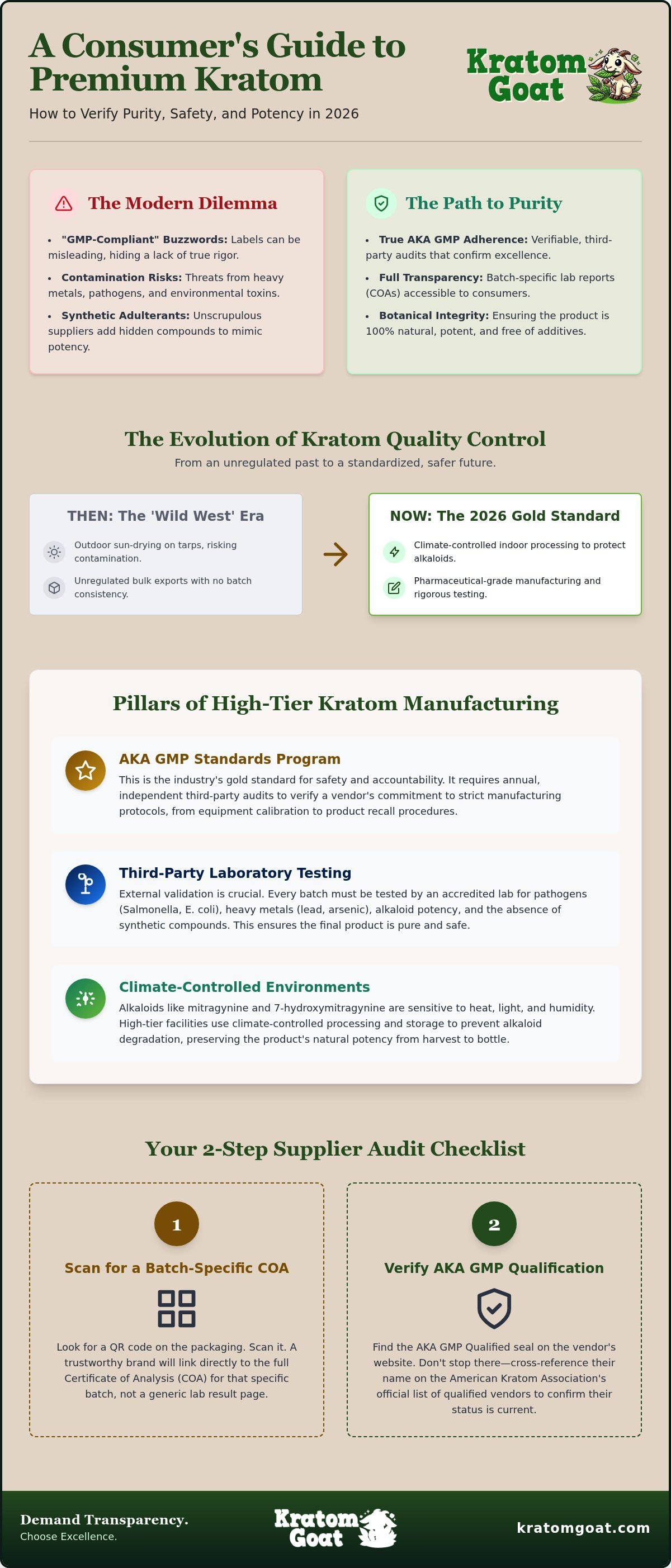
Quality control has evolved from primitive methods to high-tech solutions. Traditional sun-drying on outdoor tarps is a relic of the past. Modern standards require climate-controlled indoor processing to prevent alkaloid degradation and environmental contamination. This precision is especially vital as the 2026 market focuses on high-potency alkaloid isolates. State-level legislation has also forced a higher standard. The Kratom Consumer Protection Act (KCPA) now mandates strict registration and testing in states like Utah and Florida. These laws ensure that sourcing isn't just a choice; it's a legal requirement for market entry in many jurisdictions.
Why Sourcing Standards Protect the Consumer
Strict sourcing standards act as a shield for the end user. They mitigate the risk of pathogens like salmonella and E. coli through specialized pasteurization techniques. Beyond biological threats, these standards mandate testing for heavy metals like lead and arsenic, which can naturally occur in soil. Perhaps the most critical function of modern standards is preventing the "adulteration trap." This occurs when unscrupulous suppliers add synthetic compounds to boost a product's perceived potency. Rigorous kratom sourcing standards ensure that every tablet and liquid extract is exactly what the label claims. You get the power of the plant without the risk of hidden additives.
The Pillars of High-Tier Kratom Manufacturing
High-tier manufacturing is the invisible barrier between a premium experience and a potential safety hazard. While the previous section defined the broad scope of kratom sourcing standards, the manufacturing phase is where botanical integrity is either preserved or lost. Precision isn't optional here. It's the standard. Top-tier facilities operate with a pharmaceutical-adjacent mindset, ensuring that every raw leaf shipment is transformed into a stable, consistent product. This process relies on dedicated cleanroom environments for tablet pressing and bottling, preventing environmental cross-contamination that often plagues lower-end operations.
Consistency is the hallmark of a professional vendor. Achieving batch-to-batch uniformity in standardized extract production requires sophisticated equipment and rigid protocols. Beyond the machinery, climate-controlled storage is a necessity. Alkaloids like mitragynine and 7-hydroxymitragynine are sensitive to light, heat, and humidity. Without precise environmental controls, these compounds degrade rapidly, resulting in a product that lacks the promised potency. High-standard manufacturing ensures that the alkaloid profile remains locked in from the moment of extraction until the consumer opens the package.
AKA GMP Standards: The Industry Gold Standard
The foundation of trust in this industry is the American Kratom Association’s GMP Standards Program. This isn't a one-time badge. It requires an annual third-party audit from independent firms to verify that a vendor's facility meets strict criteria. These audits scrutinize everything from equipment calibration to the Standard Operating Procedures (SOPs) for product recalls and adverse event reporting. Only a small fraction of vendors successfully maintain AKA GMP Qualified status because the financial and operational hurdles are significant. This exclusivity is exactly why consumers should prioritize brands that have invested in this level of transparency.
Third-Party Laboratory Testing and COA Transparency
External validation is the only way to prove botanical purity. ISO-certified laboratories provide the objective data needed to verify that a product is free from heavy metals and microbiological pathogens. This is especially critical given the FDA warnings on kratom regarding potential contamination in unregulated supply chains. A reputable vendor doesn't just test their products; they make the results accessible. Mastering the skill of reading a kratom certificate of analysis allows you to verify alkaloid concentrations and safety data for yourself. If you want to ensure you're only accessing vetted, high-purity options, you can explore curated brands that meet these exact benchmarks.
Sourcing Standards for Advanced Alkaloids: 7-OH and Extracts
Advanced alkaloids like 7-hydroxymitragynine represent a significant paradigm shift in the botanical industry. While raw leaf powder relies on traditional harvesting and drying techniques, 7-OH tablets and liquid extracts demand a level of pharmaceutical-grade precision that most vendors simply cannot achieve. Establishing strict kratom sourcing standards for these potent compounds is essential for long-term consumer safety. It isn't enough to simply extract the alkaloid; the manufacturing process must ensure that the 7-hydroxymitragynine science aligns perfectly with the latest peer-reviewed safety data. This requires an uncompromising "Natural-Only" mandate. By rejecting synthetic 7-OH analogs, high-integrity brands preserve the botanical integrity that discerning consumers expect from a premium provider.
Precision in 7-Hydroxymitragynine Extraction
High-performance liquid chromatography (HPLC) serves as the backbone of this technical precision. This technology allows for exact alkaloid quantification, ensuring each production batch hits the target potency without the dangerous variance seen in unvetted products. Because the concentration process often involves specialized solvents, a high-tier sourcing standard mandates the total removal of these residuals through rigorous purging cycles. Industry leaders like 7OHMZ and Hydroxie have set the gold standard here. They utilize sophisticated multi-stage filtration and vacuum purging to ensure the final concentrate is chemically pure. This meticulous attention to detail separates professional-grade extracts from amateur experiments.
Avoiding Adulterants and Synthetic Additives
The popularity of advanced extracts has unfortunately invited an "adulteration trap" where profit is prioritized over safety. Unscrupulous suppliers might use unlisted research chemicals or synthetic analogs to mimic the effects of high-potency kratom. This poses a massive risk to the consumer. Ongoing research on kratom alkaloids highlights the delicate synergy between naturally occurring compounds. When you introduce synthetics, you disrupt this botanical balance and create an unpredictable safety profile. Modern kratom sourcing standards are specifically designed to identify these red flags. High-integrity curators audit every step of the supply chain to ensure no "spiking" occurs, maintaining a strictly botanical product line that consumers can trust.
How to Audit Your Kratom Supplier: A 2026 Checklist
Theoretical knowledge of kratom sourcing standards is only valuable if you can apply it to the products sitting in your cabinet. In a market where marketing claims often outpace actual laboratory rigor, you must take an active role in verifying the products you consume. Empowerment comes from independent verification. You don't have to be a chemist to spot a high-integrity brand; you simply need to know where the red flags hide. Use this five-step checklist to audit any supplier before making a purchase.
- Step 1: Locate the American Kratom Association (AKA) GMP Qualified seal on the brand's official website and verify their name on the AKA's current participant list.
- Step 2: Confirm that every individual package features a batch-specific QR code that leads directly to a verifiable laboratory report.
- Step 3: Cross-reference the data on that report with the third-party lab's own internal database to ensure the results haven't been fabricated.
- Step 4: Look for specific details regarding their source farms in Southeast Asia, as reputable brands are proud of their direct-trade relationships.
- Step 5: Perform a quick search for the brand's history of recalls or FDA warning letters to evaluate their long-term commitment to safety.
Verifying Certificate of Analysis (COA) Authenticity
A Certificate of Analysis (COA) is the ultimate proof of a product's chemical and biological profile, serving as the definitive record of its purity and potency. However, a PDF is easily altered. To spot a fake, look for misaligned fonts, inconsistent date formats, or blurred logos that suggest photoshopping. The date of the analysis must match the batch number on your specific product; a report from two years ago is useless for a tablet manufactured last month. If the laboratory's contact information is missing or the report looks generic, the brand is likely cutting corners. You can skip the guesswork and shop our curated selection of lab-tested brands at Kratom Goat today.
Evaluating Brand Transparency and Review Integrity
Review integrity is a cornerstone of modern sourcing. You should distinguish between genuine customer feedback and incentivized reviews that offer discounts for five-star ratings. Established industry leaders like OPMS and Press'd maintain higher kratom sourcing standards because they operate under intense market scrutiny and regulatory pressure. These brands invest in accessible customer support channels specifically to handle technical sourcing inquiries. If a company hides behind a generic contact form and refuses to answer specific questions about their alkaloid extraction methods, they don't deserve your trust or your business.
Why Kratom Goat Sets the Benchmark for Sourcing Excellence
Kratom Goat operates as a meticulous expert in a market that often lacks clear direction. Our philosophy is simple: we only curate what we would use ourselves. This isn't just a sentiment; it's a rigorous filter that eliminates the vast majority of products currently available. By maintaining the industry's most stringent kratom sourcing standards, we provide a steady, reliable presence for customers who refuse to settle for anything less than perfection. Our selection process for wholesale 7-hydroxymitragynine products is equally demanding. We ensure that our retail partners can offer the same level of vetted quality to their own clientele, protecting their reputation alongside our own.
Validation comes from the community we serve. With over 2000 verified customer reviews, our reputation as a high-integrity partner is well-documented. We prioritize brands that invest in pharmaceutical-grade manufacturing because we understand that the physical and emotional outcomes of the product experience depend entirely on botanical integrity. We don't stock mediocrity. We don't gamble with your trust. We provide a curated path to high-potency, safe botanical solutions that you can rely on every single time.
Curating the Industry's Most Trusted Brands
Our catalog is a strategic collection of market leaders. We stock OPMS gold capsules and 7OHMZ because these brands have proven their commitment to alkaloid consistency over years of scrutiny. Similarly, Hydroxie liquid extract meets our rigorous potency and purity standards by utilizing advanced concentration techniques that preserve the plant's natural profile. We also monitor emerging innovators like Dozo Perks and Press'd, subjecting them to the same exhaustive vetting process before they earn a spot on our shelves. We don't follow trends; we verify results through technical data and consistent performance.
Our Unwavering Commitment to Purity and Performance
Transparency isn't a slogan at Kratom Goat. It's our operational baseline. We provide direct access to batch-specific COAs for every product we carry, ensuring you have the data you need to make informed decisions. Our 2026 promise remains unchanged: zero synthetic additives and zero compromise on safety. By adhering to the highest kratom sourcing standards, we eliminate the "adulteration trap" mentioned earlier in this guide. We invite you to join the Goat newsletter for real-time updates on sourcing developments and the latest lab results. Stay informed, stay empowered, and choose the curator that puts your safety and satisfaction first.
Secure Your Standard of Botanical Excellence
The landscape of 2026 demands more than just a label; it requires a verifiable commitment to botanical integrity. You now have the tools to navigate complex kratom sourcing standards and the expertise to distinguish between marketing hype and genuine laboratory rigor. By prioritizing pharmaceutical-grade manufacturing and third-party verification, you take control of your safety and your results. This isn't just about a purchase. It's about establishing a superior standard for what you allow into your body and your life.
Kratom Goat stands as the industry's serious curator, providing a vetted selection of AKA GMP-compliant brands that meet these exacting benchmarks. Our commitment is backed by over 2000 verified 5-star reviews and a refusal to stock products with synthetic additives. We ensure that every order reaches you via fast national shipping, maintaining the chain of quality from our warehouse to your door. You deserve the empowerment that comes with total transparency and meticulously sourced products.
Shop Lab-Tested Premium Kratom at Kratom Goat and step into a new era of botanical performance. You've earned the confidence that comes with a superior standard.
Frequently Asked Questions
What are the most important kratom sourcing standards to look for?
The most critical standards include AKA GMP qualification, batch-specific third-party testing, and total origin transparency. You should prioritize brands that provide comprehensive Certificates of Analysis (COAs) for every production lot. These documents must verify the absence of pathogens and heavy metals while confirming exact alkaloid potency. A commitment to climate-controlled indoor processing and storage is also a vital indicator of botanical integrity in the 2026 market.
Is all kratom sold in the US lab-tested for safety?
No, lab testing is not currently a federal requirement in the United States. While reputable vendors voluntarily adhere to strict kratom sourcing standards, many lower-tier products enter the market without any safety verification. This regulatory gap makes it essential for you to only purchase from curators who mandate independent testing for every SKU. Without a verifiable COA, there is no way to guarantee a product is free from dangerous contaminants.
How can I tell if a kratom brand is AKA GMP Qualified?
You can verify a brand's status by checking the official American Kratom Association website for their list of "Qualified Vendors." These companies have successfully passed a rigorous annual third-party audit from an independent firm. Don't rely solely on a logo printed on a bottle. Unscrupulous companies sometimes use the seal without actually undergoing the extensive auditing process required to maintain true qualification and consumer safety.
Are 7-hydroxymitragynine tablets sourced differently than kratom powder?
Yes, 7-hydroxymitragynine tablets require a specialized extraction and concentration process that goes far beyond standard leaf milling. These advanced products demand higher precision in alkaloid quantification and residual solvent testing. While raw powder focuses on traditional harvesting and drying, 7-OH tablets rely on pharmaceutical-grade laboratory environments. This ensures the final product is a pure, potent isolate rather than just ground botanical material with inconsistent effects.
What should I do if a kratom product doesn't have a QR code or COA?
If a product lacks a QR code or an easily accessible COA, you should avoid using it immediately. The absence of these transparency markers is a major red flag indicating a lack of professional quality control. Reliable brands provide these tools so you can verify the safety and potency of your specific batch. Without this data, you are taking an unnecessary risk with your health and the purity of your experience.
Can kratom sourcing standards prevent heavy metal contamination?
Rigorous kratom sourcing standards are the only effective way to mitigate the risk of heavy metal contamination. Since kratom can absorb lead or arsenic from the soil, vendors must test raw materials before they enter the manufacturing phase. High-tier standards require rejecting any batch that exceeds strict safety thresholds. Consistent testing at multiple stages of production ensures that the final product meets the highest purity benchmarks for human consumption.
Why do sourcing standards matter for kratom wholesale buyers?
For wholesale buyers, sourcing standards are a critical shield against legal liability and brand damage. Retailers who stock unvetted products risk consumer safety and intense regulatory scrutiny. By choosing brands that adhere to AKA GMP guidelines, wholesalers ensure they are providing reliable, compliant inventory to their customers. This professional rigor builds long-term trust and protects the business from the fallout of potential product recalls or safety incidents.
Does the 2026 market have stricter standards than previous years?
The 2026 market is significantly more regulated due to new Indonesian export laws and the expansion of the Kratom Consumer Protection Act across several states. These updates mandate stricter processing requirements and professional "downstreaming" of the raw material. Additionally, the rise of advanced alkaloid products has forced the industry to adopt more sophisticated laboratory testing protocols. These changes have professionalized the market, making it safer for discerning consumers than ever before.