

Kratom Purity Testing: 2026 Consumer Safety Guide
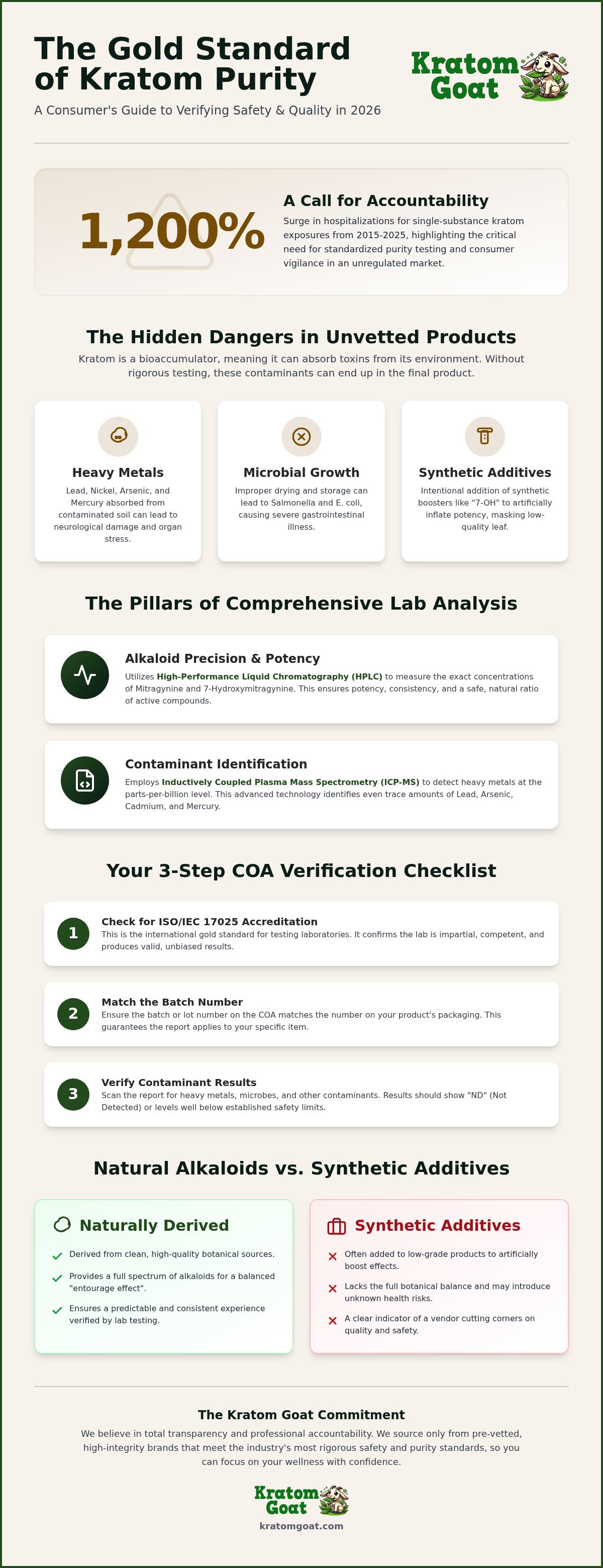
Did you know that hospitalizations for single-substance kratom exposures surged by 1,200% between 2015 and 2025? This alarming statistic isn't an indictment of the plant itself, but a wake-up call regarding the critical importance of standardized kratom purity testing in a complex market. As we move through 2026, the burden of safety has shifted to the informed consumer who demands total transparency and professional accountability from every vendor.
You're right to feel concerned about what's actually inside your tablets or liquids. Between the fear of lead or nickel contamination and the rise of synthetic "7-OH" boosters, the industry can feel like a minefield of technical jargon and hidden risks. You deserve a product that empowers your lifestyle without compromising your physical safety. We believe that professional rigor and meticulous sourcing are the only ways to establish true consumer trust and long-term reliability.
This guide will teach you how to verify the safety of your products by decoding complex lab reports and identifying the gold standards of third-party verification. We provide a clear checklist for verifying purity, explain the vital difference between natural and synthetic alkaloids, and highlight why brands like 7OHMZ and Hydroxie lead the market in uncompromising quality control.
Key Takeaways
- Understand why independent validation is non-negotiable for identifying soil-based toxins and heavy metals in botanical products.
- Learn to navigate the four pillars of kratom purity testing, including precision alkaloid profiling and parts-per-billion heavy metal screening.
- Master the process of verifying a Certificate of Analysis by checking for ISO/IEC 17025 accreditation and matching batch numbers to your specific delivery method.
- Identify the critical safety differences between naturally derived alkaloids and the synthetic additives often found in low-grade retail products.
- Gain the confidence to select only high-integrity, pre-vetted brands like Hydroxie and 7OHMZ that meet the industry's most rigorous safety standards.
The Critical Necessity of Kratom Purity Testing in 2026
In 2026, the definition of quality has evolved beyond simple aesthetics. Professional kratom purity testing is the baseline requirement for consumer safety. This process involves the independent validation of alkaloid content and the absolute absence of environmental toxins. As the global market for Mitragyna speciosa extracts is valued at 244.7 million dollars this year, the demand for high-potency products has never been higher. This shift toward concentrated extracts necessitates a higher level of rigor in kratom purity testing protocols. In-house testing is insufficient; the gold standard remains third-party verification from ISO-accredited laboratories that provide unbiased results.
The botanical nature of this plant makes it uniquely susceptible to its environment. Because it's a bioaccumulator, it absorbs elements from the soil and water with remarkable efficiency. This means that even the most traditionally harvested leaf can contain hazardous levels of heavy metals if the growing conditions aren't strictly monitored. Relying on "natural" labels isn't enough. You need the assurance that comes from professional, third-party scrutiny to ensure your wellness journey remains safe and effective.
Why "Natural" Doesn’t Always Mean Safe
The "all-natural" label often masks a complex reality. Environmental conditions in Southeast Asia can introduce significant variables into raw leaf quality. Heavy metals like lead and nickel are often present in volcanic soil and are easily absorbed by the plant. Improper drying and storage in humid climates also lead to rapid microbial growth. Modern consumers must prioritize 7-hydroxymitragynine purity, ensuring that high-potency extracts are derived from clean sources rather than synthetic shortcuts. We don't accept compromises on these standards.
The Risks of Unvetted Botanical Products
Ingesting unvetted botanical products carries severe health implications. Chronic exposure to lead or arsenic can lead to neurological damage and significant organ stress. Poorly processed powders are also frequent vectors for salmonella and E. coli, which cause acute gastrointestinal distress. Adulteration is the intentional addition of chemicals or synthetic boosters to artificially enhance a product's effects. We reject these shortcuts, focusing instead on meticulous sourcing and transparent reporting to protect your well-being and maintain our position as a high-standard provider.
The Four Essential Pillars of Comprehensive Lab Analysis
To achieve a gold standard in consumer safety, professional laboratories rely on four specific analytical pillars. These pillars provide a complete profile of the product's chemical makeup and safety status. Rigorous kratom purity testing is not a single check but a multi-layered verification process. It begins with identifying what is present in the plant and ends with confirming what has been successfully removed during processing. This methodical approach ensures that every tablet or liquid extract meets the high expectations of a discerning audience.
Alkaloid Precision and Potency
Precision is the hallmark of professional sourcing. Laboratories utilize High-Performance Liquid Chromatography (HPLC) to measure the exact concentrations of active compounds. This ensures the ratio of Mitragynine to 7-Hydroxymitragynine remains within natural, safe parameters. Consistency across different production cycles is a primary indicator of a reputable kratom supplier. Beyond the primary two, testing must also account for secondary alkaloids. These minor compounds contribute to the "entourage effect," which characterizes the full-spectrum experience many users seek. We prioritize brands that maintain this delicate botanical balance without relying on artificial spikes.
Contaminant Identification Protocols
Detecting environmental impurities requires advanced technology. Inductively Coupled Plasma Mass Spectrometry (ICP-MS) is the industry standard for detecting heavy metals at the parts-per-billion level. This technology identifies even trace amounts of Lead, Arsenic, Cadmium, and Mercury. Because the market remains largely unregulated, as noted in the DEA Drug Fact Sheet, third-party labs must enforce their own "Pass/Fail" thresholds. These limits are typically aligned with the American Kratom Association (AKA) standards to ensure long-term wellness. Additionally, shelf-life testing is conducted to verify that kratom purity testing results remain valid throughout the product's entire period of viability.
Microbiological safety and chemical residue checks complete the safety profile. Pathogens such as Salmonella, E. coli, and various molds can thrive in poorly handled botanical matter. Professional labs screen for these biological threats to prevent acute illness. For extract-based products, testing for pesticide and solvent residue is equally vital. This ensures that no industrial chemicals from the extraction process, such as ethanol or CO2, remain in the final delivery format. You can explore our vetted product selection to see how these rigorous pillars translate into premium consumer offerings.
How to Verify a Kratom Certificate of Analysis (COA) Before You Buy
Professional kratom purity testing is only as good as the document that proves it. A Certificate of Analysis (COA) is your primary defense against contamination and mislabeling. It is a verifiable record of a product's chemical identity and safety profile. However, simply seeing a QR code on a bottle is not enough. You must know how to audit the information provided to ensure it meets the rigorous standards we demand for our community. Verification is your responsibility, and it starts with the lab's credentials.
Always verify the laboratory's identity first. A credible report must come from an independent, third-party facility with ISO/IEC 17025 accreditation. This certification ensures the lab follows international standards for accuracy and reliability. Next, match the batch number on your packaging directly to the COA. Whether you are comparing kratom tablets vs capsules, the specific lot code must be identical. If the numbers don't match, the testing is irrelevant to the product in your hand. Finally, analyze the date of the report. Results should be recent, typically within the last 6 to 12 months, to reflect current stock integrity.
The Anatomy of a Professional Lab Report
A professional report follows a predictable structure. The header should clearly state the brand name, the sample description, and the laboratory's contact information. You will often see a "Limit of Quantitation" (LOQ) listed next to the actual result. The LOQ is the lowest concentration the lab's equipment can reliably detect. For heavy metals and pesticides, the gold standard is "Non-Detect" (ND) status. This indicates that any presence of toxins is below the detectable limit. For those focusing on potency, our guide to reading a kratom certificate of analysis provides a visual breakdown of where to find 7-Hydroxymitragynine levels to ensure they align with natural botanical ratios.
Detecting Forged or Altered COAs
The Mayo Clinic safety guide highlights that unvetted products frequently contain harmful germs and heavy metals. This reality makes spotting forgeries essential. Be wary of reports that appear blurry, lack official lab signatures, or show signs of "cut and paste" batch numbers. These are immediate red flags. If a report looks suspicious, don't hesitate to contact the testing facility directly to verify the sample ID. Transparency is the ultimate differentiator for premium brands. High-integrity partners welcome this scrutiny because their kratom purity testing processes are built to withstand it. We take pride in this level of detail because your confidence is our greatest asset.
Beyond Heavy Metals: Identifying Synthetic Additives and Adulterants
While heavy metal screening serves as a baseline for safety, modern kratom purity testing must now address the sophisticated threat of synthetic adulteration. The 2026 market has seen a surge in concentrated 7-hydroxymitragynine (7-OH) products, making it vital to distinguish between botanical extracts and lab-synthesized mimics. In July 2026, the DEA announced its intent to temporarily schedule synthetic and concentrated 7-OH, a move specifically targeting artificial boosters rather than naturally occurring leaf alkaloids. This regulatory shift highlights why naturally derived extracts are superior. They maintain the plant's biological integrity without the risks associated with unlisted chemical additives. High potency is not a sign of impurity; rather, elite extraction processes often yield a cleaner product by meticulously removing plant waxes and fats.
Industry leaders like OPMS gold capsules have set the standard for purity through specialized cold-water extraction methods. These processes preserve the natural alkaloid profile while ensuring the final product is free from industrial solvents. By focusing on precision rather than shortcuts, premium brands provide a level of reliability that generic alternatives cannot match. Meticulous expert curation is the only way to navigate a market where chemical "boosters" are often hidden behind vague labels.
The 7-OH Purity Standard
Isolating 7-hydroxymitragynine presents significant extraction challenges that require professional-grade equipment. The benchmark for this precision is found in 7OHMZ tablets, which utilize advanced chromatography to ensure every tablet meets strict potency requirements without synthetic interference. Rigorous kratom purity testing for these products specifically screens for dangerous adulterants like O-desmethyltramadol, which have no place in a high-integrity botanical product. We prioritize brands that can prove the absence of these substances through transparent, verifiable data.
Spotting "Gas Station" Red Flags
The difference between a premier provider and a low-grade retail outlet is often visible on the packaging. Professional products feature clear, QR-coded lab results and detailed alkaloid breakdowns. In contrast, "gas station" products often rely on generic, opaque labeling and "proprietary blends" that hide the true contents of the product. These unvetted blends pose a significant risk to purity and consumer safety. High-quality testing is an expensive, technical process; therefore, the retail price is often a direct reflection of the cost of ensuring your safety. We believe that transparency is not an option but a requirement. Secure your peace of mind by browsing our vetted selection of pure kratom extracts today.
The Kratom Goat Commitment: Sourcing Vetted Excellence
Kratom Goat stands as the premier authority in a market that demands absolute transparency. We operate as a serious curator, assuming the responsibility of vetting every product so you don't have to. Our inventory is not a random collection of botanical goods; it's a meticulously selected portfolio of elite brands. Every item we carry has passed a rigorous kratom purity testing protocol to ensure it meets our uncompromising standards for reliability and safety. This assertive approach to quality control positions us as a high-standard provider for a discerning audience that values professional rigor.
Our selection process is methodical and exhaustive. We only partner with manufacturers that demonstrate a palpable pride in their own production methods. For instance, the Hydroxie liquid extract in our collection is chosen for its precision and consistent alkaloid profile. We verify that these brands utilize independent, accredited laboratories to eliminate any risk of contamination. With over 2,000 reviews and high quality ratings, our community provides the real-world validation that confirms our commitment to excellence. Choosing a specialist like Kratom Goat over a generalist shop ensures you're supported by experts who understand the technical nuances of 7-OH precision and botanical integrity.
Our Vetted Brand Portfolio
Our portfolio represents the gold standard of the industry. We carry names like 7OHMZ, Press’d, and Krave because these entities have proven their dedication to natural purity and professional manufacturing. We ensure all stock is fresh and currently batch-tested, maintaining a rhythmic flow of high-quality products. This focus on kratom purity testing transforms our store into a safe haven for enthusiasts who refuse to settle for unvetted retail options. We provide a steady, reliable presence in an evolving market, ensuring that every purchase is backed by verifiable data and expert oversight.
Safe Shopping and Quality Assurance
Our commitment to integrity extends from the lab to your doorstep. We utilize secure shipping methods and discreet packaging to protect the physical and chemical integrity of your order. This ensures that the standards established during the extraction process remain intact until the product reaches you. We invite you to join our newsletter to stay informed about the latest purity updates and evolving industry standards. This transparency empowers you to make self-assured decisions about your wellness journey. Shop our fully lab-tested kratom collection today and experience the confidence that comes from partnering with a high-integrity leader.
Secure Your Wellness with Verifiable Standards
The evolution of the kratom market in 2026 demands a higher level of consumer vigilance. You now possess the analytical tools to audit certificates of analysis and identify the four pillars of comprehensive safety. Professional kratom purity testing isn't just a hurdle for manufacturers; it's the foundation of your confidence and peace of mind. By rejecting unvetted retail products and demanding naturally derived alkaloids, you prioritize your long-term health and empower your lifestyle with precision-grade botanical extracts.
We take pride in our role as your meticulous expert and transparent partner. Our selection process is uncompromising, ensuring that every product in our inventory meets the industry's most rigorous standards. With over 2,000 verified customer reviews and an exclusive list of vetted premium brands, we provide the reliability you deserve. Every offering is guaranteed free from synthetic additives, allowing you to focus on the physical and emotional outcomes of your experience.
Browse Our Curated Selection of Lab-Tested Kratom
Step forward with the assurance that only elite, third-party verification can provide. Your commitment to quality is our shared mission.
Frequently Asked Questions
What is the most important thing to look for in kratom purity testing?
The most critical factor is ISO/IEC 17025 accreditation of the testing facility. This certification guarantees that the laboratory adheres to international standards for technical competence and valid results. You must verify that the lab is independent from the brand to avoid conflicts of interest. Comprehensive results should include both alkaloid potency and a full contaminant screen for heavy metals, pathogens, and residual solvents used during the extraction process.
Can I trust a kratom brand that does not show a Certificate of Analysis?
No, you shouldn't trust any brand that fails to provide a verifiable Certificate of Analysis (COA). A lack of transparency is a significant red flag in the botanical market. Without a COA, there's no professional proof that the product is free from lead, arsenic, or synthetic additives. Elite brands like 7OHMZ and Hydroxie lead the industry by making these documents easily accessible to every consumer through QR codes.
Does "third-party tested" mean the same thing for all kratom brands?
The scope of the analysis can vary significantly between different companies. While some brands only verify mitragynine content, elite providers conduct comprehensive kratom purity testing that includes heavy metals, pesticides, and microbiological pathogens. You must review the actual lab report to confirm the specific contaminants the lab screened for. Professional rigor requires a full-spectrum analysis rather than a surface-level potency check to ensure total safety.
How often should a kratom batch be tested for purity?
Testing must occur for every unique production batch or lot number to ensure consumer safety. A single lab report from a year ago doesn't guarantee the purity of a product manufactured today. Professional standards require that the date on the Certificate of Analysis is recent, typically within the last 6 to 12 months. This consistent cycle of validation is the only way to maintain a reliable and safe experience for the user.
What are the specific heavy metals that are dangerous in kratom?
Lead, arsenic, cadmium, and mercury are the primary elemental impurities that labs screen for during kratom purity testing. Because the plant is a bioaccumulator, it easily absorbs these toxins from the soil and water in Southeast Asia. Professional labs use Inductively Coupled Plasma Mass Spectrometry (ICP-MS) to detect these metals at the parts-per-billion level. This technology ensures that any presence of heavy metals remains well below established safety thresholds.
Is 7-Hydroxymitragynine more likely to be contaminated than regular kratom?
Concentrated 7-OH isn't inherently more contaminated, but the isolation process requires significantly higher technical rigor. If a manufacturer uses low-grade extraction methods or industrial solvents without proper purging, the risk of chemical residue increases. This is why sourcing from expert curators is vital. Professional brands utilize advanced chromatography to ensure their 7-hydroxymitragynine tablets or liquids remain pure, natural, and free from synthetic mimics or unlisted "booster" chemicals.
How do I verify if a QR code on a kratom package is legitimate?
Scan the code and confirm that it leads directly to an independent laboratory's official domain. It shouldn't simply redirect to the vendor's homepage or a generic PDF hosted on a private server. Once on the lab's site, match the batch number printed on your product packaging to the one listed on the digital report. If the lab name, batch number, or date don't align perfectly, the report is not valid.
Why does Kratom Goat only carry specific brands?
We operate as a serious curator, selecting only high-integrity brands like 7OHMZ, Hydroxie, and Press'd. Our selective process and commitment to kratom purity testing ensure that we don't carry low-grade or unvetted products. We prioritize brands that demonstrate professional rigor and a palpable pride in their manufacturing. This focused portfolio allows us to maintain a steady, reliable presence for customers who value transparency and meticulous sourcing above all else.