

Kratom Potentiation Techniques: What to Know About Safety and Risk
Could trying to make kratom feel stronger make its effects less predictable instead? If you’ve found conflicting advice online, caution is warranted. Claims about kratom potentiation techniques often rely on personal anecdotes, which can’t reliably predict how a particular product or combination will affect you.
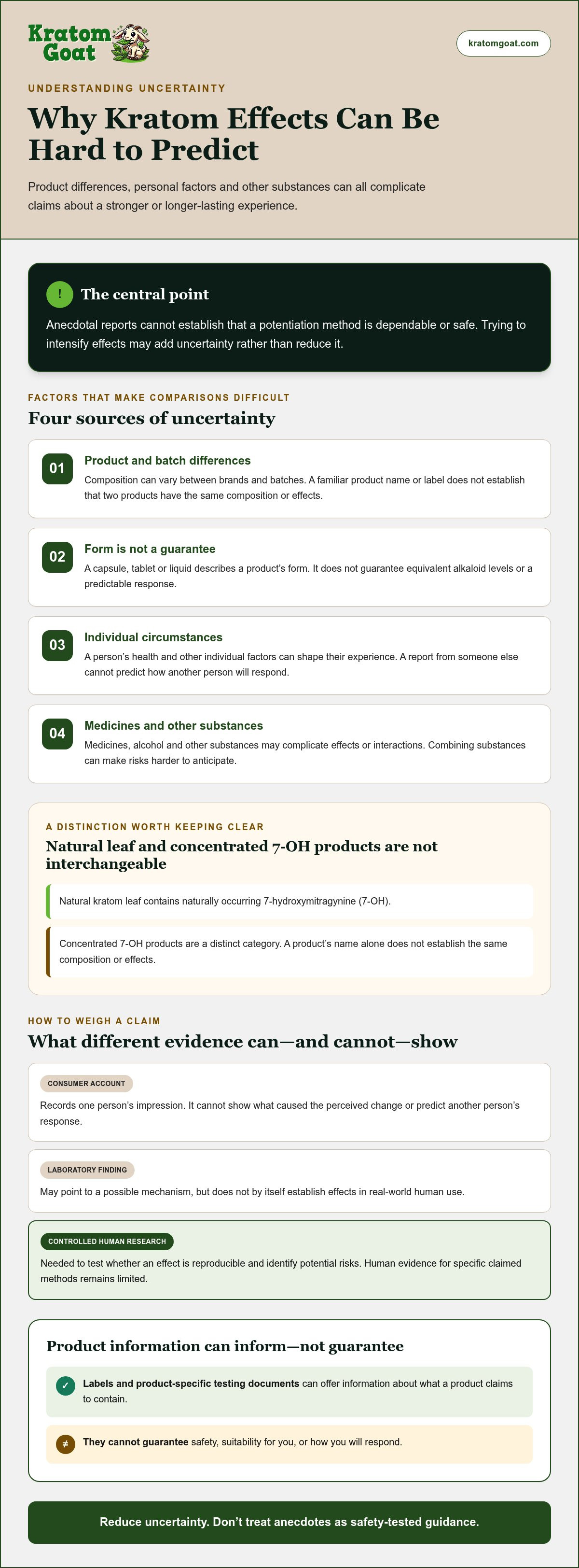
The safer priority isn’t intensifying effects. It’s reducing uncertainty. Kratom’s composition and effects can vary, and it may interact with medicines or other substances in ways that increase risk. Combining substances to seek a stronger effect can make those risks harder to anticipate.
This guide explains what people mean by potentiation, why popular claims don’t establish a safe or dependable method, and which factors can raise the chance of harm. You’ll also learn how to read product information, why avoiding combinations can be prudent, and what warning signs call for urgent help. The central takeaway is clear: don’t treat an anecdotal technique as a safety-tested way to change kratom’s effects.
Key Takeaways
- Kratom potentiation techniques are often discussed through personal anecdotes, which can’t establish reliable effects or safety.
- A product’s form or label alone doesn’t guarantee consistent composition across brands or batches.
- Avoid combining kratom with medicines, alcohol, or other substances without professional guidance.
- Focus on reducing uncertainty rather than trying to intensify effects.
- A certificate of analysis may offer product information, but it can’t guarantee safety or suitability for you.
What Are Kratom Potentiation Techniques, and Why Do People Seek Them?
Online discussions often promise a stronger or longer-lasting experience. That can sound appealing when you’re unsure what to expect, especially when different accounts recommend different approaches. But reported effects aren’t guarantees, and trying to intensify them can add uncertainty rather than clarity.
In general, potentiation means an attempt to make a substance’s effects feel stronger or last longer. In kratom discussions, kratom potentiation techniques refers to claimed ways to change the experience. This article won’t provide enhancement recipes. It will help you assess such claims cautiously and understand why an anecdote isn’t a dependable guide.
What does potentiation mean in kratom discussions?
The term describes an intended effect, not proof that a particular method works. Someone might report that an experience felt stronger after making a change, but that alone can’t show the change caused the difference or that another person would respond the same way. Stronger or longer-lasting effects should not be assumed to be beneficial, predictable, or safe.
Kratom comes from the plant Mitragyna speciosa. Experiences may differ with the product, the individual, and other substances involved. A familiar form or label can’t establish that one product has the same composition or effects as another product or batch. These differences make simple comparisons difficult.
Why can online potentiation advice be misleading?
Personal testimonials describe what someone believes happened to them. They aren’t controlled clinical evidence, which is needed to examine effects systematically and distinguish a real relationship from coincidence or other influences. A post may leave out important context, including the exact product, its amount or strength, the person’s health, and any medicines or other substances involved.
Without those details, readers can’t reliably compare accounts. A reported stronger experience also can’t prove a repeatable interaction. An approach that seemed to affect one person may have no similar effect for someone else, or may carry risks the account doesn’t mention.
Anecdotal reports cannot establish safety. Treat confident online claims as unverified, not as personalized guidance. Curiosity is understandable, but caution matters more than chasing intensity. Ask what’s known, what remains uncertain, and how to avoid adding preventable risk.
Why Kratom Potentiation Claims Can Produce Unpredictable Effects
A label can tell you a product’s stated form, but it doesn’t mean products from different brands or batches have identical composition. Plant-derived leaf products and concentrated products are not interchangeable categories. Formulation and alkaloid content can differ, while individual factors also shape how someone experiences a product. These variables make claims about kratom potentiation techniques difficult to evaluate or generalize.
Concentrated 7-hydroxymitragynine (7-OH) products should also be distinguished from natural kratom leaf, which contains naturally occurring 7-OH. The name alone doesn’t tell you that products have the same composition or effects. For more on this distinction, see our 7-hydroxymitragynine science and standards guide.
Why products and personal responses can differ
Even two products in the same broad format may differ in composition. A capsule, tablet, or liquid describes a form, not a guarantee of equivalent alkaloid levels or a predictable response. Label details can help you understand what a product claims to contain, but they can’t establish how you will respond.
Individual health factors and the use of medicines, alcohol, or other substances may further complicate the picture. Combining substances can create additional uncertainty. A report that someone felt a stronger effect doesn’t demonstrate that an interaction is consistent or safe.
What can research establish about potentiation?
Evidence needs to be interpreted by type. A consumer account records an individual’s experience; a laboratory finding may point to a possible mechanism. Neither, on its own, establishes how a method affects people in real-world use. Controlled human research is needed to test whether an effect is reproducible and identify potential risks.
Evidence limits are clear: the FDA’s kratom overview describes agency concerns and warnings, but it doesn’t establish that consumer potentiation claims are predictable or safe. Human evidence for specific claimed methods remains limited. See FDA warnings on kratom.
For practical product information, read the label and any available product-specific testing documentation rather than relying on claims about stronger effects. You can review kratom product listings to examine product labels. Transparency can inform a choice, but it can’t rule out individual risks or interactions.
Common Kratom Potentiation Claims: What to Question
Online discussions can make a claim feel established simply because it appears often. Repetition isn’t evidence. A popular account may reflect one person’s impression, not a reliable effect or a safe approach for others. Judge claims about kratom potentiation techniques by the quality of the evidence, not the number of posts.
Does a stronger reported effect prove a method works?
Not by itself. Self-reports can be influenced by expectations, memory, and changes a person may not have measured, such as differences between products or batches. Even an honest account can’t establish what caused the perceived change or predict another person’s response.
The table below separates common claim types from what they can actually establish:
| Claim type | Evidence limitations | Safer interpretation |
|---|---|---|
| “I felt a stronger effect, so this approach works.” | A personal report may not account for expectations, memory, product differences, or other factors. | Treat it as one person’s experience, not a dependable prediction. |
| “A proposed mechanism explains why the effect should increase.” | A plausible explanation or laboratory finding does not by itself demonstrate a predictable effect in people. | Look for relevant, controlled human evidence before treating the claim as established. |
| “It’s natural, so combining it is safe.” | Natural origin does not rule out interactions or other risks. A testimonial cannot confirm safety. | Don’t assume a combination is safe based on the ingredient’s source or popularity. |
Does natural mean safe to combine?
No. A plant-derived substance can still affect the body and may interact with medicines or other substances. The absence of a reported problem in an online post doesn’t prove a combination is safe. Risks may be unrecognized, unreported, or different for another person.
If you take medication or have health concerns, speak with a qualified healthcare professional before using kratom or combining it with anything else. Forum advice can’t assess your individual risk. Careful reading helps, but it can’t replace professional guidance tailored to your circumstances.
Reducing Risk Instead of Intensifying Kratom Effects
The safer response to uncertainty is not to experiment with ways to make effects stronger or last longer. These steps focus on reducing avoidable risk, not on finding or testing kratom potentiation techniques.
- 1. Avoid combinations. Don’t combine kratom with medicines, alcohol, or other substances unless a qualified healthcare professional has advised you about your situation. A product’s natural origin doesn’t rule out interactions.
- 2. Don’t experiment to extend or intensify effects. Online claims aren’t a reliable basis for trying combinations or changing how you use a product.
- 3. Read and retain product information. Keep the packaging or a clear photo of the label. Note the product name, form, and any listed ingredients or alkaloid information so you can share accurate details during a healthcare discussion.
- 4. Pause if you’re concerned. If you notice a troubling reaction, don’t take more while seeking guidance from a qualified healthcare professional. This article can’t determine the cause of symptoms or assess your personal risk.
- 5. Share relevant details. Be ready to explain what product was used, when it was taken, and whether medicines or other substances were involved.
When should someone seek urgent help?
Act promptly if symptoms are severe or rapidly worsening. Seizures, difficulty breathing, or loss of consciousness require emergency assistance. If someone is unresponsive or in immediate danger, contact emergency services rather than waiting to see whether the situation improves.
Give medical responders the product packaging, label, or a photo if available. Share what was taken and any other medicines or substances involved, as accurately as you can. Clear details can help responders assess the situation, but don’t delay emergency care to gather them.
For non-emergency questions about medication or a health condition, speak with a qualified healthcare professional before using kratom. To review product information, you can read kratom product labels and descriptions. Product details can support informed questions, but they can’t establish that a product is safe for you or prevent an adverse reaction.
Choosing Transparent Kratom Products Without Chasing Potency
A responsible product choice starts with information, not a promise of stronger effects. Transparency can help you understand what a label or test document says, but it can’t tell you how you’ll respond or eliminate uncertainty. No claim about kratom potentiation techniques should be treated as proof of a reliably safe or effective way to intensify effects.
What can product testing documentation tell you?
A certificate of analysis (COA) is a laboratory report for a sample. If available, check whether it identifies the product or batch, when the sample was tested, what testing covered, and which analytes were measured. A report’s value depends on its scope: results for certain compounds or contaminants don’t address every possible concern, and a document may not represent every batch.
A COA is useful context, not a safety guarantee. It can’t establish that a product is suitable for a particular person, predict effects, rule out interactions, or prove that using it is risk-free. Kratom Goat emphasizes lab testing for its kratom products. Interpret any product-specific documentation according to what it actually reports, rather than treating “lab-tested” as a blanket assurance.
For a clearer framework for reading these reports, see the guide to reading a kratom certificate of analysis. Focus on the report’s date, scope, and results, and note what it doesn’t cover.
What should the reader take away?
There’s no basis for treating a potentiation claim as a dependable method. A more informed approach is straightforward: avoid combining kratom with medicines, alcohol, or other substances without professional guidance; read the label and available product information; and speak with a qualified healthcare professional if you have medication or health concerns. If you experience a concerning reaction, pause use and seek appropriate help. Severe or rapidly worsening symptoms require emergency assistance.
Choose transparency over intensity. Kratom Goat sells kratom products in different forms and emphasizes lab testing, but product information doesn’t promise predictable effects or personal suitability. To understand what a COA can and can’t show, review the linked guide before drawing conclusions from a testing claim.
Choose Clarity Over Intensification
Online claims about kratom potentiation techniques can sound persuasive, but anecdotes don’t establish predictable effects or safety. Product composition and individual responses vary, so trying to intensify or extend effects may add uncertainty rather than resolve it.
A more careful path is to avoid combining kratom with medicines, alcohol, or other substances without professional guidance, and to read product labels closely. Product-specific testing documentation can provide useful information about what was tested, but it can’t guarantee safety, suitability, or a particular experience.
Kratom Goat describes its products as lab-tested. Review available product and testing information with a clear understanding of what the documentation does and doesn’t show. Review Kratom Goat’s product and testing information before making an informed choice.
Prioritize transparency, ask a qualified healthcare professional about personal health or medication concerns, and seek urgent help for severe symptoms. Caution is a practical choice, and informed decisions put you on firmer ground.
Frequently Asked Questions
What are kratom potentiation techniques?
Kratom potentiation techniques are methods people claim can make kratom’s effects feel stronger or last longer. Online discussions often rely on personal reports, which can’t establish predictable results or safety. A reported experience doesn’t prove a method works for others. This guide doesn’t recommend recipes or combinations. The safer focus is understanding uncertainty, avoiding risky experimentation, and seeking qualified guidance about medication or health concerns.
Do kratom potentiation techniques actually work?
Personal accounts may describe perceived changes, but anecdotes alone can’t show that a method reliably causes them. Product composition, individual responses, expectations, and other substances can all complicate comparisons. A single experience can’t predict another person’s response. Even if someone reports a stronger effect, that doesn’t establish that the method is safe, predictable, or appropriate for anyone else. Treat online claims cautiously rather than as proven guidance.
Is it safe to combine kratom with other substances to increase its effects?
Combining kratom with medicines, alcohol, or other substances can make effects less predictable and may increase risk. No combination should be assumed universally safe based on an online account. If you take medication or have health concerns, discuss kratom use with a qualified healthcare professional before combining substances. Don’t experiment to intensify effects. Seek emergency help if symptoms are severe, rapidly worsening, or create immediate danger.
Can grapefruit or other foods potentiate kratom?
Online claims about grapefruit or other foods don’t establish a dependable effect or a safe interaction. Their popularity isn’t proof, and claims may not apply consistently across products or people. Don’t treat these discussions as instructions for changing kratom’s effects. Combining substances can add uncertainty. If you take medication or have a health concern, ask a qualified healthcare professional before making changes to your use or routine.
Are kratom extracts and 7-hydroxymitragynine products the same as traditional kratom?
No. They shouldn’t be treated as interchangeable categories. Products can differ in formulation and composition, and concentrated 7-hydroxymitragynine products aren’t simply equivalent to traditional kratom products. A finding about one type may not apply to another. Read product information carefully and rely on current, credible evidence rather than assumptions based on a shared name or format. Product differences don’t establish predictable effects or personal suitability.
What should I do if I feel unwell after taking kratom?
Don’t take more kratom or another substance to try to change the effects. For severe or rapidly worsening symptoms, or immediate danger, contact emergency services. For other concerning reactions, seek prompt guidance from a qualified healthcare professional or poison-control service. Share the product packaging and details about what was taken, including any medicines or other substances. If someone is unresponsive or having difficulty breathing, treat it as an emergency.