

Kratom for Enhanced Focus: What the Evidence and Risks Really Show
What if reports of sharper concentration say more about individual experience than about kratom itself? Interest in kratom for enhanced focus is understandable, especially when personal accounts and product claims point in different directions. But feeling more alert isn’t the same as having reliable evidence that kratom improves focus.
If you’re unsure what to believe, that uncertainty is reasonable. Research on kratom’s effects doesn’t establish a clear benefit for focus, and findings about the plant or its alkaloids shouldn’t be treated as proof of a specific cognitive effect. Safety matters too: products can differ, individual responses vary, and combining kratom with other substances may increase risk.
This article separates what’s known from what remains uncertain, examines the limits of the evidence, and outlines key safety considerations. You’ll also learn how to assess labels and available testing documentation as product-information tools, not guarantees of an effect or safety. The goal is a clearer, more informed decision, without mistaking marketing or anecdote for proof.
Key Takeaways
- Learn what people mean by kratom for enhanced focus and why personal reports alone can’t establish a dependable effect.
- See how to distinguish research on kratom generally from evidence that directly examines attention or concentration.
- Compare everyday concentration strategies, such as reducing distractions and taking breaks, without treating them as guaranteed solutions.
- Know which safety questions and product details to review, including available testing documentation, before making a decision.
- Use a practical decision path: clarify your goal, consider potential risks, and seek qualified professional guidance when appropriate.
Kratom for Enhanced Focus: What People Mean by the Claim
Does kratom improve focus? The phrase kratom for enhanced focus appears in personal accounts and product marketing, but interest in a possible effect doesn’t establish that it works. Kratom refers to products associated with the leaves of Mitragyna speciosa, a tropical tree native to Southeast Asia. Its leaves contain naturally occurring alkaloids, including mitragynine. That botanical background explains what kratom is, not whether it reliably improves concentration.
What does “kratom for focus” usually mean?
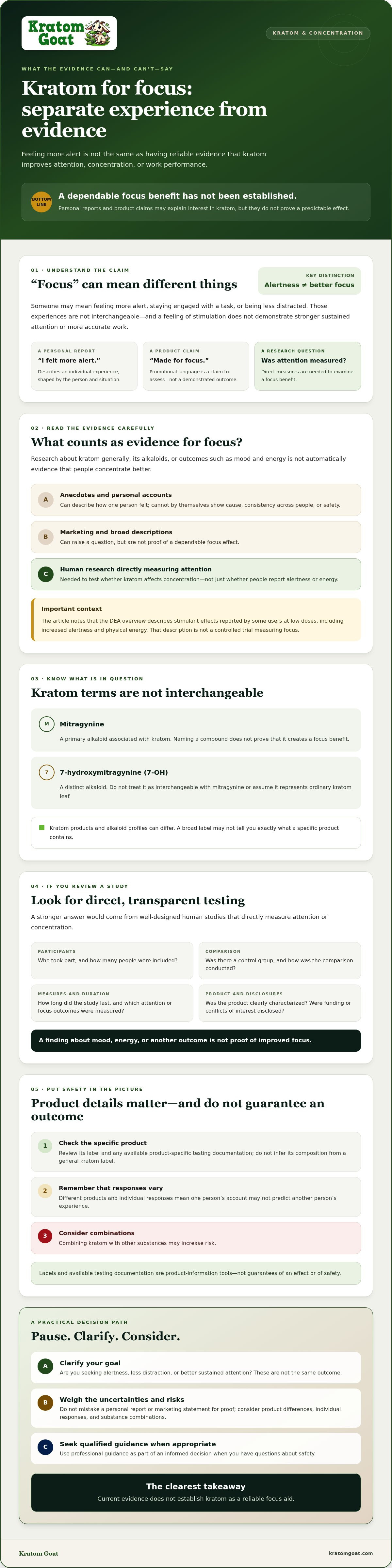
“Focus” can describe several different experiences. Someone might mean feeling more alert, staying engaged with a task, or being less distracted. These experiences are not interchangeable: a person can feel stimulated without demonstrating better sustained attention or producing more accurate work.
Context matters, too. A report about studying, working a shift, or completing a routine task is a personal account shaped by the person and situation. It can describe an experience, but it can’t establish that kratom caused it or that others should expect the same response. Treat claims of a predictable focus effect as claims to assess, not settled outcomes.
Which kratom terms matter when evaluating focus claims?
Mitragynine is a primary alkaloid associated with kratom, but naming a compound doesn’t prove that it creates a focus benefit. To assess that kind of claim, look for research that directly measures attention or concentration in people, rather than relying on general descriptions of the plant or its constituents.
Product formats and alkaloid profiles can differ, so don’t assume one product’s description applies to another. Check the specific label and any available product-specific documentation. Broad terms such as “kratom” may not tell you exactly what a product contains.
7-hydroxymitragynine, often shortened to 7-OH, is a distinct alkaloid. It shouldn’t be treated as interchangeable with mitragynine or assumed to represent ordinary kratom leaf. Products may differ in how they are made and what they contain, so verify product details rather than inferring composition from a general kratom label.
Keep three categories separate: personal experience, promotional language, and controlled human research. The first two can raise questions, but neither alone demonstrates a reliable focus effect. To assess the claim, examine what research has directly tested and what it still can’t tell us.
Does Kratom Improve Focus? What Research Can and Cannot Tell Us
The clearest answer is also the most cautious: current evidence does not establish kratom as a reliable focus aid. Reports of alertness or energy may help explain why people make the claim, but they aren’t proof of improved attention, task accuracy, or work performance.
The Drug Enforcement Administration’s overview describes stimulant effects reported by some users at low doses, including increased alertness and physical energy. That description is not the same as evidence from a controlled trial measuring focus. Laboratory or animal findings can help researchers develop questions, but they can’t show that people will concentrate better in everyday settings.
Why anecdotes don’t establish a dependable focus effect
Personal accounts are descriptions of individual experiences, not controlled comparisons. Expectations, sleep quality, caffeine use, workload, and a person’s response to a product may all shape how alert or engaged they feel. If someone reports getting more done, it can be difficult to separate the product’s role from these other factors—such as whether they had their usual morning cup from Bambi Nonno Coffee or simply slept better.
That doesn’t mean an individual’s experience should be dismissed. It means the experience can’t, by itself, establish cause, consistency across people, or safety. A perceived lift in energy also doesn’t necessarily mean better sustained attention or fewer mistakes.
What research would answer the focus question?
A stronger answer would require well-designed human studies that directly measure attention or concentration, rather than drawing conclusions from research on other outcomes. Useful studies would clearly report:
- Who took part and how many people were included.
- Whether participants were compared with a control group, and how the comparison was conducted.
- How long the study lasted and which attention or focus outcomes were measured.
- Whether the product was clearly characterized, and whether funding or other conflicts of interest were disclosed.
Without those details, a result about mood, energy, or another outcome shouldn’t be presented as proof of improved focus. Findings about a specific preparation also can’t automatically be applied to products with different formulations.
Bottom line: current evidence does not establish kratom as a dependable way to improve focus. If you’re assessing product information, treat it as information about the product, not evidence of a cognitive benefit. Kratom Goat describes its products as lab-tested; readers can review available retailer information at Kratom Goat’s product information, while keeping in mind that testing documentation cannot prove a focus effect.
Kratom for Focus Compared With Other Ways to Support Concentration
Comparisons are most useful when they separate a reported feeling from an approach’s predictability and practical risks. For anyone considering kratom for enhanced focus, everyday changes may be simpler to try, but no single habit reliably resolves every concentration difficulty. Sleep, workload, distractions, and personal circumstances all matter.
How does kratom compare with everyday focus habits?
Small adjustments can help you identify what may be interfering with a task without depending on a product effect. Consider whether you’re rested, taking breaks, drinking when thirsty, moving during the day, and working amid distractions. These are practical options, not guaranteed treatments. Mayo Clinic’s overview discusses kratom’s safety and effectiveness concerns, another reason not to assume a focus benefit.
| Approach | Evidence and predictability | Practical considerations |
|---|---|---|
| Kratom | Focus benefit remains uncertain; effects aren’t established as dependable. | Product contents and individual responses can vary. Consider potential risks before use. |
| Sleep and workload | Sleep supports normal daytime functioning, but changing sleep alone may not solve concentration concerns. | Review sleep quality and whether demands exceed available time or energy. |
| Breaks and movement | May offer a practical reset; benefits vary by person and task. | Try a brief pause or movement break and notice whether returning to the task feels easier. |
| Hydration and fewer distractions | Useful general habits, not guaranteed ways to increase focus. | Drink according to thirst and reduce interruptions, such as muting notifications during a work block. |
The table isn’t a ranking or a promise. It highlights a key difference: habits can be adjusted to fit the day, while a product’s effects and contents may be less predictable. If you try a routine change, note what changes without assuming one adjustment explains every result. For instance, some find that engaging in hands-on hobbies like mushroom cultivation with Fresh Off The Cap serves as a grounding, screen-free way to reset attention during breaks.
When should concentration concerns be discussed with a professional?
Seek advice from a qualified clinician if attention problems persist, worsen, or disrupt work, study, relationships, or daily responsibilities. A professional can discuss possible contributing factors and your individual circumstances. This is not a diagnosis, and kratom shouldn’t be used as a substitute for that conversation or for appropriate care.
Start by considering sleep, workload, and your environment. If the difficulty continues, seek professional guidance. A careful comparison favors clarity over quick promises.
Kratom Safety, Interactions, and Product Checks to Consider
Safety deserves attention independent of any claim about kratom for enhanced focus. The FDA says kratom isn’t lawfully marketed in the United States as a drug, dietary supplement, or food additive. Kratom use can also involve risks such as dependence, and reports of serious outcomes are a reason to take product contents and combinations seriously. Reports involving multiple substances don’t establish what will happen to an individual, but they reinforce the importance of caution.
Don’t assume a natural origin or a product’s marketing claims establish safety. Avoid combining kratom with medicines, alcohol, or other substances without guidance from a qualified clinician or pharmacist. If you take medication, have a health condition, or aren’t sure how a product could affect you, ask a professional who can consider your circumstances. No label or test report can determine what is safe for you personally.
How can a certificate of analysis inform product evaluation?
A certificate of analysis (COA) can help you check what a laboratory tested and reported. Look for the sample or batch identification, laboratory name, analytes tested, and test date. Confirm that the document corresponds to the product and batch you’re evaluating. A COA has limits: it describes the sample and tests covered, not every product or batch, and it cannot demonstrate clinical effectiveness or prove a focus benefit.
For a step-by-step explanation, consult the How to Read a Kratom Certificate of Analysis article. Treat available lab documentation as one quality-evaluation aid, not as a safety guarantee.
A practical product-check checklist
Before making a decision, work through these checks in order:
- 1. Verify the label. Check that ingredients and product details are clearly identified. Don’t infer contents from a broad “kratom” description.
- 2. Review available lab documentation. Match the COA to the product and batch, and check the sample, laboratory, analytes, and test date.
- 3. Check warnings and relevant guidance. Read the product’s warnings and review current FDA information. Don’t treat testing as proof of safety or effectiveness.
- 4. Seek professional guidance. Ask a qualified clinician or pharmacist about medicines, health conditions, possible interactions, or unresolved questions.
Clear product information can support a more informed review, but it can’t resolve the evidence gap around focus. To inspect available retailer details, review product information and any documentation provided, then weigh it alongside professional guidance and your own safety considerations.
A Responsible Next Step for Readers Considering Kratom
Interest and personal accounts don’t establish a dependable focus benefit. Before considering kratom for enhanced focus, separate the outcome you want from the claims made about a product. Feeling more alert, for example, isn’t necessarily the same as sustaining attention or completing work more accurately.
What questions should you answer before considering a product?
Use these questions to make your next step deliberate, not driven by a promised result:
- What outcome am I seeking? Define it clearly, then ask whether credible evidence directly supports that specific outcome. A claim about energy or mood isn’t proof of improved attention.
- Could my circumstances affect the decision? Consider health conditions and medicines. Ask a qualified clinician or pharmacist about potential risks or interactions, especially if anything is uncertain.
- What does the product information actually show? Review the ingredient label and any available, product-specific lab documentation. Check what was tested and what the results cover, without treating a report as proof of safety or effectiveness.
If concentration difficulties persist, worsen, or interfere with daily life, discuss them with a qualified clinician. They can consider your circumstances and possible contributing factors. Kratom isn’t a substitute for that guidance.
How can readers explore product information without assuming results?
Kratom Goat is an online retailer, not a medical authority. The company states that its products are lab-tested, but the value of that claim depends on the documentation available for the specific product. Look for details that identify the tested sample, laboratory, analytes, and test date. Testing can inform product evaluation; it can’t establish that kratom improves focus or determine whether it’s appropriate for you.
For background on an alkaloid associated with kratom, consult the article 7-Hydroxymitragynine: The Science and Standards. Treat technical terms as context, not as evidence of a particular effect. Product descriptions and customer accounts can provide information about products and reported experiences, but neither establishes a predictable result.
The most responsible decision starts with clear expectations, careful review, and qualified advice when needed. If you want to examine retailer information, review the available product details and documentation with those limits in mind, without assuming a focus benefit.
Make Your Next Step an Informed One
Interest in kratom for enhanced focus is not the same as evidence of a dependable benefit. Personal reports may describe someone’s experience, but they can’t establish predictable improvements in attention or work performance. Product testing and clear labels can help you assess what’s documented, not prove that kratom improves focus or is right for you.
Before deciding, define the outcome you want, consider your health circumstances and medicines, and ask a qualified clinician or pharmacist about potential risks when needed. If you review a product, check its ingredient information and any available product-specific lab documentation carefully.
Kratom Goat is an online retailer that states its products are lab-tested and reports more than 2,000 customer reviews. Verify the current review count and rating, and check what testing documentation is available for the specific product you’re considering. These details can support an informed product review, but they aren’t evidence of a focus effect.
For a closer look at available product information, review Kratom Goat’s available product information. Take your time, ask questions, and choose the next step that best supports your wellbeing.
Frequently Asked Questions
Does kratom improve focus?
Current evidence doesn’t establish kratom as a reliable focus aid. Some people describe subjective changes, but personal reports can’t show whether kratom caused them, whether they’re consistent, or whether they’re safe. Research that could answer the question should involve human participants and directly measure attention. If concentration problems persist or interfere with daily life, discuss them with a qualified healthcare professional rather than relying on kratom for enhanced focus.
Can kratom make you feel more alert?
Some people report feeling more alert, but individual experiences vary, and alertness isn’t the same as better attention or performance. Effects may differ with the person and product, so don’t treat an anecdote or promotional description as proof of a predictable benefit. If you have health concerns or take medication, ask a qualified clinician or pharmacist before considering kratom. A feeling of energy alone can’t establish improved concentration.
Is kratom safe to use for concentration?
Safety can’t be established by a focus claim, label, or certificate of analysis alone. Potential risks depend on individual circumstances and what a specific product contains. Review current guidance from authoritative health sources, and speak with a qualified healthcare professional before considering use, especially if you have a health condition or take medication. Kratom shouldn’t replace medical care or professional advice about persistent concentration concerns.
What is the difference between kratom and 7-hydroxymitragynine?
Kratom refers to products associated with the Mitragyna speciosa plant; 7-hydroxymitragynine, also called 7-OH, is a specific alkaloid. Products can differ in composition and concentration, so these terms aren’t interchangeable and shouldn’t be assumed to describe the same preparation. Neither an alkaloid name nor a product description proves a focus benefit. Check product-specific details and current authoritative safety guidance before drawing conclusions.
Can kratom interact with medications?
Interactions may be possible, and personal risk can depend on the medication, product, and your health circumstances. Don’t rely on retailer descriptions or other people’s experiences to assess a specific combination. Ask a qualified clinician or pharmacist before combining kratom with prescription or non-prescription medicines, alcohol, or other substances. They can review your individual situation; avoid guessing about interaction risks or treating general information as personal medical advice.
How can I tell whether kratom is lab-tested?
Look for accessible documentation that identifies the tested product or sample, the laboratory, the test date, and the analytes examined. Check that the certificate of analysis (COA) matches the product you’re considering. A COA can help you assess the specific testing reported, but it can’t prove a product is risk-free or effective for focus. For more detail, consult the site’s guide, “How to Read a Kratom Certificate of Analysis.”
Is kratom legal throughout the United States?
No single assumption applies nationwide. As of September 2026, traditional botanical kratom isn’t federally controlled, but the FDA doesn’t consider it lawfully marketed as a dietary supplement or food additive. State and local rules vary; several states ban kratom, and other restrictions may apply. Check current rules with authoritative sources before buying or possessing it. This isn’t legal advice, and a retailer’s shipping availability doesn’t establish legality where you live.