

Kratom Dosage for Beginners: Safety, Product Differences, and What to Know
There’s no responsible, one-size-fits-all answer to kratom dosage for beginners. Online recommendations may give a number without explaining which product it refers to, how concentrated that product is, or how a person’s health and other substances may affect the risks. Those details matter more than finding a dose to copy.
If conflicting advice has left you unsure, caution is warranted. Traditional kratom leaf products aren’t interchangeable with concentrated extracts or 7-hydroxymitragynine (7-OH) products, which can have different potency and risk profiles. The FDA hasn’t approved kratom for medical use and warns of potential serious health risks, including liver toxicity, seizures, and dependence.
This guide explains why a standard beginner dose can’t be recommended responsibly and what to examine before making an informed decision. You’ll learn how product type, alkaloid content, individual factors, and possible interactions can affect risk; what labels and testing information can and can’t tell you; and when to avoid kratom or seek qualified help. The priority is clarity, not a number.
Key Takeaways
- Kratom dosage for beginners has no universally established starting amount. Product composition and individual health factors make a single number unreliable.
- Compare product formats by their labels and alkaloid information. Don’t treat concentrated extracts as equivalent to kratom powder.
- Online dose anecdotes and larger numbers on a label aren’t personalized medical guidance. Understand what product testing can and can’t confirm.
- Before considering a product, check its identity and discuss medications, health conditions, and substance use with a licensed clinician.
- If a concerning reaction occurs, stop further use and contact a healthcare professional. Seek emergency help for severe or rapidly worsening symptoms.
Kratom Dosage for Beginners: Why There Is No Universal Starting Amount
The available evidence doesn’t establish a universal beginner dose. Kratom products can differ in preparation and alkaloid content, while a person’s health, prior exposure, and use of other substances may also affect risk. A dose shared online may not describe the same product or circumstances you’re considering.
Kratom is made from the leaves of Mitragyna speciosa, a tropical tree native to Southeast Asia. Learn more about the plant in Kratom (Mitragyna speciosa). General information can explain product labels and known uncertainties, but it can’t determine an appropriate amount for an individual. That requires qualified advice from a licensed clinician familiar with the person’s health and medications.
What does “kratom dosage” mean across different products?
“Dosage” refers to the amount of a particular product taken, but the amount alone doesn’t tell you how much of each alkaloid it contains. Powder, capsules, tablets, and liquid extracts are different formats, not automatically interchangeable measures. Labels may provide different details, so check the product identity and stated composition rather than assuming one format matches another.
Mitragynine and 7-hydroxymitragynine, often shortened to 7-OH, are naturally occurring alkaloids found in kratom. Their proportions can vary among products. Don’t convert a concentrated extract into a powder equivalent based on appearance, package size, or an online comparison. Without reliable composition information, that conversion would be guesswork.
Why can the same product affect people differently?
Responses may vary with individual health, prior exposure, product composition, and substances used at the same time, including medications. These factors can overlap, and a product label may not capture every detail relevant to a person’s risk. That uncertainty is one reason a general recommendation can’t serve as individualized medical guidance.
Product variability changes what’s in the package; individual variability changes how a person may respond. Neither creates a dependable formula for choosing a dose. If you’re considering kratom, have health conditions, take medication, or use other substances, discuss the risks with a licensed clinician before making a decision. No online calculator or anecdote can replace that assessment.
Kratom Effects and Risks Depend on Product Type and Alkaloid Profile
Product format tells you how kratom is presented, not exactly which alkaloids it contains or how a person will respond. Powder, capsules, tablets, and liquid extracts may differ in ingredients, concentration, and the detail provided on their labels. Don’t assume that similar-looking packages, serving labels, or brand names indicate equivalent composition.
Traditional kratom products versus concentrated extracts
Powder is loose plant material; capsules and tablets are solid formats, while liquids are another preparation. Format alone doesn’t establish whether a product contains plain leaf material or an extract. Read the complete label for ingredient and alkaloid information, and look for product-specific testing documentation where available. A certificate of analysis may report what was tested and found, but it doesn’t establish that a product is safe or appropriate for you.
Use particular caution with concentrated extracts because their composition may not be comparable to ordinary leaf products. Don’t convert an extract into a powder equivalent using package size, serving counts, or online estimates. Without comparable, reliable composition information, such a calculation can create false confidence. Mayo Clinic also outlines consumer safety concerns in Mayo Clinic's warning on kratom.
Kratom Goat’s online selection includes tablets, capsules, and liquid products. These formats are product options, not dosing equivalents or personal recommendations.
What beginners should know about 7-hydroxymitragynine
7-hydroxymitragynine, commonly called 7-OH, is an alkaloid associated with kratom and is specifically featured in some concentrated products. It isn’t interchangeable with the broader term “kratom,” which can refer to traditional leaf preparations with varying alkaloid profiles. Assess a product marketed around 7-OH by its stated ingredients and composition, rather than treating it as equivalent to leaf powder.
The FDA has warned about potential serious health risks associated with kratom, and the regulatory focus on concentrated 7-OH products is distinct from traditional leaf. On July 1, 2026, the DEA announced its intent to temporarily schedule certain products exceeding specified 7-OH concentration thresholds. As of mid-September 2026, a final temporary scheduling order had not been published. This proposed action shouldn’t be confused with a blanket description of all kratom products.
For a more informed review, compare the product’s ingredient list, alkaloid information, serving-label details, and any accessible testing report. These details can help identify a product, but they can’t predict an individual response. If you’re comparing formats and labels, explore kratom product categories for product information, not personal dosing guidance.
Common Kratom Dosage Myths: Bigger Labels Do Not Mean Clearer Guidance
A precise number on a chart or package can look authoritative, but precision doesn’t prove that a recommendation applies to you. Advice labeled “beginner” may not identify the product, its alkaloid composition, or the person’s health circumstances. Context matters: kratom dosage for beginners can’t be responsibly reduced to a number copied across brands, formats, or batches.
Can online dose charts establish a safe starting amount?
Not by themselves. An unsourced chart may leave out whether its figures refer to powder, an extract, or another preparation. It may also omit medications, health conditions, prior exposure, or other substances that can affect risk. Even a specific-looking recommendation may be based on personal reports rather than evidence establishing a safe amount for an individual.
Customer anecdotes can describe one person’s experience, but they aren’t individualized medical guidance or reliable dose evidence. The National Institute on Drug Abuse (NIDA) overview of kratom provides broader context on effects and research. Treat online recommendations cautiously when their source, product identity, and supporting evidence aren’t clear. Don’t use an anecdote to resolve uncertainty about interactions or personal health risks.
What a certificate of analysis can, and cannot, tell you
A certificate of analysis (COA) records selected test results for a particular sample or batch. It can help identify what was measured, but it doesn’t establish that kratom is safe, determine an appropriate amount, or predict how someone will respond. Testing is informative only in relation to the analytes listed and the sample tested.
A label describes what the seller says is in the product and how it is presented. A COA reports selected test results for a sample. Neither predicts your personal response.
Before relying on a COA, check whether it clearly matches the product and batch in question, when the sample was tested, which laboratory issued the report, and which analytes were examined. A report without a clear product match or relevant test details may not answer your question. A COA also isn’t a substitute for medical advice or a guarantee about every unit in a product run.
If a guide to reading kratom COAs is available, use it to understand the report’s scope and limitations. Separate product information from personal safety decisions: clearer documentation can help you assess what was tested, but it can’t turn an online dose recommendation into individualized guidance.
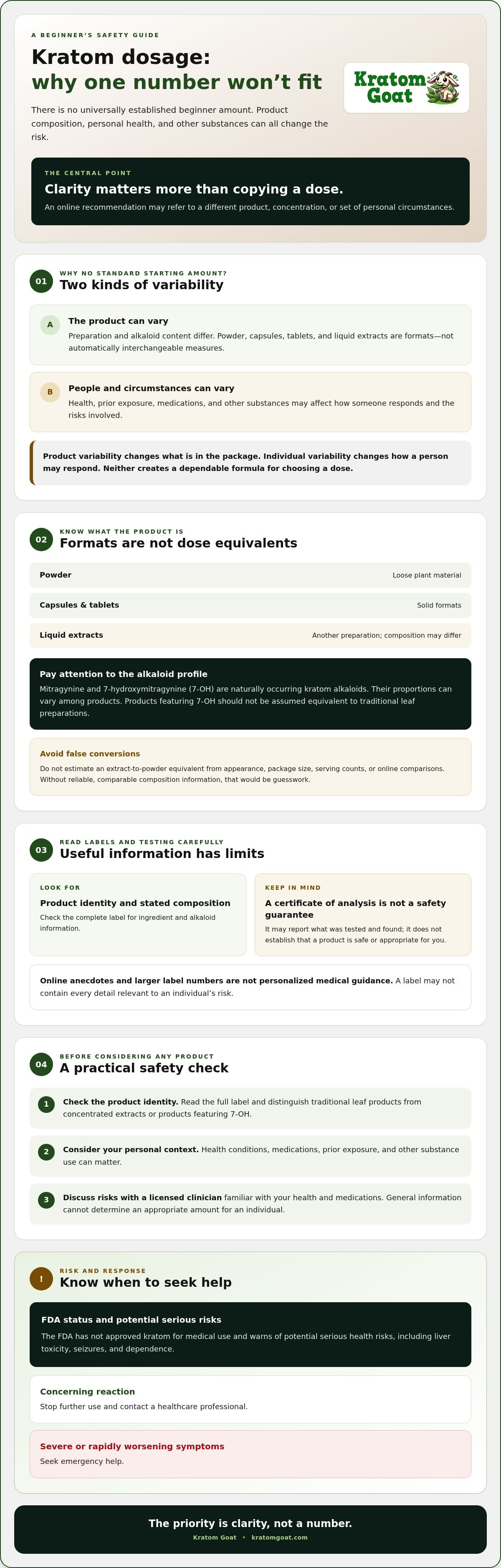
A Beginner Kratom Safety Checklist Before Considering Any Product
A label can help identify a product, but it can’t determine whether kratom is appropriate for you or provide a safe personal dose. Before making a decision, work through this checklist. If you’re looking for kratom dosage for beginners, product details and clinician guidance matter more than a number copied from an online source.
Use this checklist before considering a product
- 1. Pause before acting on a dose recommendation. Don’t rely on an online chart, anecdote, or serving suggestion as individualized medical advice.
- 2. Confirm the exact product identity. Read the full ingredient list and serving information. Check whether it’s a powder, capsule, tablet, liquid, or extract, and don’t assume different formats are interchangeable.
- 3. Review available batch documentation. If a certificate of analysis is provided, check that it matches the product and batch, then review its date, laboratory details, and listed tests. Testing information doesn’t establish personal safety.
- 4. Discuss personal risk factors with a licensed clinician. Ask about medications, health conditions, and any alcohol or other substance use. Don’t combine kratom with alcohol, opioids, sedatives, or other substances without clinician guidance.
- 5. Avoid use during pregnancy or breastfeeding unless a clinician gives specific guidance. Don’t treat general online advice as a substitute for care tailored to your circumstances.
When should someone avoid kratom or seek medical advice first?
Medication use, an existing health condition, pregnancy, and breastfeeding are all reasons to consult a licensed clinician before considering kratom. A clinician can discuss potential risks in light of your situation, but that doesn’t mean they can establish a universally safe kratom dose. Kratom Goat is an online retailer and doesn’t provide medical consultations or personalized dosing advice.
How to assess product information without treating it as a safety guarantee
Look for a precise product name, complete ingredients, clear serving information, and current documentation tied to the specific batch. Terms such as “natural,” “pure,” or “lab-tested” don’t mean risk-free, medically approved, or suitable for every person. A report speaks only to the sample and substances tested; it can’t predict how you may respond.
Use product information to understand what’s being sold and what was tested. Use qualified clinical advice to discuss personal risks. Transparency is useful, but it isn’t proof of personal safety. To review available product information and labels, explore Kratom Goat’s product selection, then take health questions to a licensed clinician.
What to Do If Kratom Causes a Concerning Reaction
If you feel unwell after taking kratom, don’t take more. Contact a qualified healthcare professional for advice, and share the product label and any available batch information. Symptoms and circumstances matter; online discussion can’t assess an individual reaction. This response plan is more important than searching for a different kratom dosage for beginners.
Which symptoms call for urgent help?
Call emergency services right away for severe trouble breathing, loss of consciousness, a seizure, or other signs of a life-threatening emergency. Don’t wait for an online response or for symptoms to pass on their own. If you’re unsure whether the situation is an emergency, contact emergency services for guidance.
For a possible exposure or a concerning reaction that isn’t immediately life-threatening, U.S. Poison Control provides guidance at 1-800-222-1222. You can also use Poison Control’s online resource. If symptoms are severe or rapidly worsening, call emergency services first rather than delaying care to make another call.
Where can beginners find reliable next-step information?
For non-emergency concerns, contact a healthcare professional and explain what was taken, when it was taken, and what symptoms occurred. Keep the packaging or a clear record of the product name and ingredients available, if possible. This information can help a professional understand the situation, but don’t postpone urgent care to collect it.
For general information, prioritize qualified healthcare professionals, official public-health resources, and Poison Control over testimonials or dose charts. Product testing documents may help identify what was tested, but they can’t diagnose a reaction or establish personal safety. The article’s certificate-of-analysis education resource can help you understand what a report does and doesn’t show.
Act on symptoms, not internet reassurance. Stop further use, seek qualified guidance, and use emergency services for severe signs. Continue learning with reliable health and product-literacy resources, and keep education separate from self-dosing decisions.
Make Product Clarity Your Next Step
The key lesson is simple: there’s no universally established kratom dosage for beginners. Products can differ in composition, and individual health factors can change the risks. A label or certificate of analysis may clarify product details, but neither can determine what’s appropriate for you or predict your response.
Approach any decision with care. Review the exact product information, avoid treating online anecdotes as personal guidance, and speak with a licensed clinician about medications, health conditions, or other substances. If you have questions about a test report, learn what it does and doesn’t establish before relying on it.
To review product labels and available formats, explore Kratom Goat’s online selection. For questions about personal health risks, speak with a licensed clinician rather than relying on a number that may not apply to you.
Frequently Asked Questions
Is there a safe kratom dose for beginners?
There’s no universal, evidence-based starting amount established for beginners. Kratom products can differ in composition, and individual health factors, medications, and other substance use may affect risk. The FDA hasn’t approved kratom for medical use or established official dosage guidelines. If you’re considering kratom, discuss your circumstances with a licensed clinician. That conversation can help you understand potential risks, but it doesn’t establish a guaranteed safe dose.
How much kratom should a beginner take?
No specific amount can be recommended responsibly for every beginner. Product format, alkaloid composition, and individual health factors vary, so a number shared online may not apply to the product or person in question. Don’t rely on a dose chart, anecdote, or serving suggestion as individualized guidance. Before considering kratom, review the product information and talk with a licensed clinician about medications, health conditions, and other substances.
Can kratom capsules and powder be taken in the same amount?
Not necessarily. Capsules contain material in a measured format, while powder is loose plant material, and their composition can vary by product. The amount of material alone doesn’t establish equivalent alkaloid content. Don’t use a conversion chart or assume that a capsule and a scoop of powder are interchangeable. Check the specific product label and ask a licensed clinician about personal health concerns rather than trying to calculate an equivalent amount.
Can beginners take kratom extract instead of powder?
Extracts differ from powder in preparation and may have a different concentration or alkaloid profile. A serving label or package size doesn’t prove that an extract is equivalent to a powder serving, and predictable effects can’t be assumed. Don’t convert extract servings into powder equivalents or use online comparisons to choose an amount. Review the product’s ingredients and composition, and consult a licensed clinician before making a decision about potential risks.
What happens if someone takes too much kratom?
Effects and risks can vary, so stop taking more and seek advice from a healthcare professional if you’re concerned. For a possible exposure in the U.S., contact Poison Control at 1-800-222-1222. Call emergency services immediately for severe trouble breathing, loss of consciousness, a seizure, or other life-threatening symptoms. Don’t wait for online replies if symptoms are severe or rapidly worsening, and keep product packaging available if it’s easy to do so.
Can kratom interact with medications or alcohol?
Potential interactions are a reason to use caution. Don’t combine kratom with alcohol, opioids, sedatives, or other substances without guidance from a licensed clinician. If you take medication or have a health condition, discuss kratom with a healthcare professional before considering it. Don’t assume that spacing substances apart or following an online recommendation prevents risk. A clinician can discuss your circumstances, but can’t promise a combination is safe.
Is 7-hydroxymitragynine the same as regular kratom?
No. 7-hydroxymitragynine, often called 7-OH, is a distinct alkaloid associated with kratom; products emphasizing concentrated 7-OH aren’t interchangeable with traditional leaf preparations. Their composition and product information can differ, so don’t treat one as equivalent to the other or convert between them using online ratios. Check the label for ingredients and composition, and discuss health questions with a licensed clinician rather than relying on product names alone.
How can beginners check whether kratom is lab-tested?
Look for a certificate of analysis (COA) that clearly identifies the product or batch, gives the test date and laboratory details, and lists the substances tested. Confirm that the document matches the product you’re reviewing, rather than relying on a general “lab-tested” claim. A COA reports results for a sample and selected tests; it doesn’t establish that kratom is safe, medically approved, or appropriate for you, and it can’t predict personal effects.