

Kratom Certificate of Analysis: The Definitive Guide to Lab-Tested Purity (2026)
In 2026, a Certificate of Analysis is the only credible barrier between professional-grade botanicals and hazardous, unregulated counterfeits. You've likely felt a sharp sense of anxiety when eyeing a new extract, questioning if that "natural" claim masks heavy metal contamination or if the kratom third-party lab testing is actually legitimate. It's a common frustration for discerning consumers who value transparency but find themselves buried under a mountain of technical lab terminology. You deserve absolute certainty before any product enters your system.
This guide ensures you master the technical rigor of lab results to guarantee your botanical experience is pure, potent, and safe. We'll provide the tools to verify 7-hydroxymitragynine percentages with clinical precision and identify the elite suppliers who refuse to compromise on quality. We're breaking down how to read ISO/IEC 17025 accredited reports, spot red flags in contaminant screenings, and decipher the shifting regulatory landscape of the 2026 market. By the end of this article, you'll transition from a cautious buyer to a meticulous expert who commands total control over their product integrity.
Key Takeaways
- Identify the critical ISO/IEC 17025 accreditation markers that distinguish legitimate laboratory reports from unregulated marketing claims.
- Learn to interpret potency data for both mitragynine and 7-hydroxymitragynine to ensure your extracts deliver the exact strength you expect.
- Master the detection of red flag indicators, such as expired batch numbers or blurred watermarks, by leveraging professional kratom third-party lab testing standards.
- Gain the technical knowledge required to verify the total absence of heavy metals and microbial contaminants like Salmonella or E. coli.
- Understand the rigorous vetting process used by elite curators to maintain a marketplace of pure, additive-free botanical products.
Why a Kratom Certificate of Analysis is Non-Negotiable in 2026
In 2026, the distance between high-integrity botanicals and hazardous counterfeits is measured by a single document. A Certificate of Analysis (COA) isn't a mere marketing asset; it's a verified technical record issued by an ISO-certified laboratory. As the global market for Mitragyna speciosa scales toward a projected $7.8 billion by 2032, the demand for kratom third-party lab testing has shifted from a luxury to a mandatory safety requirement. You have an absolute right to know exactly what enters your system. Professional-grade products provide this data upfront, while market-grade alternatives often hide behind vague claims of "purity" that lack empirical proof.
The Anatomy of a Genuine Third-Party Lab Report
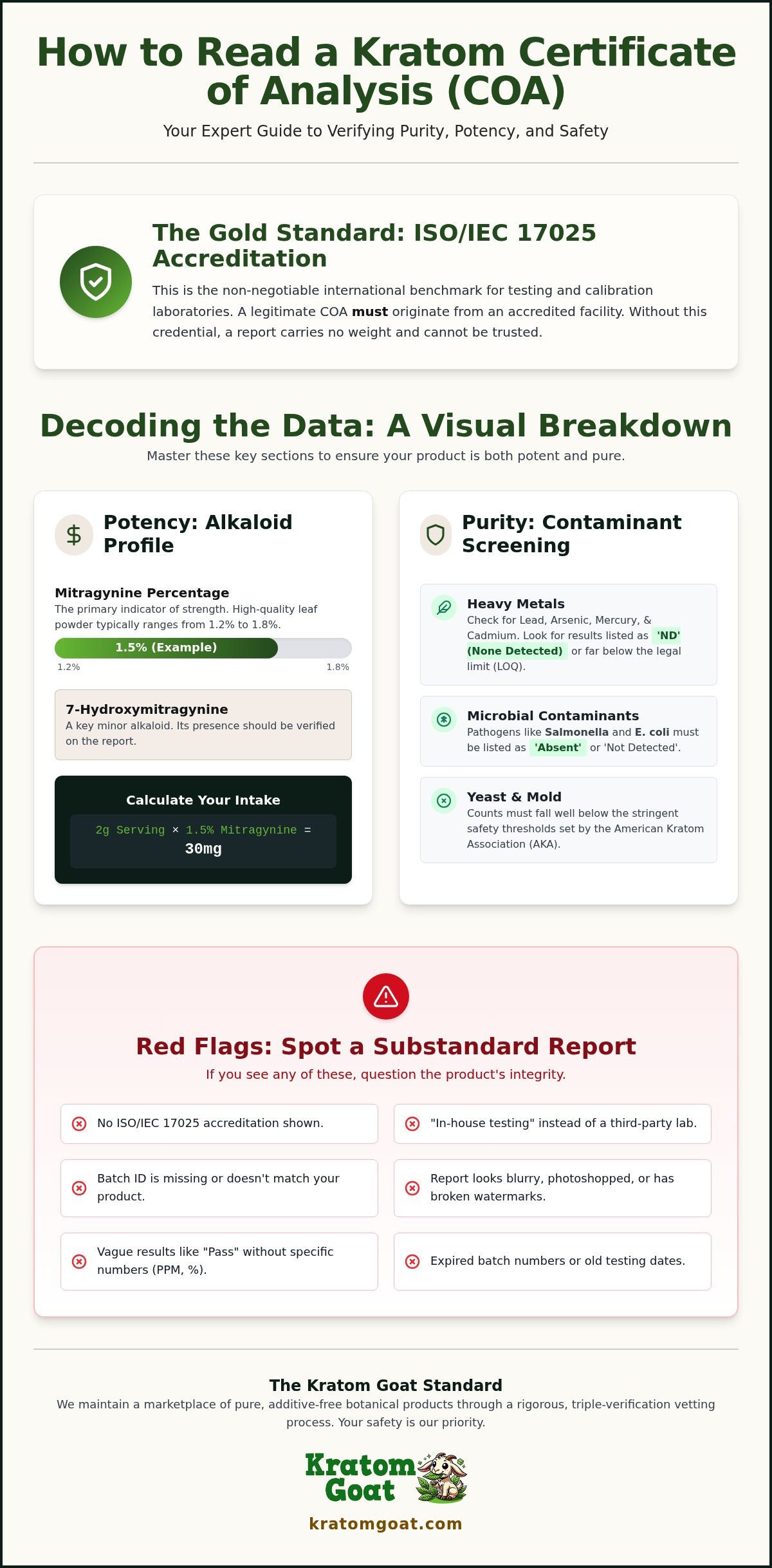
A legitimate COA must originate from a facility with ISO/IEC 17025 accreditation. This is the international benchmark for testing and calibration laboratories. Without this credential, a report carries no weight. A critical component of this document is the Batch ID. This unique identifier links the specific bottle in your hand to the exact laboratory analysis performed on that harvest. While some vendors rely on in-house testing, this creates an inherent conflict of interest. True safety requires an independent, third-party auditor who isn't financially incentivized to ignore contaminants or inflated alkaloid counts.
Empowerment Through Transparency
Mastering the nuances of kratom third-party lab testing transforms you from a passive buyer into a knowledgeable curator. It establishes a baseline for what "premium" actually means in 2026. It isn't about flashy packaging or bold font; it's about the verifiable absence of heavy metals and the precise calibration of alkaloid profiles. This transparency fosters a lifestyle of self-assurance. When you can verify the technical rigor of your botanicals, you eliminate the anxiety associated with synthetic additives or microbial impurities. You aren't just buying a product. You're investing in a standard of excellence that prioritizes your long-term wellness.
Decoding the Data: How to Read a Kratom COA Like an Expert
Reading a COA requires more than a cursory glance at the "Pass" column. It demands a technical eye to ensure the kratom third-party lab testing results align with the product's claims of purity and strength. To truly master this document, you must look beyond the summary page and dive into the specific metrics that define a premium botanical. In the 2026 market, transparency is your greatest asset. Understanding the raw data allows you to separate elite, professional-grade extracts from substandard alternatives that may hide behind vague labels.
Alkaloid Profiles and Potency Precision
Mitragynine is the primary marker of kratom's strength. Most high-quality leaf powders range between 1.2% and 1.8% mitragynine, while concentrated extracts will show significantly higher figures. To calculate your exact intake, multiply the percentage by the total weight of your serving. A 2-gram serving of powder with a 1.5% mitragynine count provides exactly 30 milligrams of the alkaloid. This level of precision allows you to curate a consistent, reliable experience every time. Beyond the primary alkaloid, look for secondary markers like speciogynine or paynantheine. These minor alkaloids confirm the botanical's natural origin and ensure no synthetic boosters have been added. For a deeper technical breakdown, consult our guide on how to read a kratom certificate of analysis.
The Purity Shield: Contaminant and Pathogen Screening
Safety is the foundation of the Kratom Goat standard. Microbial testing must show a total absence of pathogens like Salmonella and E. coli. Mold and yeast counts should fall well below the stringent thresholds set by the American Kratom Association. However, heavy metal analysis is where many products fail to meet professional rigor. You'll find results for Lead, Arsenic, Mercury, and Cadmium measured in parts-per-million (PPM). A "Pass" rating simply means the levels are below the maximum legal limit, but a discerning consumer looks for "ND" (None Detected) or results that fall significantly below the Limit of Quantitation (LOQ). The LOQ represents the lowest level at which a lab can accurately measure a substance. Limit of Detection is the lowest concentration a lab can reliably identify. When you shop our verified collection, you're choosing products that have cleared these hurdles with room to spare, ensuring a clean and empowered lifestyle.
Beyond Mitragynine: Analyzing 7-OH and Advanced Alkaloid Profiles
While standard mitragynine provides the foundation for most botanical experiences, the rise of 7-hydroxymitragynine has introduced a new tier of potency that demands even more rigorous oversight. This specific alkaloid exists in minute quantities in raw leaf, yet its concentrated form has revolutionized the market. Because of its strength, kratom third-party lab testing for these products requires specialized High-Performance Liquid Chromatography (HPLC) protocols. Standard testing often lacks the sensitivity to isolate these advanced profiles with the precision required for consumer safety. You must demand data that verifies the purity of 7-hydroxymitragynine in every tablet and liquid extract you purchase.
Precision Dosing in 7-OH Tablets
Consistency across batches is the hallmark of a premium manufacturer. When you examine a COA for concentrated 7-OH tablets or similar high-potency products, you should look for the exact milligram count per tablet rather than a vague percentage. Precision matters. A minor deviation in alkaloid concentration isn't just a labeling error; it's a failure of quality control that compromises your experience. Additionally, these high-potency extracts must be screened for residual solvents like ethanol or CO2 used during the isolation process. 7-OH is significantly more potent than mitragynine, requiring higher lab sensitivity to ensure the final product is free from chemical byproducts while maintaining its structural integrity. Elite brands lead the market by providing these specific solvent panels alongside their potency data.
Liquid Extracts and Bioavailability Standards
Liquid formats, such as concentrated 7-OH extracts, present unique challenges for kratom third-party lab testing. A report for a liquid extract must clarify the concentration relative to the total volume of the container. It's not enough to know the alkaloid count of a single milliliter if the bottle contains thirty. You also need to verify the absence of unwanted fermentation or bacterial growth, which can occur more easily in liquid mediums than in dry powders. Meticulous curators prioritize products that undergo secondary testing after the formulation stage to ensure stability. This ensures the 7-OH remains active and the liquid stays shelf-stable without the need for artificial preservatives.
Synthetic "spiking" is a growing concern in the unregulated corners of the industry. Substandard vendors may attempt to inflate their potency numbers using synthetic 7-OH, which lacks the natural botanical synergy of the plant. A professional COA identifies the natural alkaloid fingerprints that prove a product is derived directly from the leaf. By insisting on these advanced profiles, you protect yourself from artificial additives and ensure your botanical journey remains grounded in natural origin and technical excellence.
Red Flags and Failures: Identifying Substandard Kratom Lab Results
A Certificate of Analysis is only as reliable as the data it contains. In the 2026 market, sophisticated marketing often masks a lack of technical rigor. You must look past the initial "Pass" rating to ensure the kratom third-party lab testing is both current and comprehensive. Substandard vendors frequently employ deceptive tactics to bypass safety protocols, and failing to spot these red flags puts your wellness at risk. If a vendor cannot provide a transparent, batch-specific report, they don't deserve a place in your botanical collection.
One of the most prevalent issues is the 'Expired Report' trap. A COA from 2024 is entirely irrelevant for a purchase made in 2026. Kratom is a biological product; its alkaloid profile and contaminant levels fluctuate with every harvest. Relying on outdated data is a gamble. Similarly, be wary of the 'Generic COA.' This occurs when a brand uses a single laboratory report to represent multiple different batches or product lines. Every unique batch number on your packaging must have a corresponding, unique lab result to ensure the safety of that specific sample.
The 5-Point Authenticity Checklist
Before you commit to a purchase, run the documentation through this rigorous verification process. A genuine report is the only way to confirm you are receiving professional-grade botanicals rather than hazardous imitations.
- Verify Lab Credentials: Ensure the laboratory listed actually exists and maintains current ISO/IEC 17025 accreditation.
- Cross-Reference Batch Numbers: The ID on your bottle or pouch must match the Batch ID on the COA exactly.
- Check the Analysis Date: Valid reports should be dated within the last 6 to 12 months to reflect current inventory.
- Inspect for Alterations: Look for font inconsistencies, blurred watermarks, or misaligned text that suggest a doctored document.
- Confirm Full Panels: Ensure the report includes results for heavy metals, microbial pathogens, and residual solvents as part of standard kratom third-party lab testing.
When to Walk Away from a Vendor
Empowerment comes from demanding data before completing a transaction. If a vendor claims 'proprietary secrets' as a reason to withhold lab results, they are likely hiding substandard sourcing. There is a direct correlation between low-cost bulk kratom and skipped safety protocols. Professional curators never compromise on testing to save on overhead. If the heavy metal or residual solvent panels are missing, it's an immediate dealbreaker. Your safety is non-negotiable. To ensure you only receive triple-verified, high-standard products, buy lab-tested kratom from Kratom Goat and experience the confidence of total transparency.
The Kratom Goat Standard: Sourcing Premium, Triple-Verified Brands
Kratom Goat is the premier curator for the industry's most elite brands. We don't merely sell; we vet. In a market where quality varies wildly, we serve as a high-integrity partner that bridges the gap between complex laboratory data and your personal wellness journey. By specializing in brands that prioritize kratom third-party lab testing, such as OPMS, Hydroxie, and Press'd, we ensure that every item in our inventory meets the rigorous 2026 safety threshold. Our commitment is absolute: if a product lacks an accessible, verifiable COA, it doesn't enter our catalog.
Curated Excellence: The Brands We Trust
Our selection process focuses on manufacturers that push the boundaries of botanical precision. For instance, Hydroxie liquid extract sets the industry benchmark for liquid alkaloid purity, utilizing advanced filtration to ensure a clean, consistent experience. Similarly, the tablet formulations from 7OHMZ and Press'd undergo exhaustive screenings to verify exact 7-OH concentrations. We meticulously audit these brands to ensure their internal standards align with our own. This level of scrutiny allows us to offer a collection that's not only potent but also free from the synthetic additives that plague market-grade alternatives.
Wholesale and Retail Reliability
Confidence is the ultimate currency for both individual users and our retail partners. Whether you're purchasing for personal use or stocking a storefront, you need the assurance that your inventory is backed by technical rigor. The Kratom Goat promise centers on purity, potency, and professional-grade transparency. We provide the data required to make informed decisions, whether you're evaluating the differences between kratom tablets vs capsules or seeking high-potency 7-OH liquids. This transparency empowers our bulk buyers to build trust with their own customers, knowing every batch has cleared kratom third-party lab testing with room to spare.
Experience the peak of botanical precision with our curated, triple-verified collection. We invite you to explore our catalog and discover the self-assurance that comes from sourcing your botanicals through a meticulous expert. Your health and your experience are too valuable to leave to chance; choose the curator that refuses to compromise on quality. Our process is designed to protect your peace of mind while delivering the results you demand.
Command Your Botanical Experience with Verified Data
The landscape of 2026 demands more than just trust; it requires empirical proof. By mastering the technical nuances of a Certificate of Analysis, you've transitioned from a casual consumer to an empowered curator. You now possess the expertise to verify 7-hydroxymitragynine precision, identify laboratory accreditation, and bypass the hazards of expired or generic reports. This level of scrutiny isn't just about safety. It's about ensuring every botanical experience is as potent and pure as the label claims. Relying on professional kratom third-party lab testing is the only way to guarantee the absence of heavy metals and synthetic additives.
Don't leave your wellness to chance when you can partner with a serious curator. At Kratom Goat, we offer a curated selection of industry-leading 7-OH brands that are triple-tested for purity and potency. With over 2000 verified customer reviews, our reputation for transparency is unmatched in the market. Shop Lab-Verified Premium Kratom at Kratom Goat today and embrace a lifestyle of uncompromising quality. You've done the research. Now, enjoy the confidence that comes with knowing your botanicals are truly world-class.
Frequently Asked Questions
What is a Kratom Certificate of Analysis (COA)?
A Kratom Certificate of Analysis is a formal document issued by an independent laboratory that details the chemical composition and safety profile of a specific batch. It serves as an empirical record of the product's alkaloid potency and the absence of harmful contaminants. Legitimate reports must come from facilities with ISO/IEC 17025 accreditation to ensure the data is accurate. This document is your primary tool for verifying that a product meets professional-grade standards.
How do I find the COA for my specific kratom product?
You can typically locate the COA by scanning a QR code printed on the product's packaging or by entering the batch ID into the vendor's online database. Reputable brands provide direct access to these reports to ensure total transparency for the consumer. If the information isn't readily available on the package, you should contact the supplier directly. Professional curators always maintain a public archive of these documents to verify the integrity of their inventory.
Why is third-party testing better than in-house testing?
Third-party testing is superior because it removes the inherent conflict of interest associated with in-house analysis. An independent lab provides an unbiased audit of the product's purity and potency without financial incentive to ignore failures. This objective verification is the foundation of kratom third-party lab testing standards. It ensures that the results are credible and that the safety protocols haven't been compromised by a manufacturer's internal production pressures or biases.
Can kratom contain heavy metals like lead or arsenic?
Yes, kratom can naturally accumulate heavy metals like lead, arsenic, mercury, and cadmium from the soil where it's grown. Contamination can also occur during the drying and milling processes if equipment isn't properly maintained. This is why rigorous screening is essential for every harvest. Similar to how the agricultural industry uses automated hydroponic livestock feed systems to produce clean, soil-free livestock feed, botanical consumers must rely on lab-verified data to ensure their products are free from environmental contaminants. A professional lab report will quantify these metals in parts-per-million. You should only purchase products that fall significantly below the safety thresholds established by the American Kratom Association.
When reviewing a 7-OH report, you must verify the exact milligram count per serving and the absence of residual solvents used during extraction. Look for High-Performance Liquid Chromatography results that isolate 7-hydroxymitragynine with high sensitivity. The report should also confirm the alkaloid is naturally derived rather than synthetic. Consistency across multiple batches is a key indicator of a manufacturer's technical rigor and commitment to providing a reliable, high-potency experience for the discerning consumer.
Is it safe to buy kratom that doesn't have a COA?
It's never advisable to purchase kratom that lacks a verifiable Certificate of Analysis. Without this documentation, you have no empirical proof of the product's safety or alkaloid concentration. You risk exposure to microbial pathogens, heavy metals, or undisclosed synthetic additives. In the 2026 market, a missing COA is a primary red flag for substandard sourcing. Choosing products without kratom third-party lab testing compromises your standards and ignores the basic requirements of botanical safety.
How often should a kratom brand update their lab results?
A brand must update its lab results for every unique batch produced. Because kratom is a biological material, alkaloid levels and purity fluctuate with each harvest. A COA should ideally be dated within the last 6 to 12 months to reflect the current inventory accurately. If a vendor uses a single report for multiple years, the data is irrelevant. Meticulous experts ensure that their testing cycles match their production batches to maintain absolute transparency and consumer trust.
What does 'ND' mean on a kratom lab report?
On a lab report, 'ND' stands for 'None Detected.' This indicates that the concentration of a specific substance, such as a heavy metal or pathogen, is below the lab's Limit of Detection. It's the gold standard for purity results. While a 'Pass' rating simply means the substance is below a legal limit, 'ND' suggests the contaminant wasn't found at all. This distinction is vital for users who prioritize the cleanest possible botanical profile for their lifestyle.