

How to Avoid Building Kratom Tolerance: A Safety-First Guide
Chasing a weaker-feeling effect with more kratom can increase risk rather than solve the problem. If the effects seem less predictable over time, it’s understandable to look for clear answers about how to avoid building kratom tolerance, especially when online advice about breaks, product changes, and dose adjustments conflicts.
This guide explains what tolerance means and how repeated use may change your response. You’ll learn about possible warning signs, why taking more isn’t a safety-first solution, and practical ways to reduce risk without escalating use. It also explains how tolerance can overlap with dependence or withdrawal, which may call for more support than a self-directed break or product switch. We’ll cover safer next steps and how to raise concerns with a qualified health professional, including asking about confidential support. The goal is informed decision-making, not stronger effects or a one-size-fits-all schedule.
Key Takeaways
- Learn how a reduced response may differ from dependence, withdrawal, or ordinary changes in experience.
- Understand why strain switching isn’t established as a reliable way to avoid building kratom tolerance.
- Use a practical framework to review your use and avoid increasing the amount, frequency, or product strength to chase effects.
- Recognize changes worth discussing with a qualified professional, and prepare clear notes about products, frequency, and other substances.
- Compare strain rotation, stronger products, self-directed breaks, and professional support through a safety-first lens.
What Kratom Tolerance Means, and How to Recognize a Change
A change in how kratom feels can raise questions, but it doesn’t confirm tolerance on its own. In general terms, tolerance means a reduced response after repeated exposure to a substance. That definition can help frame what you’re noticing, but it isn’t a diagnosis, and experiences differ from person to person.
Kratom comes from the kratom plant. Products and their compositions may vary, and research on kratom’s effects and patterns of use has limitations. There’s no reliable, universal timeline for when tolerance might develop, or a single experience that proves it has.
What changes might suggest tolerance?
You might notice that an effect seems weaker than before or doesn’t seem to last as long. Those changes can have other explanations, including differences in the product or in your own circumstances. Don’t treat them as proof of tolerance or respond by taking more.
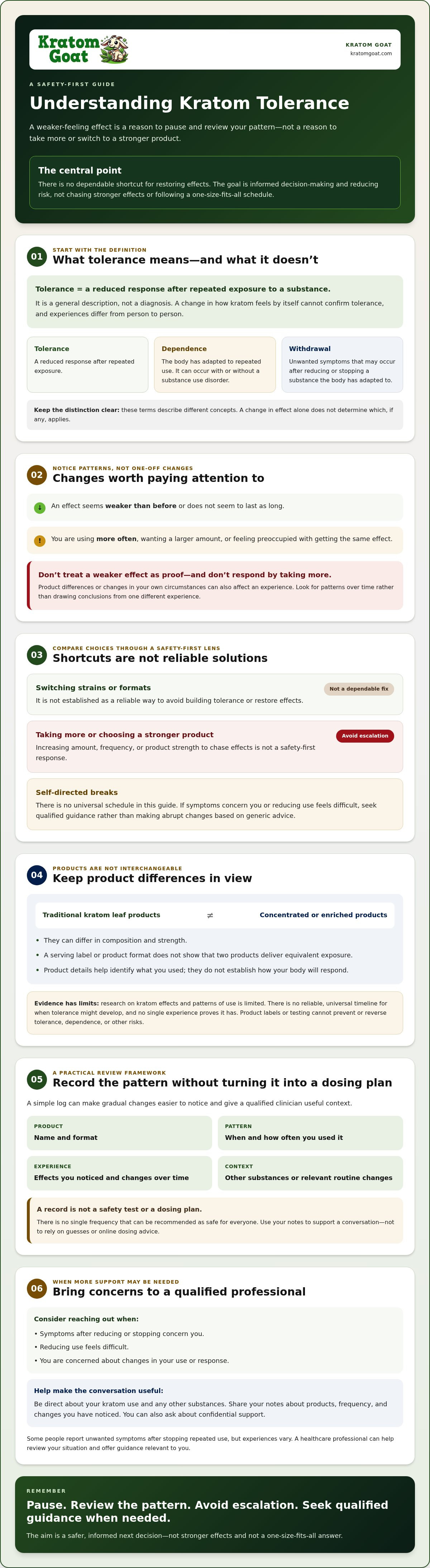
Pay attention to patterns. Using more often, wanting a larger amount, or feeling preoccupied with getting the same effect are reasons to pause and reassess. If you’re wondering how to avoid building kratom tolerance, start by recording what you use, how often you use it, and what changes you notice. A clinician can help you review those details instead of relying on guesses or online dosing advice.
Tolerance, dependence, and withdrawal are not interchangeable
Tolerance refers to a reduced response after repeated exposure. Dependence means the body has adapted to repeated use; it can occur with or without a person meeting criteria for a substance use disorder. Withdrawal refers to unwanted symptoms that may occur after reducing or stopping a substance the body has adapted to. These terms describe different concepts, and a change in effect alone can’t determine which, if any, applies.
Some people report unwanted symptoms after stopping repeated kratom use, but experiences vary. If symptoms concern you, or reducing use feels difficult, seek guidance from a qualified healthcare professional rather than making abrupt changes based on generic advice. Be direct about your kratom use and any other substances, as that information can help them offer more relevant guidance.
Why Repeated Kratom Use Can Raise Tolerance Concerns
Repeated exposure is a pattern worth paying attention to, but it doesn’t prove that every person will develop tolerance. Responses can vary, and available evidence doesn’t establish a precise timeline or predictable outcome. Frequency, consistency, product composition, and other factors can all make it harder to compare one experience with another.
Why frequency and consistency matter
Tracking use can make gradual changes easier to spot. A simple log might include the product name and format, when and how often you used it, the effects you noticed, and any other substances or relevant changes in your routine. Look for patterns over time instead of drawing conclusions from one different experience.
This record isn’t a dosing plan, and it can’t determine what’s safe for you. It can, however, give a qualified clinician useful information if you’re concerned. There’s no single frequency that can be recommended as safe for everyone.
Why extracts and 7-hydroxymitragynine need careful discussion
Traditional kratom leaf products and concentrated or enriched products shouldn’t be treated as interchangeable. They can differ in composition and strength, and a serving label or product format alone doesn’t show that two products deliver equivalent exposure. Product details can help identify what you used, but they don’t establish how your body will respond.
The U.S. Drug Enforcement Administration describes kratom as a drug of concern and discusses its potential effects and abuse risks. Evidence about specific products and longer-term patterns remains limited, so don’t assume a concentrated product will have the same effects or risks as ordinary leaf. For additional background, see “7-Hydroxymitragynine: The Science and Standards of Kratom’s Most Potent Alkaloid.”
Clear product information can help you identify what a label says, but neither a label nor testing can prevent or reverse tolerance, dependence, or other risks. If you’re trying to understand how to avoid building kratom tolerance, don’t use a stronger product or switch formats to compensate for weaker effects. Review your pattern and discuss concerns with a healthcare professional. For product information, you can review kratom product details, keeping shopping decisions separate from medical advice.
Do Strain Switching, Breaks, or Stronger Products Prevent Tolerance?
There’s no dependable shortcut for restoring effects. Switching strains or formats isn’t established as a reliable way to prevent tolerance, and increasing product strength to overcome weaker effects can add uncertainty rather than resolve the concern. The comparison below sets common approaches against a safety-first perspective.
| Approach | What to understand | Safety-first perspective |
|---|---|---|
| Strain rotation | Different labels or perceived effects don’t prove different tolerance outcomes. | Don’t rely on switching strains as a prevention method. |
| Stronger products | Concentrated or enriched products may differ from ordinary leaf products. | Don’t increase strength to chase a previous effect. |
| Self-directed break | A pause may change exposure, but it isn’t a guaranteed reset. | There’s no universal break duration; seek advice if stopping raises concerns. |
| Professional support | A qualified clinician can consider your use pattern, symptoms, and health context. | Discuss concerns rather than making dose or schedule changes based on online rules. |
Why switching strains or formats may not solve the concern
Strain names, product labels, and personal impressions don’t establish that products produce different tolerance outcomes. Formats aren’t automatically interchangeable either: capsules, tablets, powders, and extracts can differ in composition and how they’re used. For background on format differences, read Kratom Tablets vs Capsules: A Comprehensive Comparison of Delivery Methods. Changing format shouldn’t be treated as a proven way to prevent tolerance.
Why stronger products can increase uncertainty
A concentrated product may make experiences harder to compare, especially when its composition differs from what you used before. Moving to extracts or products enriched with 7-hydroxymitragynine to overcome weaker effects isn’t a safety strategy. Testing or product information may describe composition, but it can’t determine your individual tolerance or medical risk. It also doesn’t remove the possibility of unwanted effects, dependence, or withdrawal.
If you’re researching how to avoid building kratom tolerance, focus on observing your pattern rather than trying to force a stronger response. Don’t use strain rotation, stronger products, or a self-prescribed break as a guaranteed fix. If you’re considering reducing or stopping and have concerns about symptoms, ask a qualified healthcare professional for guidance. The next section outlines practical steps for reassessing use without escalating it.
Practical Steps to Reduce Risk Without Escalating Use
If effects seem weaker, resist the urge to compensate. Increasing the amount, using more often, or moving to a stronger product can add risk without resolving the cause. A steadier response is to avoid escalation, review what’s changed, and get qualified advice when needed.
Use this framework to organize your next steps:
- 1. Pause escalation. Don’t increase the amount, frequency, or product strength to chase a previous effect.
- 2. Review your pattern. Consider whether your product, routine, health, or use of other substances has changed.
- 3. Document what you notice. Keep a straightforward record so you can explain the pattern accurately.
- 4. Seek qualified advice. Contact a healthcare professional if symptoms concern you, reducing use feels difficult, or you have questions about kratom alongside medications or a health condition.
A simple way to review your pattern
Note the product type and label, how often you use it, the effects you perceive, and any unwanted symptoms. Include other substances or medications, too. The goal is to gather useful context, not to create a dosing schedule or diagnose yourself.
Labels and available certificates of analysis (COAs) may help identify what a product claims to contain. They don’t establish how it will affect you or eliminate individual health risks. For help understanding these documents, see How to Read a Kratom Certificate of Analysis (COA).
When professional support is the safer next step
Be candid with a healthcare professional about the product format, how often you use it, what has changed, and any other substances or medications. This information can support a more informed conversation. Don’t make a rapid change based on a generic online schedule, particularly if you’re experiencing unwanted symptoms.
For severe or alarming symptoms, such as trouble breathing, a seizure, collapse, or being difficult to wake, call 911 immediately. If you suspect poisoning but the person is awake and not in immediate danger, contact Poison Control in the United States at 1-800-222-1222 for guidance.
Kratom Goat is an online retailer, not a medical consultation provider. Product shopping can’t replace professional guidance. If you’re reviewing product details, explore Kratom Goat’s product information separately from decisions about tolerance or care. A practical approach to how to avoid building kratom tolerance starts with not escalating use and getting support when concerns arise.
When to Seek Help, and How to Make a Safer Next Decision
A conversation with a healthcare professional may help if effects seem to be changing, you find yourself using more often, or attempts to reduce use feel difficult. Also raise unwanted symptoms, including symptoms that appear after cutting back or stopping. These signs don’t establish a diagnosis, but they are useful reasons to ask for guidance, especially if you take medications or have a health condition.
What to tell a healthcare professional
Clear details can make the conversation more useful. Consider bringing or writing down:
- The product category and format, plus its label or any available certificate of analysis.
- How often you use it and whether that pattern has changed.
- What effects seem different, when you noticed the change, and any unwanted symptoms.
- Any attempts to reduce or stop, and what you experienced.
- Other substances, supplements, or medications you use.
You don’t need to decide whether you have tolerance or dependence before asking for help. Share what you’ve observed and ask what next steps make sense for your circumstances. Don’t assume an online break schedule or another person’s advice will apply to you.
Keep product research separate from health advice
Product descriptions and testing documents can provide information about a product’s stated contents. They can’t establish how it will affect a particular person, prove that it prevents tolerance, or show that use is risk-free. A label or certificate isn’t a substitute for an individualized health assessment.
Kratom Goat is an online retailer, not a provider of medical consultations. Its product information is for shopping research, not personalized advice about tolerance, symptoms, or whether to use kratom. If product details would help you identify what you have used, review them at your own pace and bring relevant information to a qualified professional. Your health questions deserve an independent conversation, not a product recommendation.
If you’re still asking how to avoid building kratom tolerance, prioritize not escalating use and seek qualified guidance when changes or symptoms concern you. The safest next decision is one informed by your experience and health needs, not by chasing a stronger effect.
Choose a Safer Next Step
Changing effects can be a reason to reassess, not a signal to take more. Tolerance, dependence, withdrawal, and ordinary differences in experience are distinct, and a change alone can’t confirm what’s happening. Strain switching and stronger products aren’t established solutions for preventing tolerance.
A practical answer to how to avoid building kratom tolerance is to avoid escalating the amount, frequency, or product strength, keep a clear record of use and effects, and talk with a qualified healthcare professional if symptoms concern you or reducing use feels difficult. Share product details, other substances, medications, and relevant health conditions to give the conversation useful context.
Kratom Goat is an online retailer, not a medical provider. Product descriptions and testing information, when available for a specific item, can help you review product details, but they don’t offer personalized health guidance or establish that a product is risk-free. For shopping research, review Kratom Goat’s product information. Keep health decisions grounded in qualified advice, and take the next step at a pace that prioritizes your well-being.
Frequently Asked Questions
Is kratom tolerance inevitable?
No, tolerance isn’t inevitable, and there’s no reliable timeline that predicts who may experience it. If effects seem weaker or shorter-lasting, that change alone doesn’t confirm tolerance or another diagnosis. Avoid increasing how much or how often you use to chase a previous effect. Track what you notice and discuss the pattern with a qualified healthcare professional, especially if reducing use feels difficult or unwanted symptoms appear.
Can switching kratom strains prevent tolerance?
There isn’t enough reliable evidence to treat strain rotation as a dependable way to prevent tolerance. Labels and perceived differences don’t guarantee meaningfully different exposure or responses. Switching strains shouldn’t be used as a workaround for diminishing effects. Instead, review your use pattern and avoid escalating the amount, frequency, or product strength. If effects are changing or use feels difficult to control, discuss your concerns with a qualified healthcare professional.
How long does it take to build kratom tolerance?
There’s no dependable timeline that applies to every person or product. Individual factors, frequency of use, product composition, and other substances may affect experiences, while research remains limited. A specific number of days or weeks can’t reliably predict what will happen to you. If you notice changing effects or feel compelled to use more, record what’s changed and discuss it with a qualified healthcare professional rather than relying on a timeline.
Does taking a break reset kratom tolerance?
No break can be promised to reset tolerance, and stopping isn’t risk-free for everyone. Some people may experience unwanted symptoms after repeated use, and the safest next step depends on their circumstances. There’s no universal break length or taper that can be recommended here. If you’re considering changing your use, seek guidance from a qualified healthcare professional, particularly if you have symptoms, health concerns, or difficulty reducing use.
Can a stronger kratom extract stop tolerance from getting worse?
No product should be used or recommended to overcome tolerance. A stronger or more concentrated product can make exposure harder to compare and add uncertainty about effects and risks. Don’t compensate for diminished effects by increasing product strength or frequency. If you’re concerned about changing effects, a qualified healthcare professional can help you consider your use pattern and discuss safer next steps based on your health circumstances.
What are signs that kratom use may be becoming difficult to manage?
Possible concerns include repeatedly using more often than intended, finding it difficult to reduce use, or continuing despite unwanted effects. These experiences don’t establish a diagnosis, but they’re good reasons to speak honestly with a qualified professional. Share the product type, how often you use it, changes you’ve noticed, and any other substances or medications. This context is more useful than relying on an online self-assessment.
Should I talk to a doctor about kratom tolerance?
Yes, consider speaking with a healthcare professional if effects are changing, reducing use feels difficult, or symptoms concern you. Bring the product label or available testing information, and describe your frequency of use, what has changed, and any other substances or medications. Seek urgent care for severe or alarming symptoms. A retailer may provide product information, but it can’t replace individualized medical advice or assess your health.