

How Long for Kratom to Kick In? 2026 Onset & Duration Guide
The most critical window of your kratom experience isn't the moment of ingestion; it's the thirty-minute mark when you're tempted to reach for a second dose. If you've ever felt the anxiety of a delayed onset, you're not alone. Many enthusiasts struggle with the uncertainty of how long for kratom to kick in, often leading to the dangerous "stacking" effect where circulating alkaloids climb toward their 60 to 78-minute peak just as a second serving is added. This lack of predictability doesn't just ruin the experience; it compromises your safety and results.
We recognize that discerning consumers demand precision and transparency. You deserve a predictable outcome every time you utilize a high-standard extract or tablet. This guide will help you master the science of kratom onset timelines, explaining how biological factors and specific delivery methods dictate your physiological response. From the rapid 5-minute uptake of liquid extracts to the slower 60-minute digestion of capsules, we provide a methodical breakdown of 2026 pharmacokinetic data. You'll gain a thorough understanding of the biological "why" behind these timings, ensuring your experience remains assertive, controlled, and safe.
Key Takeaways
- Understand that determining how long for kratom to kick in depends on a specific biological window, with initial physiological recognition beginning at 15 minutes and peak plasma levels reached between 60 and 78 minutes.
- Learn how gastric contents and individual metabolic rates act as primary drivers for absorption speed, directly influencing the time it takes for alkaloids to enter the bloodstream.
- Discover why standardized serving options and advanced alkaloid preparations provide more predictable onset timelines compared to traditional powder or capsules.
- Master the science of avoiding the stacking trap by waiting a minimum of 3 to 5 hours before redosing to prevent the adverse wobbles associated with over-saturation.
- Identify how lab-tested purity and alkaloid concentration from trusted sources like Kratom Goat ensure consistent results, eliminating the delays and unpredictability caused by low-grade fillers or contaminants.
The Kratom Onset Timeline: What to Expect in the First Hour
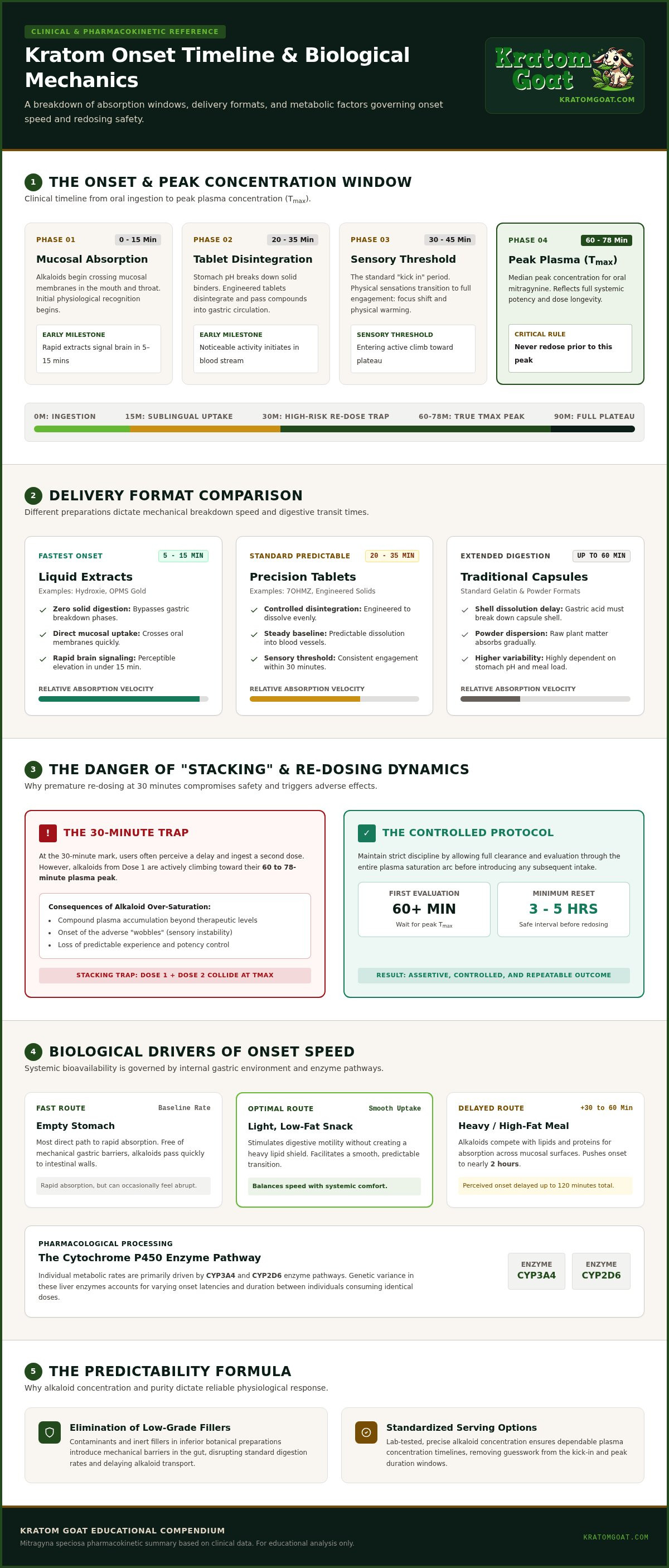
Precision is the hallmark of a superior kratom experience. Determining how long for kratom to kick in isn't a matter of guesswork; it's a predictable physiological sequence governed by alkaloid absorption and metabolic timing. While many users expect an immediate shift, the body requires a specific window to process these botanical compounds. Clinical data indicates that the median time to reach peak plasma concentration ($T_{max}$) for orally administered mitragynine is between 60 and 78 minutes. Understanding this timeline allows you to manage your expectations and avoid the common pitfalls of premature redosing.
The First 15 Minutes: The Absorption Phase
The first quarter-hour is defined by initial physiological recognition. During this phase, alkaloids begin crossing the mucosal membranes in the mouth and throat before entering the stomach. The speed of this process depends heavily on the delivery format. Liquid extracts, such as Hydroxie or OPMS Gold, bypass the need for solid digestion, often signaling the brain within 5 to 15 minutes. For those utilizing tablets or capsules, stomach pH plays a vital role in breaking down binders or shells. A comprehensive understanding of the Mitragyna speciosa botanical profile reveals that these early minutes are focused on transport rather than peak effect.
30 To 60 Minutes: Reaching the Threshold
Between 30 and 45 minutes, most users cross the sensory threshold. This is the standard "kick in" period where physical sensations transition into full botanical engagement. Precision-pressed options like 7OHMZ tablets are engineered for predictable disintegration, typically achieving noticeable activity within 20 to 35 minutes. It's during this window that you'll identify the first clear milestones of the experience. You might notice a shift in focus, a warming sensation, or a change in physical comfort. This period represents the climb toward the plateau, not the destination itself.
Safety is paramount during this hour. You should never redose before the 60-minute mark. Because circulating alkaloid levels are still rapidly climbing toward their 90-minute peak, taking more too early creates a stacking effect. This can lead to over-saturation and the unpleasant "wobbles." Recognizing these sensory milestones helps you stay in control:
- 15-20 Minutes: Sublingual absorption begins; subtle mood elevation may occur with liquid extracts.
- 30-45 Minutes: The primary "kick in" window; metabolic processing reaches the bloodstream in earnest.
- 60-90 Minutes: Peak concentration ($T_{max}$); this is the true indicator of the dose's potency and longevity.
By respecting this biological rhythm, you ensure a disciplined and high-standard experience that prioritizes results and reliability.
Biological Factors That Influence Your Onset Speed
Your body's internal environment is the ultimate arbiter of speed. While delivery formats provide a baseline, biological variables explain why two people taking the same dose have vastly different experiences. Factors like body mass and hydration levels influence systemic bioavailability, but the most significant driver is gastric content. If you're wondering how long for kratom to kick in, you must first look at what's currently in your stomach.
The Empty Stomach Debate
Consuming kratom on an empty stomach is the most direct route to rapid onset. Clinical pharmacology assessments indicate that a heavy or high-fat meal can delay initial effects by 30 to 60 minutes, pushing the perceived onset window to nearly two hours post-ingestion. This occurs because the alkaloids must compete with lipids and proteins for absorption in the gastric mucosa. However, a completely fasted state isn't always ideal. A light, low-fat snack often facilitates a smoother transition by stimulating the digestive system without creating a significant mechanical barrier. Understanding this "first-pass metabolism" is essential for those who prioritize a predictable and assertive timeline.
Tolerance and Alkaloid Sensitivity
Individual chemistry goes beyond what you ate for lunch. The Cytochrome P450 enzyme pathway, specifically the CYP3A4 and CYP2D6 enzymes, handles the metabolism of mitragynine. Genetic differences in these pathways mean some users are "ultra-rapid metabolizers" while others process alkaloids much more slowly. Frequent use also plays a critical role. Receptor down-regulation can shift the perception of onset; you might feel the physical recognition at the 15-minute mark, but the psychological "kick" may feel muted or delayed if your tolerance is high. To maintain a consistent experience, many discerning users opt for precision-dosed 7OHMZ tablets to eliminate the variable of alkaloid density.
Hydration is another frequently overlooked factor in botanical efficiency. Mitragynine is lipophilic, yet systemic transport requires adequate fluid levels to maintain metabolic momentum. Dehydration can stall gastric clearance, leading to a sluggish and unpredictable start. Reliability is also compromised by low-grade products that lack standardized testing. The FDA warning on kratom safety and purity underscores the risks of unregulated sources, which often contain contaminants that interfere with natural absorption. By choosing lab-tested, high-potency botanicals, you ensure that your body's unique chemistry is the only remaining variable in the equation.
Delivery Method Comparison: Tablets vs. Capsules vs. Extracts
The medium is the message in botanical science. The delivery format you select is the single most significant controllable variable in determining how long for kratom to kick in. While biological factors set the stage, the physical engineering of the product dictates the mechanical speed of absorption. Traditional formats like raw powder or "toss and wash" allow for immediate gastric contact, typically resulting in a 15 to 30-minute onset. However, modern innovations have introduced a level of precision that traditional leaf simply cannot match.
Traditional capsules introduce a predictable mechanical delay. Gelatin or cellulose shells require the stomach to work for 10 to 15 minutes just to breach the barrier, often pushing the total onset time to the 45 or 60-minute mark. For users seeking reliability, this added step can create uncertainty. Discerning enthusiasts are increasingly moving toward formulated solids and liquids to eliminate this digestive guesswork.
The Rise of 7-OH Tablets
Precision engineering has redefined the onset profile of high-potency botanicals. 7OHMZ tablets are specifically formulated for consistent disintegration rates, removing the variability inherent in loose leaf or crude powder. Unlike standard mitragynine, 7-hydroxymitragynine interacts with receptors with a distinct affinity, often resulting in a more pronounced recognition phase. These tablets are designed to break down efficiently in the gastric environment, providing a standardized timeline that allows for a disciplined and assertive experience.
Extracts and Liquids: The Fast Track
Liquid formats represent the pinnacle of rapid delivery science. Hydroxie liquid extract offers superior bioavailability because the alkaloids are pre-solubilized. This bypasses the need for the stomach to extract active compounds from rigid plant fibers, allowing for rapid gastric uptake. Consequently, liquid extracts often signal the brain within 5 to 15 minutes, making them the preferred choice for those who value immediacy and professional-grade performance.
While standard leaf products have their place, the consistency of OPMS Gold Capsules offers a middle ground between traditional formats and high-speed extracts. These capsules contain concentrated alkaloids that provide a more assertive experience than raw powder, though the shell still dictates an initial 35 to 60-minute window. By selecting a delivery method that aligns with your specific needs, you transform the question of how long for kratom to kick in from a guessing game into a controlled, reliable ritual.
The Danger of 'Stacking': Managing Your Experience Safely
Impatience is the primary catalyst for a compromised kratom experience. Many users, particularly those unfamiliar with metabolic timing, fall into the "Kick In Trap." They ask how long for kratom to kick in and, receiving no immediate physical signal by the 30-minute mark, mistakenly conclude the dose was insufficient. This leads to premature redosing, a practice that ignores the fundamental pharmacokinetics of mitragynine. Because peak plasma concentration ($T_{max}$) is typically achieved between 60 and 78 minutes, a second serving taken at the 40-minute mark creates a dangerous overlap. You are essentially stacking two absorption curves, leading to a systemic spike that the body cannot gracefully process.
Wait Before You Redose
The golden rule for disciplined consumption is to wait a minimum of 90 minutes before evaluating the need for a second serving. Stacking alkaloids before the initial peak causes over-saturation of the central nervous system and vestibular receptors. This often triggers the "wobbles," a state defined by horizontal nystagmus, dizziness, and nausea. To mitigate this risk, professional users prioritize precision-dosed formats like Press'd 7-Hydroxymitragynine Tablets. These tablets provide a standardized alkaloid density that eliminates the guesswork associated with traditional powders. By following a strict 90-minute assessment window, you ensure your experience remains assertive and controlled rather than overwhelming.
Duration of Effects
A slow start does not indicate a short finish. While you may wonder how long for kratom to kick in, it's equally important to understand the duration of the experience. Subjective behavioral effects typically last between 2 and 6 hours, depending on the dosage and your metabolic rate. Lower doses often provide a shorter, stimulant-like focus, while higher doses result in a longer, more sedative plateau. Even after the primary effects subside, the body enters an "afterglow" phase during metabolic clearance.
It's critical to note that the elimination half-life of mitragynine is significantly longer than its subjective effects, ranging from 23.2 to 43.4 hours. This means the botanical compounds remain in your system long after you stop "feeling" them. Factors such as high-fat meals or the use of enzyme inhibitors can further extend this duration. Maintaining a personal timeline log helps you identify these patterns and refine your sessions for maximum reliability. Secure your experience and ensure predictable results by choosing lab-tested, precision-dosed kratom from a trusted partner.
Why Lab-Tested Purity Dictates Onset Reliability
Predictability is a byproduct of purity. When you ask how long for kratom to kick in, you're looking for a reliable answer that only a standardized alkaloid profile can provide. Market-grade products often contain inconsistent concentrations of mitragynine or 7-hydroxymitragynine, leading to a "guessing game" where one batch peaks in 45 minutes and the next takes 90. This variance is usually the result of poor sourcing or the inclusion of inert fillers that impede gastric clearance. A kratom certificate of analysis (COA) is your only objective tool for verifying that a product's chemical makeup aligns with your expectations for speed and performance.
The Science of Clean Botanicals
Contaminants are more than just a safety hazard; they're metabolic disruptors. Heavy metals such as Lead (limit <1.0 ppm) or Arsenic (limit <1.5 ppm) can interfere with enzymatic pathways in the liver, potentially skewing how your body processes alkaloids. "Goat-grade" reliability means every product undergoes rigorous ISO 17025 accredited laboratory testing to ensure these toxins are absent. For those sourcing wholesale 7-hydroxymitragynine products, maintaining batch-to-batch consistency is the difference between a professional-grade ritual and an unpredictable session. Clean botanicals ensure that your metabolism focuses solely on the active compounds, resulting in a rhythmic and assertive onset.
Final Recommendation for New Users
If you're beginning your journey, finding your rhythm requires a controlled environment. We recommend starting with the kratom tablets vs capsules comparison to understand your preferred mechanical delay. Tablets like 7OHMZ offer the most streamlined path to absorption, while capsules provide a slower, more methodical climb. Transparency is the ultimate tool for a superior experience. By choosing brands that prioritize rigorous testing and industry standards, you eliminate the variables that cause anxiety about how long for kratom to kick in. We invite you to browse the meticulously curated Kratom Goat collection, where every tablet and extract is a testament to our uncompromising commitment to quality and consumer empowerment.
Master Your Botanical Ritual with Precision
Achieving a predictable experience requires moving beyond guesswork. By understanding the 60-to-78-minute window for peak plasma concentration and selecting high-standard delivery methods like 7OHMZ tablets or Hydroxie extracts, you gain total control over your session. You now have the scientific framework to answer exactly how long for kratom to kick in based on your unique metabolism and gastric environment. This mastery allows you to avoid the pitfalls of stacking and ensures your botanical journey remains assertive and safe.
Reliability is not a luxury; it's a standard. We maintain this standard through strict third-party lab testing on every batch and a commitment to synthetic-free botanicals. With over 2000+ verified 5-star reviews and fast national shipping on premium brands, we provide the transparency you need to enjoy kratom with absolute self-assurance. Don't settle for the uncertainty of market-grade products when professional-grade precision is within reach.
Experience the Precision of Lab-Tested Kratom at Kratom Goat
Take command of your wellness journey and embrace the empowerment that comes with high-integrity sourcing.
Frequently Asked Questions
Does kratom kick in faster on an empty stomach?
An empty stomach facilitates the most rapid onset by allowing alkaloids to interact directly with the gastric mucosa without competition from food particles. Clinical assessments indicate that heavy or high-fat meals can delay the initial effects by 30 to 60 minutes. While a fasted state provides the fastest entry, a light, low-fat snack often ensures a smoother transition without significantly slowing the absorption of precision products like Hydroxie or 7OHMZ.
What should I do if my kratom hasn't kicked in after an hour?
You should wait at least another 30 minutes before considering any changes to your serving size. Because peak plasma concentration for orally administered mitragynine typically occurs between 60 and 78 minutes, you haven't yet reached the full threshold of the experience. Redosing now creates a stacking effect, which can lead to over-saturation and the unpleasant "wobbles." Patience is the primary tool for maintaining a disciplined and safe botanical ritual.
How long does a 7-OH tablet take to work compared to powder?
A precision-pressed 7-OH tablet, such as those from 7OHMZ or Press'd, typically takes 20 to 35 minutes to begin working. In contrast, raw powder or "toss and wash" methods usually take 10 to 25 minutes because the loose particles have more immediate surface area contact with gastric fluids. However, tablets provide a much more predictable and standardized onset timeline compared to the inherent variability of raw plant fibers found in traditional powders.
Can drinking water speed up the onset of kratom?
Adequate hydration supports efficient metabolic momentum, though it doesn't accelerate the chemical process beyond its natural baseline. Mitragynine is lipophilic, meaning it requires fluid for transport through the digestive system. Dehydration can lead to sluggish gastric clearance, which may delay your results. Drinking a glass of water when taking your dose ensures that your body has the necessary resources to process the alkaloids and maintain a reliable, assertive timeline.
Why does kratom take longer to work some days than others?
Onset variability is usually driven by internal biological factors like gastric pH, recent food intake, and current hydration levels. If you've consumed a high-fat meal, the question of how long for kratom to kick in shifts significantly, as lipids delay absorption. Additionally, your liver's Cytochrome P450 enzyme activity can fluctuate based on other substances or supplements you've taken, altering the speed at which your body metabolizes the alkaloids and reaches peak concentration.
Is there a way to make kratom kick in faster?
Utilizing liquid extracts or sublingual delivery methods is the most effective way to accelerate onset. Products like Hydroxie liquid extract are pre-solubilized, bypassing the need for solid digestion and often signaling the brain within 5 to 15 minutes. For tablets, allowing them to begin breaking down under the tongue before swallowing can also facilitate faster mucosal absorption. Avoiding heavy meals for at least two hours prior to consumption remains the gold standard for increasing speed.
How long after eating should I wait to take kratom?
You should wait approximately two to three hours after a full meal to ensure optimal absorption speed. This window allows your stomach to clear most solid food, preventing alkaloids from becoming trapped in a food bolus. If you've consumed a particularly high-fat meal, you may need to wait longer, as lipids significantly slow gastric emptying. Mastering this timing is essential for those seeking a predictable and assertive start to their botanical experience.
Does the strain color affect how long it takes to kick in?
Strain color does not fundamentally change the mechanical onset speed, but it can alter your perception of how long for kratom to kick in. White and green strains often provide a more immediate surge of stimulant-like focus, making the onset feel faster. Red strains, which are typically more sedative, may have a "creeper" effect where the physical recognition is more gradual. The delivery method remains a much larger factor than the strain's color profile.