

Best Kratom for Mood? What the Evidence Says and What to Consider
The best kratom for mood may be the product with the most confident marketing, but confidence isn’t evidence. Strain names and product claims can suggest different effects, yet no reliable evidence shows that a particular kratom strain or product consistently improves mood.
This guide separates reported experiences from established findings. You’ll learn what’s known, what remains uncertain, and how to assess product information. Clear labels and lab documentation can tell you about a product’s contents, but they can’t prove a mood benefit or make kratom a mental-health treatment.
The distinction matters because kratom’s active alkaloids affect opioid receptors, and regular use can lead to dependence and withdrawal. The FDA hasn’t approved kratom for medical use and has warned about serious risks. We’ll examine the limits of mood claims, explain what quality checks can and can’t tell you, and outline safety considerations for making an informed decision.
Key Takeaways
- No strain or product is established as a reliable mood treatment, so treat “best kratom for mood” claims with caution.
- Separate personal reports and marketing language from clinical evidence when weighing claims about mood.
- Compare product formats carefully; botanical material, extracts, tablets, and capsules aren’t interchangeable evidence categories.
- Use product-specific testing and clear labeling to assess information about contents, not to infer mood effects or a health guarantee.
- Review potential risks and consider safer next steps rather than treating kratom as mental-health care.
Best Kratom for Mood: What Can the Evidence Actually Tell You?
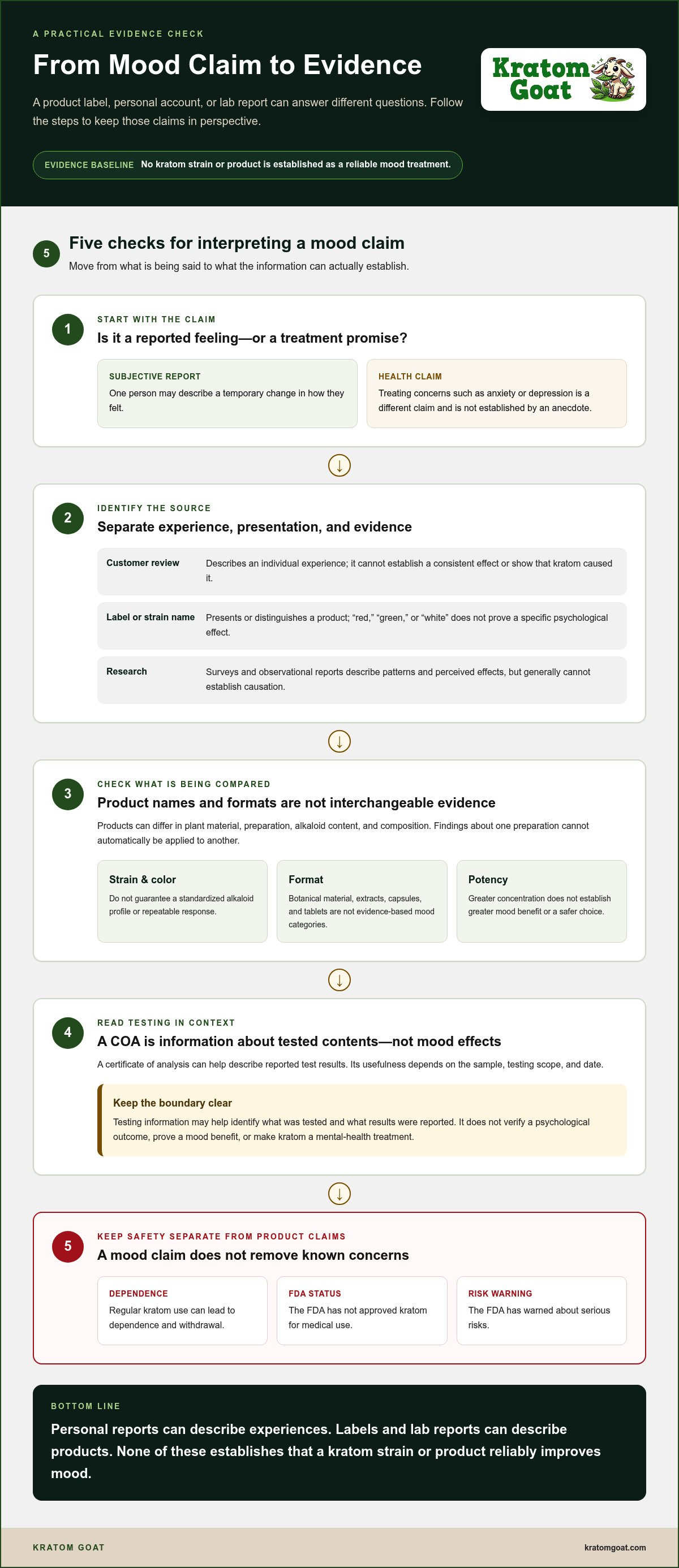
No kratom strain or product has been established as a reliable mood treatment. People may describe feeling different after using kratom, but personal accounts can’t show that an effect is consistent, caused by kratom, or appropriate for treating a mental-health condition. Strain names and product labels don’t close that evidence gap.
What does “best kratom for mood” mean?
The question can mean two different things: whether someone might notice a temporary subjective change, or whether kratom can treat concerns such as anxiety or depression. Those are not equivalent claims. A personal report reflects one person’s experience, which may be influenced by expectations, product contents, other substances, health, and setting. Anecdotes can describe experiences, but they can’t establish a predictable benefit or identify a best strain.
Labels such as “red,” “green,” or “white” are not clinical evidence that a product produces a specific psychological effect. The botanical species is Mitragyna speciosa (kratom), but naming a variety or color doesn’t demonstrate a reliable effect on mood.
What does current research establish, and what remains uncertain?
Human research includes surveys and observational reports about kratom use and perceived effects. These can help researchers understand patterns of use, but they generally rely on participants’ recollections and can’t establish that kratom caused a reported mood change. Comparisons across studies are also difficult because products may differ in alkaloid content, preparation, and composition.
More controlled research would be needed to establish whether a specific product has a consistent effect, for whom, and with what risks. Findings about an isolated compound or a particular preparation also can’t automatically be applied to every botanical product, extract, capsule, or tablet. For background on one compound and how it is studied, see this overview of the science of 7-hydroxymitragynine; it should not be read as evidence of a mood benefit.
Why strain promises fall short
Strain names may distinguish products in the marketplace, but they don’t guarantee a standardized alkaloid profile or a repeatable psychological response. Even a clear product label can’t establish a treatment effect. That requires appropriately designed clinical evidence, not descriptions, customer reviews, or reports of how a product felt to an individual.
In short, some people report mood-related experiences with kratom, but those reports do not prove that any strain or product reliably improves mood or treats a mental-health condition.
How Kratom Alkaloids and Product Types Affect What You Can Compare
Kratom products can differ in their plant material, preparation, alkaloid content, and format. Those differences matter when interpreting research: a finding about one preparation cannot automatically be applied to another, and knowing a product’s composition does not establish a mood effect.
Mitragynine, 7-hydroxymitragynine, and product labels
Mitragynine is a naturally occurring alkaloid in kratom and is commonly described as one of its primary constituents. 7-hydroxymitragynine is another alkaloid found in the plant, generally in smaller amounts. Both interact with opioid receptors, though their activity differs. The DEA factsheet on kratom summarizes the agency’s information on kratom’s psychoactive ingredients and potential effects. Receptor activity is not evidence that either compound improves mood.
Leaf-based products and extracts are not automatically equivalent. Processing can change the relative concentration of constituents, and products may vary in composition. A label or certificate of analysis (COA) can help identify what was tested and what the results report, but its usefulness depends on the sample, testing scope, and date. For background on interpreting these documents, see this guide to reading a kratom certificate of analysis. Testing information describes product contents; it does not verify a psychological outcome.
Strain names, formats, and comparison limits
Color and strain labels may distinguish products, but they don’t, by themselves, confirm alkaloid levels or predict an individual response. Capsules, tablets, and liquid extracts are formats, not evidence-based categories for mood effects. Products in the same format may also differ in composition, so compare product-specific information rather than relying on a name or format alone.
A higher concentration or greater potency should not be interpreted as a greater mood benefit or a safer choice. It changes what is present or how concentrated it is, not what clinical research has proven. For practical distinctions between two common formats, read this comparison of kratom tablets and capsules.
That’s why the search for the best kratom for mood can’t be answered by choosing a strain name or the strongest-sounding label. If you’re comparing products as retail items, you can browse kratom product formats while keeping composition and testing separate from claims about mood.
Kratom for Mood Claims: How to Separate Evidence from Marketing
Mood-related product claims can sound persuasive, but different kinds of information answer different questions. A customer review describes an individual experience. A label describes how a product is presented. A lab report documents specified test results. None, on its own, establishes that kratom reliably improves mood or treats a mental-health condition.
What a certificate of analysis can and cannot show
A certificate of analysis (COA) is useful only in context. Check whether it identifies the product or batch, gives the test date, lists the analytes tested, and names the laboratory or provides relevant laboratory details. Then compare the document with the exact product and batch being considered. A report for a different item, an older batch, or a limited set of analytes may not answer your questions about that product.
A COA reports results for the tests performed on the sample. It does not establish mood effects, prove overall safety, or determine whether a product is suitable for a particular person. “Lab-tested” is meaningful only alongside information about what was tested and when.
Read the claim, then weigh the evidence
Use this distinction to assess common statements, including promises attached to the search for the best kratom for mood:
| Claim or information | Evidence type | Appropriate interpretation |
|---|---|---|
| “I felt calmer” or “I felt more upbeat” | Personal anecdote or customer review | Reports one person’s experience; it doesn’t establish a consistent effect or show what caused it. |
| “Made for mood” or a strain-specific emotional promise | Label or marketing language | Describes a claim, not proof that the product produces that outcome. |
| “Lab-tested” with a batch-specific COA | Testing results | Can inform you about the sample and analytes tested; it doesn’t demonstrate mood effects or overall safety. |
| “Guaranteed to relieve anxiety” or treat depression | Medical or treatment claim | A promise of an outcome requires appropriate clinical evidence; marketing wording isn’t clinical proof or guidance. |
| A result from a well-designed human study | Clinical evidence | Assess the study’s methods, participants, product tested, and limitations before applying it to other products or people. |
Be cautious with guaranteed emotional outcomes, treatment language, and claims that a named strain is superior. “Natural,” “pure,” and “lab-tested” don’t mean risk-free. They also don’t answer whether kratom is appropriate for you. Treat documentation as product information, reviews as personal accounts, and health claims as questions that require stronger evidence.
Before Considering Kratom, Review Risks and Safer Decision Steps
A decision about kratom should begin with health and safety, not a search for the best kratom for mood. The FDA has not approved kratom for medical use and has warned of risks that include liver toxicity, seizures, and substance use disorder. Regular use can also lead to dependence and withdrawal symptoms. The likelihood of harm for an individual is difficult to predict, and product claims don’t remove that uncertainty.
Risks, interactions, dependence, and withdrawal
Kratom’s effects and risks may vary with the product, a person’s health, and other substances or medications involved. It may interact with medicines or other substances, so discuss potential use with a qualified healthcare professional, especially if you take medication or have an existing health concern. A personal report of a positive experience is not evidence that risks are absent.
Dependence and withdrawal are relevant considerations, not reasons for alarmist conclusions. If severe or concerning symptoms occur, seek urgent medical care or contact your local emergency service or poison center. A product test can report specified findings for a sample, but it cannot account for every compound, interaction, individual health factor, or adverse response. Testing therefore cannot eliminate all health risks.
A cautious decision checklist
- Clarify the goal. Is the interest general wellbeing, or are you trying to address persistent low mood, anxiety, or another mental-health concern? If you are looking for routine health support or symptom management during life stages, targeted wellness options from Artemis Curated focus specifically on everyday wellbeing, whereas persistent emotional concerns call for professional support, not a product-based promise.
- Review evidence and personal risks. Distinguish personal stories from clinical evidence, and read product documentation for its scope, tested sample, and date. Consider medications, other substance use, health conditions, and the possibility of dependence. A lab report is product information, not proof of safety or suitability.
- Keep care separate from shopping. Don’t use kratom as a substitute for mental-health care or delay seeking help because a label claims a mood effect. A qualified healthcare professional can help assess symptoms and discuss concerns in the context of your health.
For product transparency, consider product information alongside these limits. Product descriptions and testing records can inform a shopping decision; they don’t establish a mood benefit or replace professional care.
How to Shop for Kratom Responsibly Without Treating It as a Mood Solution
No kratom product should be presented as a proven mood treatment. If you choose to compare products as retail items, focus on what can be checked: ingredients, product identity, format, and testing information. These details can make a purchase more informed, but they can’t establish an emotional effect or guarantee health or safety.
What to look for in product information
Start with the product’s ingredient and identity details. Look for testing documentation that corresponds to the specific product and, where applicable, its batch. Check the test date, the substances analyzed, and what the reported results cover. A statement such as “pure” or “lab-tested” is not a complete description of a product’s composition or a promise that it is risk-free.
Compare formats using documented attributes rather than mood claims. Capsules, tablets, and liquid extracts describe ways a product is presented, not proven emotional effects. Product information can help you understand what is being sold; it can’t tell you how you will feel or whether the product is appropriate for your health circumstances.
Kratom Goat’s approach to product transparency
Kratom Goat sells branded kratom products in categories that include capsules, tablets, and liquid extracts, and emphasizes product transparency and lab testing. The value of testing depends on what the documentation says about the item and the tests performed. Product testing is shopping information, not proof of a mood benefit or a health guarantee.
Customer reviews may help readers understand other customers’ reported experiences, but they are not controlled research and don’t establish effectiveness. This distinction matters especially for anyone searching for the best kratom for mood: neither a positive review nor a product label proves that kratom can reliably improve mood.
If you’re comparing products by format and product information, explore Kratom Goat’s product selection. Keep the purpose clear: product descriptions and testing details can inform shopping, but kratom should not be treated as a proven mood solution or a substitute for mental-health care.
Choose Transparency Over Mood Promises
The evidence doesn’t identify a best kratom for mood: strain labels, reviews, and product descriptions can’t establish a reliable mood effect. Product-specific testing may help clarify what was tested, but it isn’t proof of effectiveness, overall safety, or suitability for you.
If you’re comparing products, focus on clear product information and documentation that applies to the item in question. Keep shopping decisions separate from mental-health care, and speak with a qualified healthcare professional about persistent mood concerns or possible interactions.
Kratom Goat emphasizes product transparency and lab testing. Review product information with its scope and results in mind. Customer reviews can offer individual perspectives, not clinical evidence. Explore Kratom Goat’s product selection and compare products based on their formats and stated information, not mood promises.
Frequently Asked Questions
Is there a best kratom strain for mood?
No kratom strain has been established as a reliable way to improve mood. Color and strain names may distinguish products in the marketplace, but they don’t prove consistent composition or predictable psychological effects. A person’s report of feeling different after using a product is an individual experience, not evidence that the same strain will have the same effect for others. Avoid treating strain labels as treatment guidance.
Can kratom improve your mood?
Some people report mood-related effects, but those accounts don’t establish that kratom causes a reliable benefit or treats anxiety, depression, or another condition. Research has limitations, including variation in products and reliance on self-reported experiences. The FDA has not approved kratom for medical use. If low mood persists or affects daily life, consider discussing it with a qualified healthcare professional rather than relying on kratom.
Which kratom alkaloid is associated with mood?
Mitragynine and 7-hydroxymitragynine are kratom alkaloids that interact with opioid receptors. Their pharmacological activity helps explain why researchers study kratom’s effects, but it doesn’t show that either alkaloid reliably improves mood. No single alkaloid has been established as a proven mood treatment. Product composition can vary, so findings about a compound or preparation shouldn’t automatically be applied to every kratom product.
Are kratom extracts better than capsules for mood?
No evidence establishes extracts as better than capsules for mood. These terms describe product preparations or formats, not proven psychological effects. Extracts and capsules may differ in composition and concentration, and products within either category may also vary. A format label cannot tell you whether a product will affect mood or be suitable for you. Compare documented product information, not promised emotional outcomes.
Is lab-tested kratom safe to use?
Lab testing doesn’t guarantee that kratom is safe. A test can report results for specified analytes in the sample tested, but it can’t establish overall safety, account for every possible risk, or predict an individual response. Review the product and batch details, test date, and scope of the report. The FDA has warned about risks including liver toxicity, seizures, and substance use disorder.
Can kratom interact with medications or cause dependence?
Yes, dependence and withdrawal are recognized concerns, and kratom may pose interaction risks when used with medications or other substances. The extent of interaction risk can depend on the product and individual circumstances. If you take medication or have health concerns, discuss kratom with a qualified healthcare professional before considering it. Regular use can lead to dependence, and stopping may bring withdrawal symptoms.
Should I use kratom instead of getting help for low mood?
No. Kratom shouldn’t replace professional help for persistent low mood, anxiety, or other mental-health concerns. No kratom product is established as a proven treatment, and delaying care may leave the underlying concern unaddressed. A qualified healthcare professional can help discuss symptoms and appropriate support. If you may be in immediate danger or are thinking about harming yourself, contact local emergency services or a crisis support service now.