

7OHMZ Kratom: What It Is, What to Check & What to Know
What if a product sold under the kratom name isn’t comparable to ordinary kratom leaf? That distinction is central to understanding 7ohmz kratom. 7OHMZ is a brand name associated with products containing 7-hydroxymitragynine (7-OH), an alkaloid that occurs naturally in kratom in small amounts. A product name alone doesn’t establish its ingredients, concentration, or how it was made. Before weighing a label or a brand claim, it’s reasonable to look for clear answers.
This guide separates the terms and explains what evidence to check. Kratom Goat lists 7OHMZ 7-Hydroxymitragynine Tablets, but current product labeling and any available certificate of analysis matter more than broad claims. A lab report may confirm measured amounts in the sample tested; it doesn’t prove safety, effectiveness, or regulatory approval. In July 2025, the FDA issued a warning letter to the marketer of 7OHMZ among companies selling products containing 7-OH. We’ll explain how 7-OH differs from kratom leaf products, what product records can and can’t confirm, and which claims deserve scrutiny so you can make an informed decision.
Key Takeaways
- Read the label closely and distinguish the plant, the alkaloid, the brand, and the product format before drawing conclusions about what’s inside.
- For 7ohmz kratom, compare any available lab report with the exact product and batch. Check its date, laboratory details, and stated testing scope.
- Use current, authoritative sources for health and legal information. Product availability and documentation alone don’t settle those questions.
- Separate independently verifiable product details from marketing language, and note what the available evidence leaves unanswered.
What Does 7OHMZ Kratom Mean? Start with the Product Name
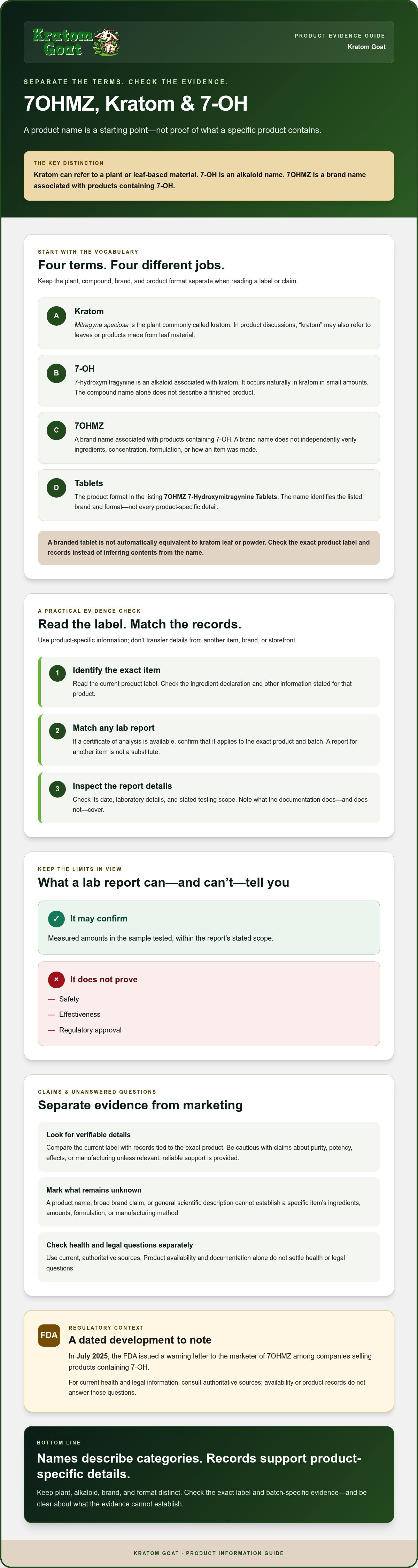
7OHMZ is a brand name associated with 7-hydroxymitragynine tablets. 7-hydroxymitragynine is the named alkaloid, and tablets are the product format. Kratom Goat lists an offering called 7OHMZ 7-Hydroxymitragynine Tablets. That description identifies the brand and format, but it doesn’t independently verify a particular item’s ingredients, formulation, or strength. Look to the current product label and product-specific records for those details, not to the name alone.
This distinction matters because “kratom” can refer to the plant, its leaves, or products made from leaf material, while “7-OH” names a specific alkaloid associated with the plant. A branded tablet isn’t automatically equivalent to kratom leaf or powder. Start with the label and records for the exact product to understand what is represented.
What is 7-hydroxymitragynine?
Mitragyna speciosa is the botanical name of the plant commonly called kratom. 7-hydroxymitragynine, often shortened to 7-OH, is an alkaloid associated with that plant. The name identifies a chemical compound, not a complete description of a commercial product. For a scientific overview of the compound, see this article on 7-hydroxymitragynine. For more detail on scientific terminology and quality standards, consult the 7-hydroxymitragynine science and standards guide.
General background can explain what an alkaloid is, but it can’t establish how much of a compound is in a specific tablet or how that product was formulated. Those are product-level questions. Check the current label and any available documentation tied to the exact item rather than treating general descriptions of the plant as proof of its contents.
Is 7OHMZ the same thing as ordinary kratom?
No. The terms describe different things: kratom refers to a plant and, in product discussions, may refer to leaf-based material; 7OHMZ is a brand name associated with tablets; and 7-hydroxymitragynine is an alkaloid name. Using “kratom” as shorthand for a branded tablet can blur those distinctions. Don’t assume a particular ingredient list or manufacturing process from the name alone.
Instead, compare the exact product label with any product-specific records. Check that the names and details match. A brand name can help identify an item, but it can’t substitute for evidence about its contents. Keep the categories separate: plant, compound, brand, and finished product.
How 7OHMZ, Kratom, and 7-OH Product Claims Relate
These terms describe different layers of information. Mitragyna speciosa is the plant commonly called kratom. Mitragynine and 7-hydroxymitragynine are distinct alkaloid names associated with the plant. 7OHMZ is a brand name, while “tablets” describes the listed product format. Keeping those categories separate helps prevent general statements about kratom from being mistaken for verified details about a specific branded item.
A product name alone cannot verify its composition. It identifies how an item is presented, not whether its actual contents match that presentation. General scientific descriptions explain terms; they don’t establish a particular product’s ingredients, ingredient amounts, formulation, or manufacturing method.
How is 7-hydroxymitragynine different from mitragynine?
They are two different alkaloids, not interchangeable names. The DEA Drug Fact Sheet on Kratom discusses kratom and identifies both compounds in its overview. For a focused discussion of their distinction, see the 7-OH and mitragynine comparison. Scientific background provides general context, not evidence of the contents or properties of a particular tablet.
Be cautious with claims about relative potency, effects, purity, or how a product was made. Such claims require relevant, reliable support and shouldn’t be inferred from an alkaloid’s name or marketing language.
What does a product label actually tell you?
Kratom Goat lists 7OHMZ 7-Hydroxymitragynine Tablets. That name identifies the listed brand and tablet format, but it doesn’t provide every product-specific detail. Check the current label for the ingredient declaration and other stated information. If a certificate of analysis is available, verify that it corresponds to the exact product and batch rather than assuming a report for another item applies.
Marketing phrases may describe how a seller positions a product, but they don’t replace a clear ingredient declaration or relevant test documentation. Don’t transfer figures or claims shown for another brand or storefront to 7OHMZ. Read the actual label, check whether supporting records match it, and note what remains unverified.
Readers comparing terminology with a specific listing can review Kratom Goat’s online product information alongside current product documentation. Treat the listing as a starting point for questions, not standalone confirmation of composition.
How to Assess 7OHMZ Product Evidence Without Guesswork
A lab report is useful only when you can connect it to the specific product you’re evaluating. For 7ohmz kratom, don’t rely on a general statement such as “lab-tested” without checking whether supporting documentation is current, product-specific, and clear about what was analyzed.
Use this checklist to review an available certificate of analysis (COA):
- 1. Match the product. Confirm that the document names the same product as the label. A report for a different product or format doesn’t establish what’s in the item you’re reviewing.
- 2. Match the batch. Look for a batch or lot identifier and compare it with the product packaging or listing. If there’s no clear match, the report’s connection to that item is uncertain.
- 3. Check the dates. Find the test or report date. A document without a date, or one that can’t be tied to the batch in question, provides limited evidence about that product.
- 4. Identify the laboratory. The report should name the laboratory responsible for testing. Review the document itself rather than relying only on a seller’s summary.
- 5. Read the scope and results. Check which analytes were tested and whether results are legible, including units and any stated limits. Testing for one set of substances doesn’t mean every possible substance or product attribute was assessed.
For help interpreting COA sections and terminology, see this kratom certificate of analysis guide. Use it to understand the document, then verify that the report applies to the exact product and batch you’re considering.
What testing can and can’t establish
A COA reports findings for the sample tested, within the methods and analytes listed. It may provide evidence about specific measured characteristics, but it can’t automatically confirm every unit in a batch, validate claims outside its testing scope, or establish that a product is effective, risk-free, or appropriate for an individual.
A test result is evidence about a tested sample, not a broad safety guarantee. Treat claims such as “pure” or “no synthetic additives” as claims to verify against current, relevant documentation. Don’t assume a report supports them unless it explicitly tests for the attribute in question.
Product testing also doesn’t determine regulatory status. For government context, consult the Federal Register notice on 7-hydroxymitragynine and check current official sources for later developments. A COA and a government notice answer different questions, so neither substitutes for the other.
What Health and Legal Questions Should Readers Check First?
Product availability and a laboratory report don’t establish that a product is safe. A test can address only the sample and substances within its stated scope; it can’t resolve every health concern or determine whether a product is lawful where you live. For 7ohmz kratom, assess product documentation separately from health evidence and current legal information.
What health risks and uncertainties should readers understand?
The FDA has warned consumers about products containing 7-hydroxymitragynine (7-OH), describing the compound as a potent opioid, and has reported concerns associated with kratom use, including liver toxicity, seizures, and substance use disorder. These reports don’t predict what will happen to any individual. They do mean that marketing claims or product testing shouldn’t be treated as proof of safety or medical benefit. The FDA has not approved kratom or 7-OH for medical use.
If you have questions about personal health risks, speak with a qualified healthcare professional. This section doesn’t diagnose, recommend use, or provide instructions for dosing or combining products.
Is 7OHMZ legal or FDA-approved?
FDA approval and legal status are separate questions. In July 2025, the FDA issued warning letters to several companies, including the marketer of 7OHMZ, concerning the sale of products containing 7-OH. The FDA has stated that 7-OH is not a lawful dietary supplement or food additive. A product listing or label isn’t evidence of FDA approval or legal compliance.
Federal scheduling information also needs careful wording. The DEA announced an intention in July 2026 to temporarily schedule 7-OH above a specified threshold. The status reported as of mid-August 2026 was that the scheduling order for 7-OH itself had not been filed. Check current DEA and Federal Register records for subsequent developments. State rules vary, with some jurisdictions banning or regulating kratom or taking specific action on 7-OH. Laws can change, so check current official rules applicable to your location. Don’t infer legality from online availability.
For Kratom Goat’s listed 7OHMZ 7-Hydroxymitragynine Tablets, review current product information and supporting documentation without treating either as proof of safety or legal status. Review Kratom Goat’s product information.
Where 7OHMZ Fits in Kratom Goat’s Product Information
After separating brand terminology from product evidence, review the information tied to the specific item. Kratom Goat lists 7OHMZ 7-Hydroxymitragynine Tablets in its online store. That confirms the name of the listed offering, but it doesn’t establish its current ingredients, formulation, or strength. Check the current product label and any documentation that can be matched to the item before drawing conclusions.
Kratom Goat describes its kratom products as pure and lab-tested. Treat those descriptions as company claims, and look for current, product-specific support before applying them to a particular 7OHMZ item. A general company statement or a report for another product isn’t a substitute for documentation linked to the product and, where available, its batch.
What information should a retailer make easy to verify?
Look for a clear product identity, a current label, and supporting records that identify the relevant item. If a certificate of analysis is provided, check whether its product and batch details match the label. Then review its date, laboratory identity, testing scope, and readable results. Missing or unclear information is a reason to seek clarification from the seller, not to fill gaps with assumptions.
Customer reviews can describe individual experiences, but they don’t verify composition, establish safety, or demonstrate health outcomes. Keep each kind of evidence in its proper role: labels describe the product as presented, testing reports address specified analyses, and reviews reflect customers’ accounts.
How can readers continue their research?
For product-focused context, read the complete 7OHMZ tablets guide. Compare any claims you encounter with the current label, relevant batch-linked lab documentation, and authoritative public information. This is a more reliable way to assess 7ohmz kratom than relying on a brand name or broad marketing description alone.
Before deciding, note what the available records confirm and what remains unclear. Review Kratom Goat’s current product information as one source of product details, then assess it alongside the supporting documentation available for the specific item.
Make Your Next Check Evidence-Based
Understanding 7ohmz kratom starts with keeping the terms distinct: a brand name, an alkaloid, and a tablet format aren’t interchangeable descriptions. A product label can tell you how an item is presented, while a current, batch-matched lab report can provide evidence about specific tests. Neither, by itself, establishes overall safety, effectiveness, or legal status.
Kratom Goat lists 7OHMZ 7-Hydroxymitragynine Tablets and reports more than 2,000 customer reviews. Reviews can reflect customer experiences, but they don’t confirm a product’s composition or safety. Focus on details that can be checked, and consult current authoritative sources for health and legal questions.
Before deciding, compare the product information with its current label and any available product-specific documentation. Review Kratom Goat’s current product information as one part of that evidence check. A careful review helps you identify what’s documented, what remains uncertain, and what questions to ask next.
Frequently Asked Questions
What is 7OHMZ kratom?
7OHMZ is a brand name associated with 7-hydroxymitragynine tablets. “Kratom” refers to the plant commonly known as Mitragyna speciosa, while 7-hydroxymitragynine, or 7-OH, is the name of an alkaloid associated with it. Kratom Goat lists 7OHMZ 7-Hydroxymitragynine Tablets. The name alone doesn’t confirm a specific tablet’s ingredients, formulation, or strength, so check its current label and any product-specific documentation.
Is 7OHMZ the same as regular kratom?
No. 7OHMZ is a brand name associated with a tablet product, while “kratom” may refer to the plant, its leaves, or products made from leaf material. These terms aren’t interchangeable. Don’t assume that a branded tablet has the same composition as leaf or powder, or infer how it was made from its name. Review the exact product label and any documentation tied to that item.
Can a certificate of analysis prove that a 7OHMZ product is safe?
No. A certificate of analysis (COA) reports results for a tested sample and the analytes or characteristics listed in the report. Check whether it identifies the same product and batch, provides a test date and laboratory identity, and shows readable results. A COA can’t establish that a product is risk-free, effective, appropriate for an individual, or legally approved. Testing evidence has limits.
Is 7OHMZ FDA-approved or legal in the United States?
Don’t assume FDA approval or nationwide legality from an online listing or product label. The FDA has stated that 7-OH isn’t a lawful dietary supplement or food additive, and there are no FDA-approved medical uses for kratom or 7-OH. Federal and state rules may change. Check current FDA, DEA, Federal Register, and applicable state sources for the specific product and location before drawing a legal conclusion.
Can 7-hydroxymitragynine products cause health risks or dependence?
Yes, health authorities have warned about risks associated with concentrated 7-OH products, including addiction, dependence, and other serious health concerns. The FDA has also reported adverse effects associated with kratom use, including liver toxicity, seizures, and substance use disorder. These reports don’t predict an individual’s response or establish a diagnosis. For personal health concerns, speak with a qualified healthcare professional.
How can I check what a 7OHMZ tablet contains?
Start with the tablet’s current label and look for an ingredient declaration and clear product identity. If a certificate of analysis is available, confirm that it matches the exact product and batch, then review its date, laboratory details, testing scope, and results. Ask the seller about missing or unclear records. Don’t treat general marketing claims, unrelated test reports, or customer reviews as confirmation of composition.